

Genus Acipenser
Danube sturgeon – Acipenser gueldenstaedtii (Brandt and Ratzeburg 1833)
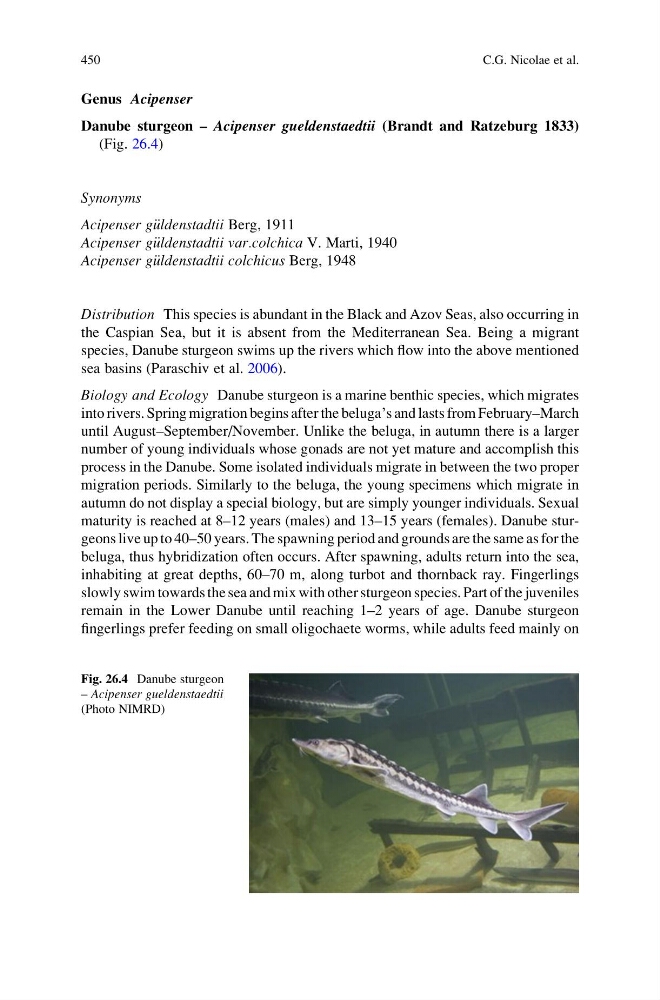
(Fig. 26.4)
Synonyms
Acipenser g€ uldenstadtii Berg, 1911
Acipenser g€ uldenstadtii var.colchica V. Marti, 1940
Acipenser g€ uldenstadtii colchicus Berg, 1948
Distribution This species is abundant in the Black and Azov Seas, also occurring in
the Caspian Sea, but it is absent from the Mediterranean Sea. Being a migrant
species, Danube sturgeon swims up the rivers which flow into the above mentioned
sea basins (Paraschiv et al. 2006).
Biology and Ecology Danube sturgeon is a marine benthic species, which migrates
into rivers. Spring migration begins after the beluga’s and lasts from February–March
until August–September/November. Unlike the beluga, in autumn there is a larger
number of young individuals whose gonads are not yet mature and accomplish this
process in the Danube. Some isolated individuals migrate in between the two proper
migration periods. Similarly to the beluga, the young specimens which migrate in
autumn do not display a special biology, but are simply younger individuals. Sexual
maturity is reached at 8–12 years (males) and 13–15 years (females). Danube sturgeons live up to 40–50 years. The spawning period and grounds are the same as for the
beluga, thus hybridization often occurs. After spawning, adults return into the sea,
inhabiting at great depths, 60–70 m, along turbot and thornback ray. Fingerlings
slowly swim towards the sea and mix with other sturgeon species. Part of the juveniles
remain in the Lower Danube until reaching 1–2 years of age. Danube sturgeon
fingerlings prefer feeding on small oligochaete worms, while adults feed mainly on
Fig. 26.4 Danube sturgeon
– Acipenser gueldenstaedtii
(Photo NIMRD)
450
C.G. Nicolae et al.
Danube sturgeon – Acipenser gueldenstaedtii (Brandt and Ratzeburg 1833)
(Fig. 26.4)
Synonyms
Acipenser g€ uldenstadtii Berg, 1911
Acipenser g€ uldenstadtii var.colchica V. Marti, 1940
Acipenser g€ uldenstadtii colchicus Berg, 1948
Distribution This species is abundant in the Black and Azov Seas, also occurring in
the Caspian Sea, but it is absent from the Mediterranean Sea. Being a migrant
species, Danube sturgeon swims up the rivers which flow into the above mentioned
sea basins (Paraschiv et al. 2006).
Biology and Ecology Danube sturgeon is a marine benthic species, which migrates
into rivers. Spring migration begins after the beluga’s and lasts from February–March
until August–September/November. Unlike the beluga, in autumn there is a larger
number of young individuals whose gonads are not yet mature and accomplish this
process in the Danube. Some isolated individuals migrate in between the two proper
migration periods. Similarly to the beluga, the young specimens which migrate in
autumn do not display a special biology, but are simply younger individuals. Sexual
maturity is reached at 8–12 years (males) and 13–15 years (females). Danube sturgeons live up to 40–50 years. The spawning period and grounds are the same as for the
beluga, thus hybridization often occurs. After spawning, adults return into the sea,
inhabiting at great depths, 60–70 m, along turbot and thornback ray. Fingerlings
slowly swim towards the sea and mix with other sturgeon species. Part of the juveniles
remain in the Lower Danube until reaching 1–2 years of age. Danube sturgeon
fingerlings prefer feeding on small oligochaete worms, while adults feed mainly on
Fig. 26.4 Danube sturgeon
– Acipenser gueldenstaedtii
(Photo NIMRD)
450
C.G. Nicolae et al.