

24.4 Conclusions
Carrying out this work, we for the first time explored distribution of the polychaete
P. kefersteini along the Crimean shoreline and by pseudolitoral depths. In the size
structure of P. kefersteini population inhabiting the pseudolitoral zone 20–35-mm
long worms dominate (75%); with increasing depth they occur more and more
rarely, decreasing to 21% at 1 m and to 1% at 1.5 m depths. For the first time growth
and development of juvenile (0.3–1.45-mm large) P. kefersteini were studied and
the time at which chaetae first arose on the body determined; in particular, forked
chaeta appeared in the individuals with 2–3-segment bodies.
References
Begun T, Teaca ˘ A, Gomoiu МТ (2010) State of macrobenthos within Modiolus phaseolinus
biocoenosis from Romanian Black Sea continental shelf. Geo–Eco–Marina 16:5–18
Boltachova NA, Kolesnikiva EA, Revkov NK (2002) The fauna of macrozoobenthos in coastal
salt Lake Donuzlav (Black Sea). Ecol Sea 78:10–13
Garry T, Simpson N (2006) Benthic Marine ecology on behalf of Portland Gas Ltd. Report:
planning, transport and environment, 70p
Jumars PA (1974) A generic revision of the Dorvilllleidae (Polychaeta), with six new species from
the deep North Pacific. Zool J Linn Soc-Lond 54(2):101–135
Kiseleva MI (2004) Polychaete worms (Polychaeta) of the Black Sea and the Sea of Azov. Kola
Research Centre Press RAS, Apatity, 409p
Kopiy VG (2011) Macrozoobenthos of the splash zone in a bay of Sevastopol, Crimea (Black Sea).
Ecological safety of the coastal and shelf zones and the versatile exploitation of shelf
resources: collected sci. articles (Sevastopol), 2011–25, vol 1, 400–407
Kopiy VG, Bondarenko LV, Anninskaya IN (2010) Macrobenthos of the splash zone in Kazachaya
bay, Crimea (Black Sea). Biodiversity and sustainable development: abstracts of the international scientific and practical conference (Crimea, Simferopol), pp 56–58
1200
1000
800
The number of the 1 st
site, ind.m 2
The number of the 2 nd
site, ind.m 2
600
400
200
0
1 site
2 site
0
10
20
30
40
50
60
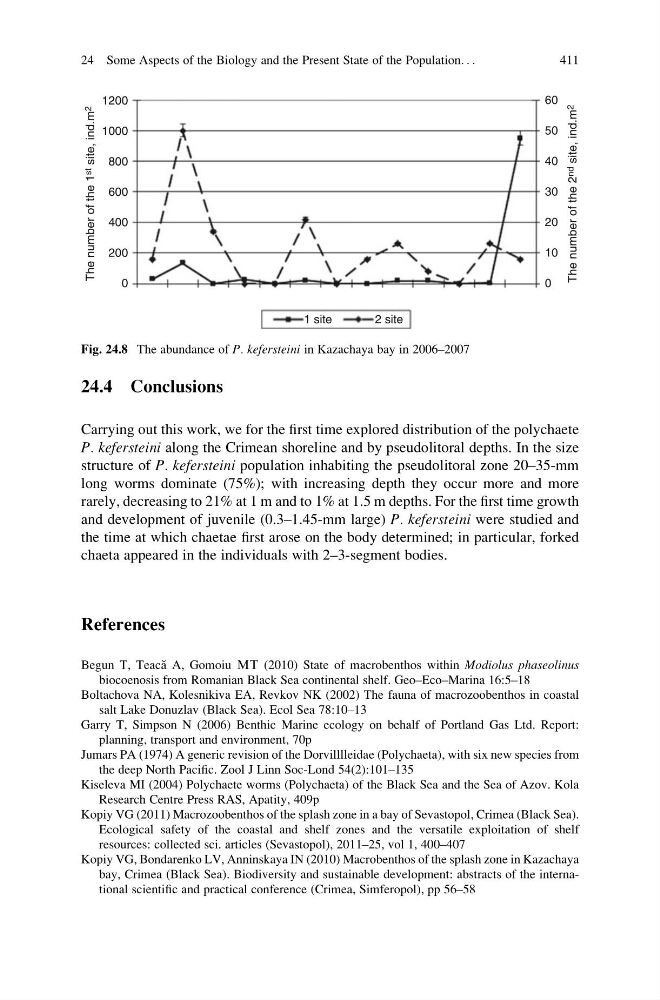
Fig. 24.8 The abundance of P. kefersteini in Kazachaya bay in 2006–2007
24 Some Aspects of the Biology and the Present State of the Population. . .
411
Carrying out this work, we for the first time explored distribution of the polychaete
P. kefersteini along the Crimean shoreline and by pseudolitoral depths. In the size
structure of P. kefersteini population inhabiting the pseudolitoral zone 20–35-mm
long worms dominate (75%); with increasing depth they occur more and more
rarely, decreasing to 21% at 1 m and to 1% at 1.5 m depths. For the first time growth
and development of juvenile (0.3–1.45-mm large) P. kefersteini were studied and
the time at which chaetae first arose on the body determined; in particular, forked
chaeta appeared in the individuals with 2–3-segment bodies.
References
Begun T, Teaca ˘ A, Gomoiu МТ (2010) State of macrobenthos within Modiolus phaseolinus
biocoenosis from Romanian Black Sea continental shelf. Geo–Eco–Marina 16:5–18
Boltachova NA, Kolesnikiva EA, Revkov NK (2002) The fauna of macrozoobenthos in coastal
salt Lake Donuzlav (Black Sea). Ecol Sea 78:10–13
Garry T, Simpson N (2006) Benthic Marine ecology on behalf of Portland Gas Ltd. Report:
planning, transport and environment, 70p
Jumars PA (1974) A generic revision of the Dorvilllleidae (Polychaeta), with six new species from
the deep North Pacific. Zool J Linn Soc-Lond 54(2):101–135
Kiseleva MI (2004) Polychaete worms (Polychaeta) of the Black Sea and the Sea of Azov. Kola
Research Centre Press RAS, Apatity, 409p
Kopiy VG (2011) Macrozoobenthos of the splash zone in a bay of Sevastopol, Crimea (Black Sea).
Ecological safety of the coastal and shelf zones and the versatile exploitation of shelf
resources: collected sci. articles (Sevastopol), 2011–25, vol 1, 400–407
Kopiy VG, Bondarenko LV, Anninskaya IN (2010) Macrobenthos of the splash zone in Kazachaya
bay, Crimea (Black Sea). Biodiversity and sustainable development: abstracts of the international scientific and practical conference (Crimea, Simferopol), pp 56–58
1200
1000
800
The number of the 1 st
site, ind.m 2
The number of the 2 nd
site, ind.m 2
600
400
200
0
1 site
2 site
0
10
20
30
40
50
60
Fig. 24.8 The abundance of P. kefersteini in Kazachaya bay in 2006–2007
24 Some Aspects of the Biology and the Present State of the Population. . .
411