

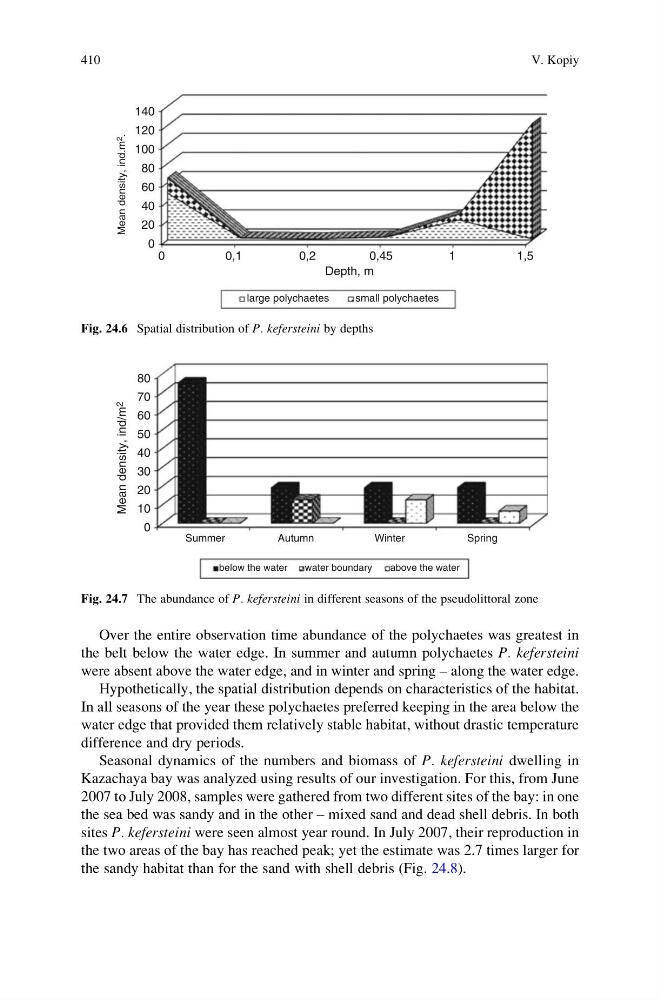
Over the entire observation time abundance of the polychaetes was greatest in
the belt below the water edge. In summer and autumn polychaetes P. kefersteini
were absent above the water edge, and in winter and spring – along the water edge.
Hypothetically, the spatial distribution depends on characteristics of the habitat.
In all seasons of the year these polychaetes preferred keeping in the area below the
water edge that provided them relatively stable habitat, without drastic temperature
difference and dry periods.
Seasonal dynamics of the numbers and biomass of P. kefersteini dwelling in
Kazachaya bay was analyzed using results of our investigation. For this, from June
2007 to July 2008, samples were gathered from two different sites of the bay: in one
the sea bed was sandy and in the other – mixed sand and dead shell debris. In both
sites P. kefersteini were seen almost year round. In July 2007, their reproduction in
the two areas of the bay has reached peak; yet the estimate was 2.7 times larger for
the sandy habitat than for the sand with shell debris (Fig. 24.8).
140
120
100
80
60
40
20
0
0
0,1
0,2
0,45
1
1,5
Depth, m
large polychaetes
Mean density, ind.m 2
.
small polychaetes
Fig. 24.6 Spatial distribution of P. kefersteini by depths
80
70
60
50
40
30
20
10
0
Summer
Autumn
below the water
water boundary
above the water
Winter
Spring
Mean density, ind/m 2
Fig. 24.7 The abundance of P. kefersteini in different seasons of the pseudolittoral zone
410
V. Kopiy
the belt below the water edge. In summer and autumn polychaetes P. kefersteini
were absent above the water edge, and in winter and spring – along the water edge.
Hypothetically, the spatial distribution depends on characteristics of the habitat.
In all seasons of the year these polychaetes preferred keeping in the area below the
water edge that provided them relatively stable habitat, without drastic temperature
difference and dry periods.
Seasonal dynamics of the numbers and biomass of P. kefersteini dwelling in
Kazachaya bay was analyzed using results of our investigation. For this, from June
2007 to July 2008, samples were gathered from two different sites of the bay: in one
the sea bed was sandy and in the other – mixed sand and dead shell debris. In both
sites P. kefersteini were seen almost year round. In July 2007, their reproduction in
the two areas of the bay has reached peak; yet the estimate was 2.7 times larger for
the sandy habitat than for the sand with shell debris (Fig. 24.8).
140
120
100
80
60
40
20
0
0
0,1
0,2
0,45
1
1,5
Depth, m
large polychaetes
Mean density, ind.m 2
.
small polychaetes
Fig. 24.6 Spatial distribution of P. kefersteini by depths
80
70
60
50
40
30
20
10
0
Summer
Autumn
below the water
water boundary
above the water
Winter
Spring
Mean density, ind/m 2
Fig. 24.7 The abundance of P. kefersteini in different seasons of the pseudolittoral zone
410
V. Kopiy