

Regarding the syntaxonomic affinities, Cenchrus longispinus is accompanied
mainly by plant species typical for the alliances Cakilion maritimae Morariu 1957,
Bassio laniflorae-Bromion tectorum (Soo ´ 1957) Borhidi 1996, Festucion
valesiacae Klika 1931 and Festucion vaginatae Soo ´ 1957 (Table 22.1). The plant
associations Secali sylvestris – Brometum tectorum Hargitai 1940, Bromo –
Cynodontetum I. Pop 1970 and Salsolo ruthenicae – Xanthietum strumarii Oberd.
et Tx. 1950 are the most frequent plant communities in which Cenchrus longispinus
has been noticed in Mamaia resort and north of Mamaia.
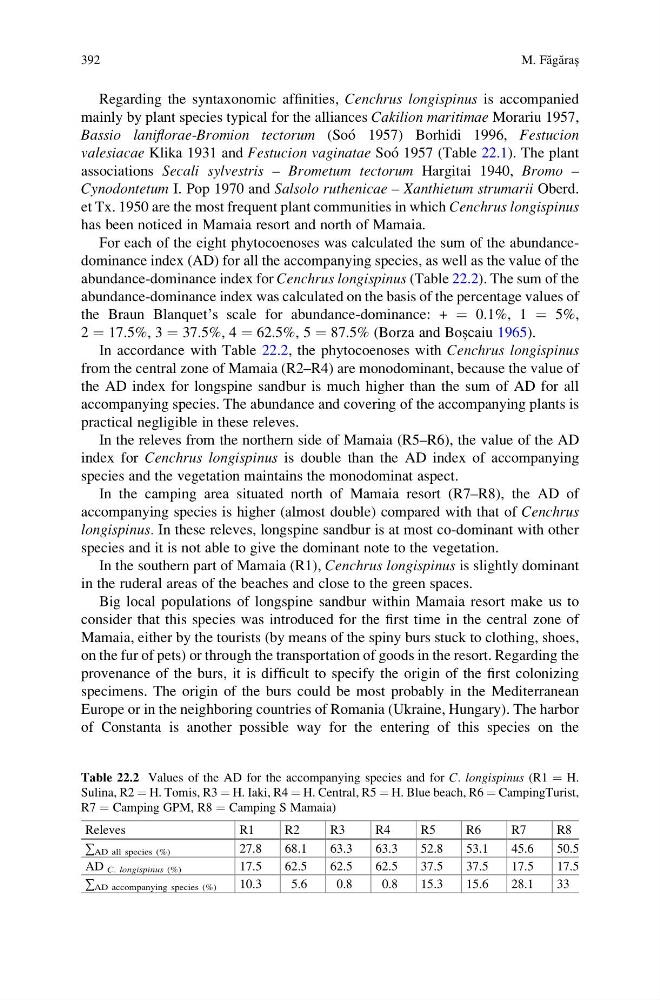
For each of the eight phytocoenoses was calculated the sum of the abundancedominance index (AD) for all the accompanying species, as well as the value of the
abundance-dominance index for Cenchrus longispinus (Table 22.2). The sum of the
abundance-dominance index was calculated on the basis of the percentage values of
the Braun Blanquet’s scale for abundance-dominance: + ¼ 0.1%, 1 ¼ 5%,
2 ¼ 17.5%, 3 ¼ 37.5%, 4 ¼ 62.5%, 5 ¼ 87.5% (Borza and Boșcaiu 1965).
In accordance with Table 22.2, the phytocoenoses with Cenchrus longispinus
from the central zone of Mamaia (R2–R4) are monodominant, because the value of
the AD index for longspine sandbur is much higher than the sum of AD for all
accompanying species. The abundance and covering of the accompanying plants is
practical negligible in these releves.
In the releves from the northern side of Mamaia (R5–R6), the value of the AD
index for Cenchrus longispinus is double than the AD index of accompanying
species and the vegetation maintains the monodominat aspect.
In the camping area situated north of Mamaia resort (R7–R8), the AD of
accompanying species is higher (almost double) compared with that of Cenchrus
longispinus. In these releves, longspine sandbur is at most co-dominant with other
species and it is not able to give the dominant note to the vegetation.
In the southern part of Mamaia (R1), Cenchrus longispinus is slightly dominant
in the ruderal areas of the beaches and close to the green spaces.
Big local populations of longspine sandbur within Mamaia resort make us to
consider that this species was introduced for the first time in the central zone of
Mamaia, either by the tourists (by means of the spiny burs stuck to clothing, shoes,
on the fur of pets) or through the transportation of goods in the resort. Regarding the
provenance of the burs, it is difficult to specify the origin of the first colonizing
specimens. The origin of the burs could be most probably in the Mediterranean
Europe or in the neighboring countries of Romania (Ukraine, Hungary). The harbor
of Constanta is another possible way for the entering of this species on the
Table 22.2 Values of the AD for the accompanying species and for C. longispinus (R1 ¼ H.
Sulina, R2 ¼ H. Tomis, R3 ¼ H. Iaki, R4 ¼ H. Central, R5 ¼ H. Blue beach, R6 ¼ CampingTurist,
R7 ¼ Camping GPM, R8 ¼ Camping S Mamaia)
Releves
R1
R2
R3
R4
R5
R6
R7
R8
∑ AD all species (%)
27.8
68.1
63.3
63.3
52.8
53.1
45.6
50.5
AD C. longispinus (%)
17.5
62.5
62.5
62.5
37.5
37.5
17.5
17.5
∑ AD accompanying species (%)
10.3
5.6
0.8
0.8
15.3
15.6
28.1
33
392
M. Fa ˘ga ˘raș
mainly by plant species typical for the alliances Cakilion maritimae Morariu 1957,
Bassio laniflorae-Bromion tectorum (Soo ´ 1957) Borhidi 1996, Festucion
valesiacae Klika 1931 and Festucion vaginatae Soo ´ 1957 (Table 22.1). The plant
associations Secali sylvestris – Brometum tectorum Hargitai 1940, Bromo –
Cynodontetum I. Pop 1970 and Salsolo ruthenicae – Xanthietum strumarii Oberd.
et Tx. 1950 are the most frequent plant communities in which Cenchrus longispinus
has been noticed in Mamaia resort and north of Mamaia.
For each of the eight phytocoenoses was calculated the sum of the abundancedominance index (AD) for all the accompanying species, as well as the value of the
abundance-dominance index for Cenchrus longispinus (Table 22.2). The sum of the
abundance-dominance index was calculated on the basis of the percentage values of
the Braun Blanquet’s scale for abundance-dominance: + ¼ 0.1%, 1 ¼ 5%,
2 ¼ 17.5%, 3 ¼ 37.5%, 4 ¼ 62.5%, 5 ¼ 87.5% (Borza and Boșcaiu 1965).
In accordance with Table 22.2, the phytocoenoses with Cenchrus longispinus
from the central zone of Mamaia (R2–R4) are monodominant, because the value of
the AD index for longspine sandbur is much higher than the sum of AD for all
accompanying species. The abundance and covering of the accompanying plants is
practical negligible in these releves.
In the releves from the northern side of Mamaia (R5–R6), the value of the AD
index for Cenchrus longispinus is double than the AD index of accompanying
species and the vegetation maintains the monodominat aspect.
In the camping area situated north of Mamaia resort (R7–R8), the AD of
accompanying species is higher (almost double) compared with that of Cenchrus
longispinus. In these releves, longspine sandbur is at most co-dominant with other
species and it is not able to give the dominant note to the vegetation.
In the southern part of Mamaia (R1), Cenchrus longispinus is slightly dominant
in the ruderal areas of the beaches and close to the green spaces.
Big local populations of longspine sandbur within Mamaia resort make us to
consider that this species was introduced for the first time in the central zone of
Mamaia, either by the tourists (by means of the spiny burs stuck to clothing, shoes,
on the fur of pets) or through the transportation of goods in the resort. Regarding the
provenance of the burs, it is difficult to specify the origin of the first colonizing
specimens. The origin of the burs could be most probably in the Mediterranean
Europe or in the neighboring countries of Romania (Ukraine, Hungary). The harbor
of Constanta is another possible way for the entering of this species on the
Table 22.2 Values of the AD for the accompanying species and for C. longispinus (R1 ¼ H.
Sulina, R2 ¼ H. Tomis, R3 ¼ H. Iaki, R4 ¼ H. Central, R5 ¼ H. Blue beach, R6 ¼ CampingTurist,
R7 ¼ Camping GPM, R8 ¼ Camping S Mamaia)
Releves
R1
R2
R3
R4
R5
R6
R7
R8
∑ AD all species (%)
27.8
68.1
63.3
63.3
52.8
53.1
45.6
50.5
AD C. longispinus (%)
17.5
62.5
62.5
62.5
37.5
37.5
17.5
17.5
∑ AD accompanying species (%)
10.3
5.6
0.8
0.8
15.3
15.6
28.1
33
392
M. Fa ˘ga ˘raș