

mentioned data it is clear that the highest level of phosphorus anthropogenic load on
the Black Sea was in the period (1980–1996). In further calculations we use the value
of the average annual income of phosphates with a total river runoff into the Black Sea
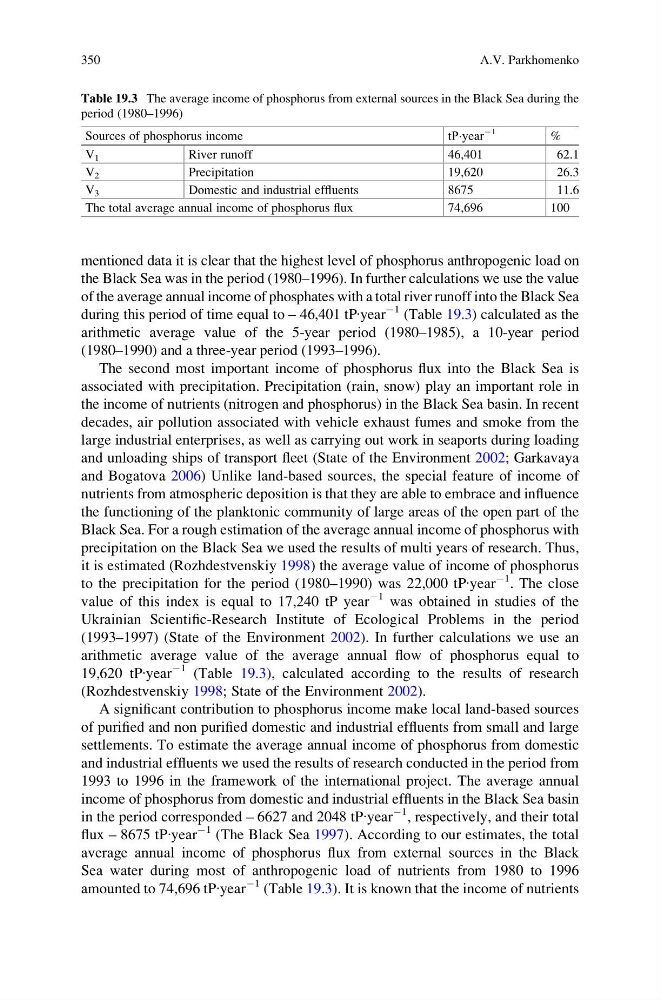
during this period of time equal to – 46,401 tP∙year
À1 (Table 19.3) calculated as the
arithmetic average value of the 5-year period (1980–1985), a 10-year period
(1980–1990) and a three-year period (1993–1996).
The second most important income of phosphorus flux into the Black Sea is
associated with precipitation. Precipitation (rain, snow) play an important role in
the income of nutrients (nitrogen and phosphorus) in the Black Sea basin. In recent
decades, air pollution associated with vehicle exhaust fumes and smoke from the
large industrial enterprises, as well as carrying out work in seaports during loading
and unloading ships of transport fleet (State of the Environment 2002; Garkavaya
and Bogatova 2006) Unlike land-based sources, the special feature of income of
nutrients from atmospheric deposition is that they are able to embrace and influence
the functioning of the planktonic community of large areas of the open part of the
Black Sea. For a rough estimation of the average annual income of phosphorus with
precipitation on the Black Sea we used the results of multi years of research. Thus,
it is estimated (Rozhdestvenskiy 1998) the average value of income of phosphorus
to the precipitation for the period (1980–1990) was 22,000 tP∙year
À1 . The close
value of this index is equal to 17,240 tP year
À1 was obtained in studies of the
Ukrainian Scientific-Research Institute of Ecological Problems in the period
(1993–1997) (State of the Environment 2002). In further calculations we use an
arithmetic average value of the average annual flow of phosphorus equal to
19,620 tP∙year
À1 (Table 19.3), calculated according to the results of research
(Rozhdestvenskiy 1998; State of the Environment 2002).
A significant contribution to phosphorus income make local land-based sources
of purified and non purified domestic and industrial effluents from small and large
settlements. To estimate the average annual income of phosphorus from domestic
and industrial effluents we used the results of research conducted in the period from
1993 to 1996 in the framework of the international project. The average annual
income of phosphorus from domestic and industrial effluents in the Black Sea basin
in the period corresponded – 6627 and 2048 tP∙year
À1 , respectively, and their total
flux – 8675 tP∙year
À1 (The Black Sea 1997). According to our estimates, the total
average annual income of phosphorus flux from external sources in the Black
Sea water during most of anthropogenic load of nutrients from 1980 to 1996
amounted to 74,696 tP∙year
À1 (Table 19.3). It is known that the income of nutrients
Table 19.3 The average income of phosphorus from external sources in the Black Sea during the
period (1980–1996)
Sources of phosphorus income
tРÁyear
À1
%
V 1
River runoff
46,401
62.1
V 2
Precipitation
19,620
26.3
V 3
Domestic and industrial effluents
8675
11.6
The total average annual income of phosphorus flux
74,696
100
350
A.V. Parkhomenko
the Black Sea was in the period (1980–1996). In further calculations we use the value
of the average annual income of phosphates with a total river runoff into the Black Sea
during this period of time equal to – 46,401 tP∙year
À1 (Table 19.3) calculated as the
arithmetic average value of the 5-year period (1980–1985), a 10-year period
(1980–1990) and a three-year period (1993–1996).
The second most important income of phosphorus flux into the Black Sea is
associated with precipitation. Precipitation (rain, snow) play an important role in
the income of nutrients (nitrogen and phosphorus) in the Black Sea basin. In recent
decades, air pollution associated with vehicle exhaust fumes and smoke from the
large industrial enterprises, as well as carrying out work in seaports during loading
and unloading ships of transport fleet (State of the Environment 2002; Garkavaya
and Bogatova 2006) Unlike land-based sources, the special feature of income of
nutrients from atmospheric deposition is that they are able to embrace and influence
the functioning of the planktonic community of large areas of the open part of the
Black Sea. For a rough estimation of the average annual income of phosphorus with
precipitation on the Black Sea we used the results of multi years of research. Thus,
it is estimated (Rozhdestvenskiy 1998) the average value of income of phosphorus
to the precipitation for the period (1980–1990) was 22,000 tP∙year
À1 . The close
value of this index is equal to 17,240 tP year
À1 was obtained in studies of the
Ukrainian Scientific-Research Institute of Ecological Problems in the period
(1993–1997) (State of the Environment 2002). In further calculations we use an
arithmetic average value of the average annual flow of phosphorus equal to
19,620 tP∙year
À1 (Table 19.3), calculated according to the results of research
(Rozhdestvenskiy 1998; State of the Environment 2002).
A significant contribution to phosphorus income make local land-based sources
of purified and non purified domestic and industrial effluents from small and large
settlements. To estimate the average annual income of phosphorus from domestic
and industrial effluents we used the results of research conducted in the period from
1993 to 1996 in the framework of the international project. The average annual
income of phosphorus from domestic and industrial effluents in the Black Sea basin
in the period corresponded – 6627 and 2048 tP∙year
À1 , respectively, and their total
flux – 8675 tP∙year
À1 (The Black Sea 1997). According to our estimates, the total
average annual income of phosphorus flux from external sources in the Black
Sea water during most of anthropogenic load of nutrients from 1980 to 1996
amounted to 74,696 tP∙year
À1 (Table 19.3). It is known that the income of nutrients
Table 19.3 The average income of phosphorus from external sources in the Black Sea during the
period (1980–1996)
Sources of phosphorus income
tРÁyear
À1
%
V 1
River runoff
46,401
62.1
V 2
Precipitation
19,620
26.3
V 3
Domestic and industrial effluents
8675
11.6
The total average annual income of phosphorus flux
74,696
100
350
A.V. Parkhomenko