

19.1.4 Potential Primary Production in Deepwater Area
of the Black Sea
By multi-directional annual variation upward flux and regeneration flux of inorganic phosphorus in its total income in photic layer varies in season considerably
smaller than its total flux. Total income of inorganic phosphorus in the photosynthesis zone in the warm season (April–October) compared with the winter months is
by 1.2 times more. But taking into consideration high degree of variability used in
the calculation of a monthly average characteristics, the validity of the differences
were not statistically justified. Therefore, we can assume that the total income of
inorganic phosphorus in the photosynthesis zone average for the year is maintained
at approximately the same level. Significant seasonal differences are possible only
in years with extremely cold winters, when the intense convective-wind mixing of
water provides additional enrichment of surface waters by nutrients. This assumption is confirmed by the analysis of long-term dynamics of primary production on
the basis of satellite data (Finenko et al. 2010), which showed that the seasonal
0
0.05 0.1 0.15 0.2
K Z , m 2 h -1
0
0.1
0.2
0.3
0.4
Ep, mg-atP m -2
day -1
1
2
3
4
5
6
7
8
9
10
11
12
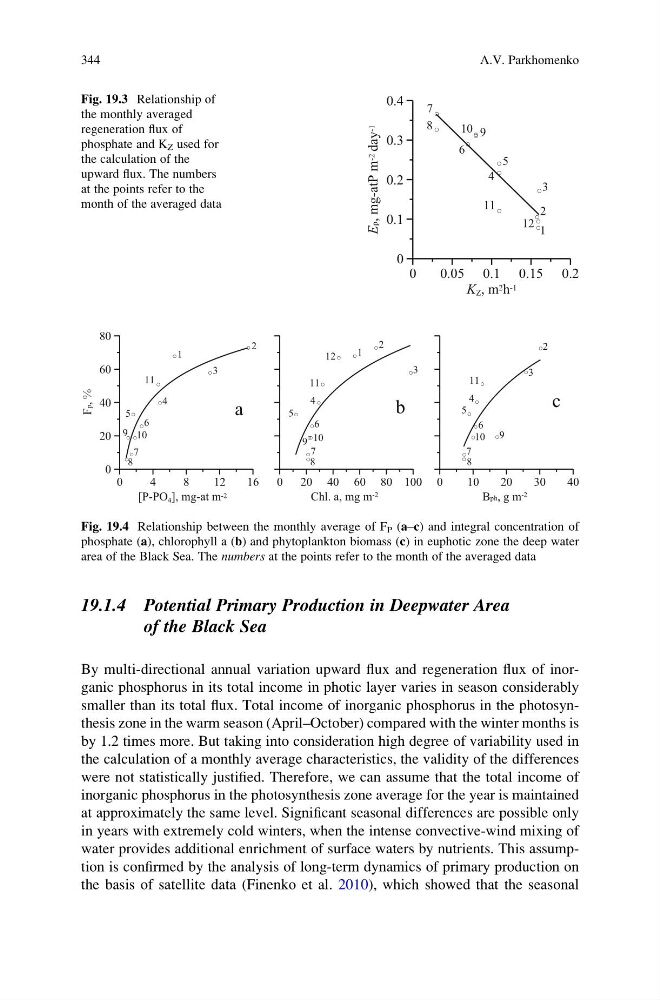
Fig. 19.3 Relationship of
the monthly averaged
regeneration flux of
phosphate and K Z used for
the calculation of the
upward flux. The numbers
at the points refer to the
month of the averaged data
0
20 40 60 80 100
Chl. а, mg m -2
0
4
8
12
16
[P-PO 4 ], mg-at m -2
0
20
40
60
80
Fp,
%
0
10
20
30
40
Bph, g m -2
1
2
3
4
5
6
7
8
9 10
11
12
1
2
2
3
3
4
4
5
5
6
6
7
7
8
8
9
9
10
10
11
11
a
b
c
Fig. 19.4 Relationship between the monthly average of F P (a–c) and integral concentration of
phosphate (a), chlorophyll a (b) and phytoplankton biomass (c) in euphotic zone the deep water
area of the Black Sea. The numbers at the points refer to the month of the averaged data
344
A.V. Parkhomenko
of the Black Sea
By multi-directional annual variation upward flux and regeneration flux of inorganic phosphorus in its total income in photic layer varies in season considerably
smaller than its total flux. Total income of inorganic phosphorus in the photosynthesis zone in the warm season (April–October) compared with the winter months is
by 1.2 times more. But taking into consideration high degree of variability used in
the calculation of a monthly average characteristics, the validity of the differences
were not statistically justified. Therefore, we can assume that the total income of
inorganic phosphorus in the photosynthesis zone average for the year is maintained
at approximately the same level. Significant seasonal differences are possible only
in years with extremely cold winters, when the intense convective-wind mixing of
water provides additional enrichment of surface waters by nutrients. This assumption is confirmed by the analysis of long-term dynamics of primary production on
the basis of satellite data (Finenko et al. 2010), which showed that the seasonal
0
0.05 0.1 0.15 0.2
K Z , m 2 h -1
0
0.1
0.2
0.3
0.4
Ep, mg-atP m -2
day -1
1
2
3
4
5
6
7
8
9
10
11
12
Fig. 19.3 Relationship of
the monthly averaged
regeneration flux of
phosphate and K Z used for
the calculation of the
upward flux. The numbers
at the points refer to the
month of the averaged data
0
20 40 60 80 100
Chl. а, mg m -2
0
4
8
12
16
[P-PO 4 ], mg-at m -2
0
20
40
60
80
Fp,
%
0
10
20
30
40
Bph, g m -2
1
2
3
4
5
6
7
8
9 10
11
12
1
2
2
3
3
4
4
5
5
6
6
7
7
8
8
9
9
10
10
11
11
a
b
c
Fig. 19.4 Relationship between the monthly average of F P (a–c) and integral concentration of
phosphate (a), chlorophyll a (b) and phytoplankton biomass (c) in euphotic zone the deep water
area of the Black Sea. The numbers at the points refer to the month of the averaged data
344
A.V. Parkhomenko