

central areas of the sea in the winter-spring period (Gusarova 1992; Parkhomenko
et al. 2003).
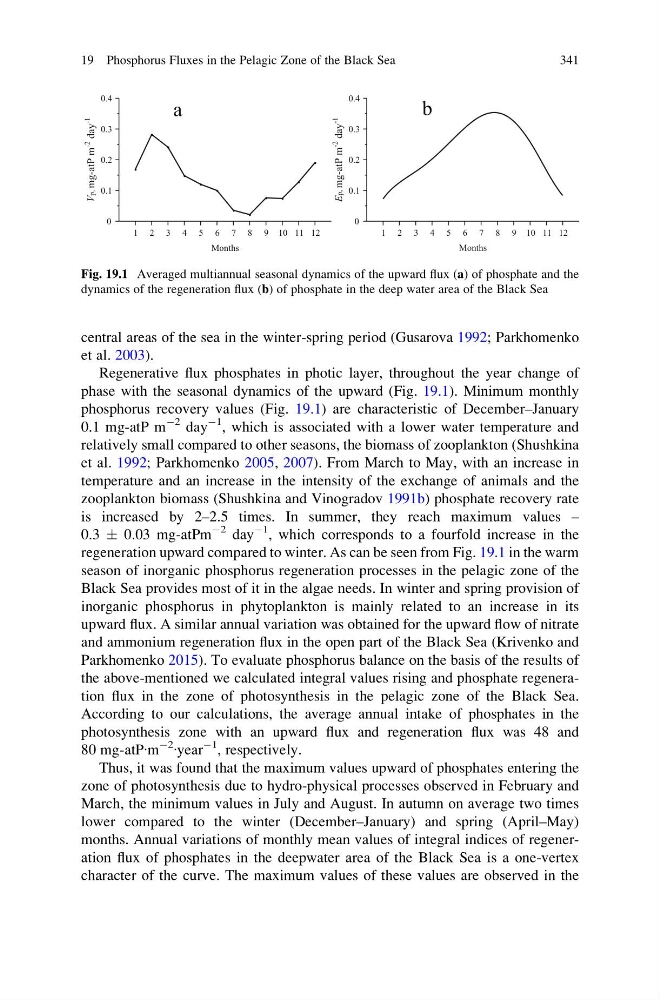
Regenerative flux phosphates in photic layer, throughout the year change of
phase with the seasonal dynamics of the upward (Fig. 19.1). Minimum monthly
phosphorus recovery values (Fig. 19.1) are characteristic of December–January
0.1 mg-atP m
À2 day
À1 , which is associated with a lower water temperature and
relatively small compared to other seasons, the biomass of zooplankton (Shushkina
et al. 1992; Parkhomenko 2005, 2007). From March to May, with an increase in
temperature and an increase in the intensity of the exchange of animals and the
zooplankton biomass (Shushkina and Vinogradov 1991b) phosphate recovery rate
is increased by 2–2.5 times. In summer, they reach maximum values –
0.3 Æ 0.03 mg-atPm
À2 day
À1 , which corresponds to a fourfold increase in the
regeneration upward compared to winter. As can be seen from Fig. 19.1 in the warm
season of inorganic phosphorus regeneration processes in the pelagic zone of the
Black Sea provides most of it in the algae needs. In winter and spring provision of
inorganic phosphorus in phytoplankton is mainly related to an increase in its
upward flux. A similar annual variation was obtained for the upward flow of nitrate
and ammonium regeneration flux in the open part of the Black Sea (Krivenko and
Parkhomenko 2015). To evaluate phosphorus balance on the basis of the results of
the above-mentioned we calculated integral values rising and phosphate regeneration flux in the zone of photosynthesis in the pelagic zone of the Black Sea.
According to our calculations, the average annual intake of phosphates in the
photosynthesis zone with an upward flux and regeneration flux was 48 and
80 mg-atP∙m
À2
∙year
À1 , respectively.
Thus, it was found that the maximum values upward of phosphates entering the
zone of photosynthesis due to hydro-physical processes observed in February and
March, the minimum values in July and August. In autumn on average two times
lower compared to the winter (December–January) and spring (April–May)
months. Annual variations of monthly mean values of integral indices of regeneration flux of phosphates in the deepwater area of the Black Sea is a one-vertex
character of the curve. The maximum values of these values are observed in the
1 2 3 4 5 6 7 8 9 10 11 12
Months
0
0.1
0.2
0.3
0.4
Vp, mg-atP m
-2
day
-1
Ep, mg-atP m
-2
day
-1
1 2 3 4 5 6 7 8 9 10 11 12
Months
0
0.1
0.2
0.3
0.4
a
b
Fig. 19.1 Averaged multiannual seasonal dynamics of the upward flux (a) of phosphate and the
dynamics of the regeneration flux (b) of phosphate in the deep water area of the Black Sea
19 Phosphorus Fluxes in the Pelagic Zone of the Black Sea
341
et al. 2003).
Regenerative flux phosphates in photic layer, throughout the year change of
phase with the seasonal dynamics of the upward (Fig. 19.1). Minimum monthly
phosphorus recovery values (Fig. 19.1) are characteristic of December–January
0.1 mg-atP m
À2 day
À1 , which is associated with a lower water temperature and
relatively small compared to other seasons, the biomass of zooplankton (Shushkina
et al. 1992; Parkhomenko 2005, 2007). From March to May, with an increase in
temperature and an increase in the intensity of the exchange of animals and the
zooplankton biomass (Shushkina and Vinogradov 1991b) phosphate recovery rate
is increased by 2–2.5 times. In summer, they reach maximum values –
0.3 Æ 0.03 mg-atPm
À2 day
À1 , which corresponds to a fourfold increase in the
regeneration upward compared to winter. As can be seen from Fig. 19.1 in the warm
season of inorganic phosphorus regeneration processes in the pelagic zone of the
Black Sea provides most of it in the algae needs. In winter and spring provision of
inorganic phosphorus in phytoplankton is mainly related to an increase in its
upward flux. A similar annual variation was obtained for the upward flow of nitrate
and ammonium regeneration flux in the open part of the Black Sea (Krivenko and
Parkhomenko 2015). To evaluate phosphorus balance on the basis of the results of
the above-mentioned we calculated integral values rising and phosphate regeneration flux in the zone of photosynthesis in the pelagic zone of the Black Sea.
According to our calculations, the average annual intake of phosphates in the
photosynthesis zone with an upward flux and regeneration flux was 48 and
80 mg-atP∙m
À2
∙year
À1 , respectively.
Thus, it was found that the maximum values upward of phosphates entering the
zone of photosynthesis due to hydro-physical processes observed in February and
March, the minimum values in July and August. In autumn on average two times
lower compared to the winter (December–January) and spring (April–May)
months. Annual variations of monthly mean values of integral indices of regeneration flux of phosphates in the deepwater area of the Black Sea is a one-vertex
character of the curve. The maximum values of these values are observed in the
1 2 3 4 5 6 7 8 9 10 11 12
Months
0
0.1
0.2
0.3
0.4
Vp, mg-atP m
-2
day
-1
Ep, mg-atP m
-2
day
-1
1 2 3 4 5 6 7 8 9 10 11 12
Months
0
0.1
0.2
0.3
0.4
a
b
Fig. 19.1 Averaged multiannual seasonal dynamics of the upward flux (a) of phosphate and the
dynamics of the regeneration flux (b) of phosphate in the deep water area of the Black Sea
19 Phosphorus Fluxes in the Pelagic Zone of the Black Sea
341