

Polikarpov et al. 2008), H eq R for marine organisms in the wide range of radionuclides concentrations in seawater and the average critical level of the
239,240 Pu
concentration activity in marine environment for each group of hydrobionts have
been determined. The limiting plutonium concentration activity in sea water was
also calculated for each Polikarpov’s zone for each group of hydrobionts with their
accumulation ability to show wide range of water concentration activity in sea
water caused the same ecological effect of ionizing radiation H eq R according to the
Polikarpov’s conceptual model on different group of hydrobionts. They varied for
“Damage to ecosystems zone” from 1 Â 10
À2 to 5 Â 10
239,240 Pu Bq∙L
À1 in sea
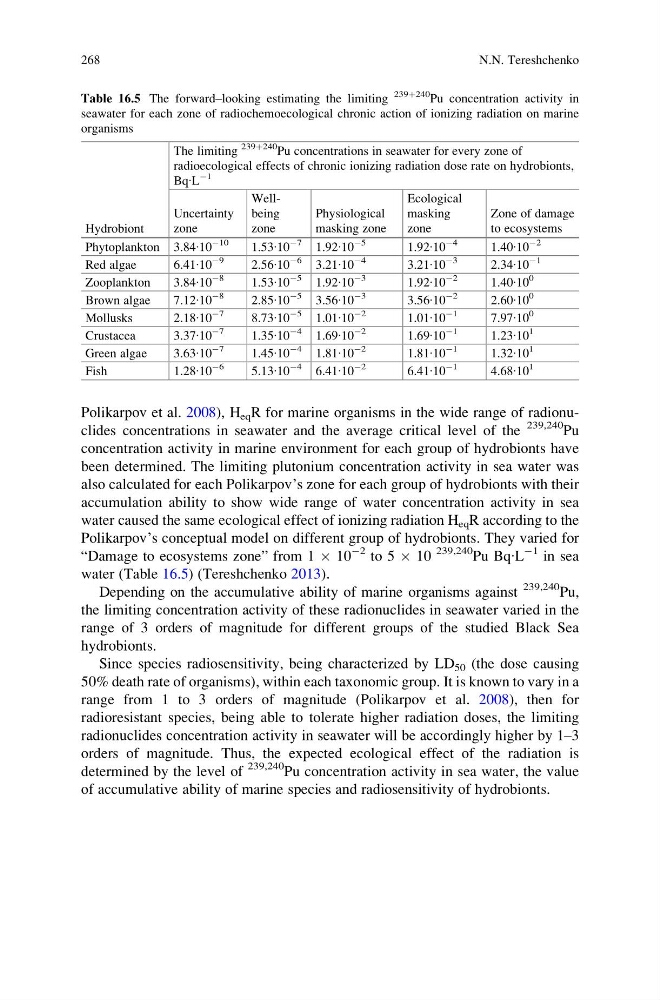
water (Table 16.5) (Tereshchenko 2013).
Depending on the accumulative ability of marine organisms against
239,240 Pu,
the limiting concentration activity of these radionuclides in seawater varied in the
range of 3 orders of magnitude for different groups of the studied Black Sea
hydrobionts.
Since species radiosensitivity, being characterized by LD 50 (the dose causing
50% death rate of organisms), within each taxonomic group. It is known to vary in a
range from 1 to 3 orders of magnitude (Polikarpov et al. 2008), then for
radioresistant species, being able to tolerate higher radiation doses, the limiting
radionuclides concentration activity in seawater will be accordingly higher by 1–3
orders of magnitude. Thus, the expected ecological effect of the radiation is
determined by the level of
239,240 Pu concentration activity in sea water, the value
of accumulative ability of marine species and radiosensitivity of hydrobionts.
Table 16.5 The forward–looking estimating the limiting
239þ240
Pu concentration activity in
seawater for each zone of radiochemoecological chronic action of ionizing radiation on marine
organisms
Hydrobiont
The limiting
239þ240
Pu concentrations in seawater for every zone of
radioecological effects of chronic ionizing radiation dose rate on hydrobionts,
Bq∙L
À1
Uncertainty
zone
Wellbeing
zone
Physiological
masking zone
Ecological
masking
zone
Zone of damage
to ecosystems
Phytoplankton 3.84∙10
À10
1.53∙10
À7
1.92∙10
À5
1.92∙10
À4
1.40∙10
À2
Red algae
6.41∙10
À9
2.56∙10
À6
3.21∙10
À4
3.21∙10
À3
2.34∙10
À1
Zooplankton
3.84∙10
À8
1.53∙10
À5
1.92∙10
À3
1.92∙10
À2
1.40∙10
0
Brown algae
7.12∙10
À8
2.85∙10
À5
3.56∙10
À3
3.56∙10
À2
2.60∙10
0
Mollusks
2.18∙10
À7
8.73∙10
À5
1.01∙10
À2
1.01∙10
À1
7.97∙10
0
Crustacea
3.37∙10
À7
1.35∙10
À4
1.69∙10
À2
1.69∙10
À1
1.23∙10
1
Green algae
3.63∙10
À7
1.45∙10
À4
1.81∙10
À2
1.81∙10
À1
1.32∙10
1
Fish
1.28∙10
À6
5.13∙10
À4
6.41∙10
À2
6.41∙10
À1
4.68∙10
1
268
N.N. Tereshchenko
239,240 Pu
concentration activity in marine environment for each group of hydrobionts have
been determined. The limiting plutonium concentration activity in sea water was
also calculated for each Polikarpov’s zone for each group of hydrobionts with their
accumulation ability to show wide range of water concentration activity in sea
water caused the same ecological effect of ionizing radiation H eq R according to the
Polikarpov’s conceptual model on different group of hydrobionts. They varied for
“Damage to ecosystems zone” from 1 Â 10
À2 to 5 Â 10
239,240 Pu Bq∙L
À1 in sea
water (Table 16.5) (Tereshchenko 2013).
Depending on the accumulative ability of marine organisms against
239,240 Pu,
the limiting concentration activity of these radionuclides in seawater varied in the
range of 3 orders of magnitude for different groups of the studied Black Sea
hydrobionts.
Since species radiosensitivity, being characterized by LD 50 (the dose causing
50% death rate of organisms), within each taxonomic group. It is known to vary in a
range from 1 to 3 orders of magnitude (Polikarpov et al. 2008), then for
radioresistant species, being able to tolerate higher radiation doses, the limiting
radionuclides concentration activity in seawater will be accordingly higher by 1–3
orders of magnitude. Thus, the expected ecological effect of the radiation is
determined by the level of
239,240 Pu concentration activity in sea water, the value
of accumulative ability of marine species and radiosensitivity of hydrobionts.
Table 16.5 The forward–looking estimating the limiting
239þ240
Pu concentration activity in
seawater for each zone of radiochemoecological chronic action of ionizing radiation on marine
organisms
Hydrobiont
The limiting
239þ240
Pu concentrations in seawater for every zone of
radioecological effects of chronic ionizing radiation dose rate on hydrobionts,
Bq∙L
À1
Uncertainty
zone
Wellbeing
zone
Physiological
masking zone
Ecological
masking
zone
Zone of damage
to ecosystems
Phytoplankton 3.84∙10
À10
1.53∙10
À7
1.92∙10
À5
1.92∙10
À4
1.40∙10
À2
Red algae
6.41∙10
À9
2.56∙10
À6
3.21∙10
À4
3.21∙10
À3
2.34∙10
À1
Zooplankton
3.84∙10
À8
1.53∙10
À5
1.92∙10
À3
1.92∙10
À2
1.40∙10
0
Brown algae
7.12∙10
À8
2.85∙10
À5
3.56∙10
À3
3.56∙10
À2
2.60∙10
0
Mollusks
2.18∙10
À7
8.73∙10
À5
1.01∙10
À2
1.01∙10
À1
7.97∙10
0
Crustacea
3.37∙10
À7
1.35∙10
À4
1.69∙10
À2
1.69∙10
À1
1.23∙10
1
Green algae
3.63∙10
À7
1.45∙10
À4
1.81∙10
À2
1.81∙10
À1
1.32∙10
1
Fish
1.28∙10
À6
5.13∙10
À4
6.41∙10
À2
6.41∙10
À1
4.68∙10
1
268
N.N. Tereshchenko