

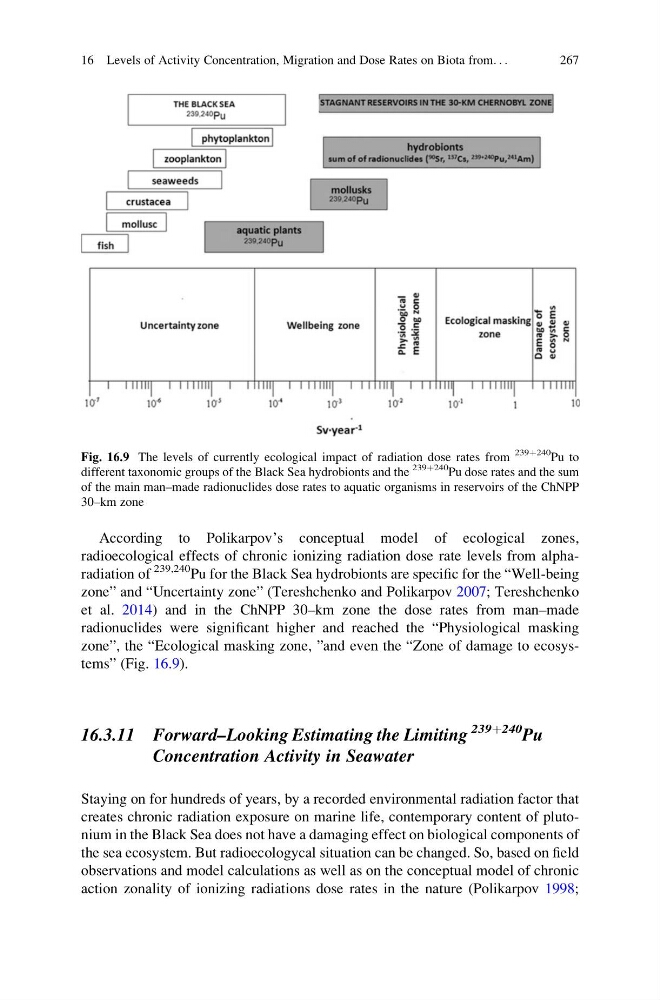
According to Polikarpov’s conceptual model of ecological zones,
radioecological effects of chronic ionizing radiation dose rate levels from alpharadiation of
239,240 Pu for the Black Sea hydrobionts are specific for the “Well-being
zone” and “Uncertainty zone” (Tereshchenko and Polikarpov 2007; Tereshchenko
et al. 2014) and in the ChNPP 30–km zone the dose rates from man–made
radionuclides were significant higher and reached the “Physiological masking
zone”, the “Ecological masking zone, ”and even the “Zone of damage to ecosystems” (Fig. 16.9).
16.3.11 Forward–Looking Estimating the Limiting
239þ240
Pu
Concentration Activity in Seawater
Staying on for hundreds of years, by a recorded environmental radiation factor that
creates chronic radiation exposure on marine life, contemporary content of plutonium in the Black Sea does not have a damaging effect on biological components of
the sea ecosystem. But radioecologycal situation can be changed. So, based on field
observations and model calculations as well as on the conceptual model of chronic
action zonality of ionizing radiations dose rates in the nature (Polikarpov 1998;
Fig. 16.9 The levels of currently ecological impact of radiation dose rates from
239þ240
Pu to
different taxonomic groups of the Black Sea hydrobionts and the
239þ240
Pu dose rates and the sum
of the main man–made radionuclides dose rates to aquatic organisms in reservoirs of the ChNPP
30–km zone
16 Levels of Activity Concentration, Migration and Dose Rates on Biota from. . .
267
radioecological effects of chronic ionizing radiation dose rate levels from alpharadiation of
239,240 Pu for the Black Sea hydrobionts are specific for the “Well-being
zone” and “Uncertainty zone” (Tereshchenko and Polikarpov 2007; Tereshchenko
et al. 2014) and in the ChNPP 30–km zone the dose rates from man–made
radionuclides were significant higher and reached the “Physiological masking
zone”, the “Ecological masking zone, ”and even the “Zone of damage to ecosystems” (Fig. 16.9).
16.3.11 Forward–Looking Estimating the Limiting
239þ240
Pu
Concentration Activity in Seawater
Staying on for hundreds of years, by a recorded environmental radiation factor that
creates chronic radiation exposure on marine life, contemporary content of plutonium in the Black Sea does not have a damaging effect on biological components of
the sea ecosystem. But radioecologycal situation can be changed. So, based on field
observations and model calculations as well as on the conceptual model of chronic
action zonality of ionizing radiations dose rates in the nature (Polikarpov 1998;
Fig. 16.9 The levels of currently ecological impact of radiation dose rates from
239þ240
Pu to
different taxonomic groups of the Black Sea hydrobionts and the
239þ240
Pu dose rates and the sum
of the main man–made radionuclides dose rates to aquatic organisms in reservoirs of the ChNPP
30–km zone
16 Levels of Activity Concentration, Migration and Dose Rates on Biota from. . .
267