

In Antarctica – the opposite pole – similar things are happening. Here, like in the
Arctic, studies have shown the same occurrence: temperatures increases in recent
years by approximately 3
C compared to the temperature of 30–40 years ago.
More research shows that the Antarctic ice sheet – 2.5 km thick – with an area
1.5 times larger than the US, began to melt too (Brown 2011a). Since 1995, reports
have started of huge pieces of ice detaching and sliding into the sea due to
temperature increases. We will mention only one example among many others,
made known by the Romanian mass-media: in 2002 NASA witnessed the moment a
piece of ice the size of Manhattan (New York) detached and broke.
But all these breaks and fallings of huge blocks of ice into the sea, in addition to
the thinning of the Arctic and Antarctic ice, lead to a reduction of the world’s
drinking water and, inevitably, to an increase of the seas and oceans level, causing
catastrophic floods (Fig. 5.5).
In his book Plan B 4.0. General Mobilization to Save Civilization, Lester Russell
Brown (2011b) mentions a study made by a team from the Institute for Arctic and
Alpine Researches, University of Colorado (USA), accomplished 8 years ago
(2008). According to this study, glaciers melting will lead to the rising of the seas
and oceans by 0.8 cm
–2 m by 2100. Also, the reports of the International Panel on
Climate Change (IPPC) indicate ocean levels increased by 0.1–0.2 m in the
twentieth century (Fig. 5.6). These reports estimate a rise of the sea by
0.18–0.59 m by the end of the twenty-first century and 2 m by the end of the
twenty-third century if the current rate of temperatures rising is maintained. Some
observers believe that if the trend of temperatures rising continues, the sea ice will
be completely melted by 2030 or even earlier. But there are other studies that
estimate the water levels will rise much more. Researchers at Harvard and
Princeton University have published the results of their studies and believe that
these increases will vary between 4 and 6 m; which would be a real catastrophe.
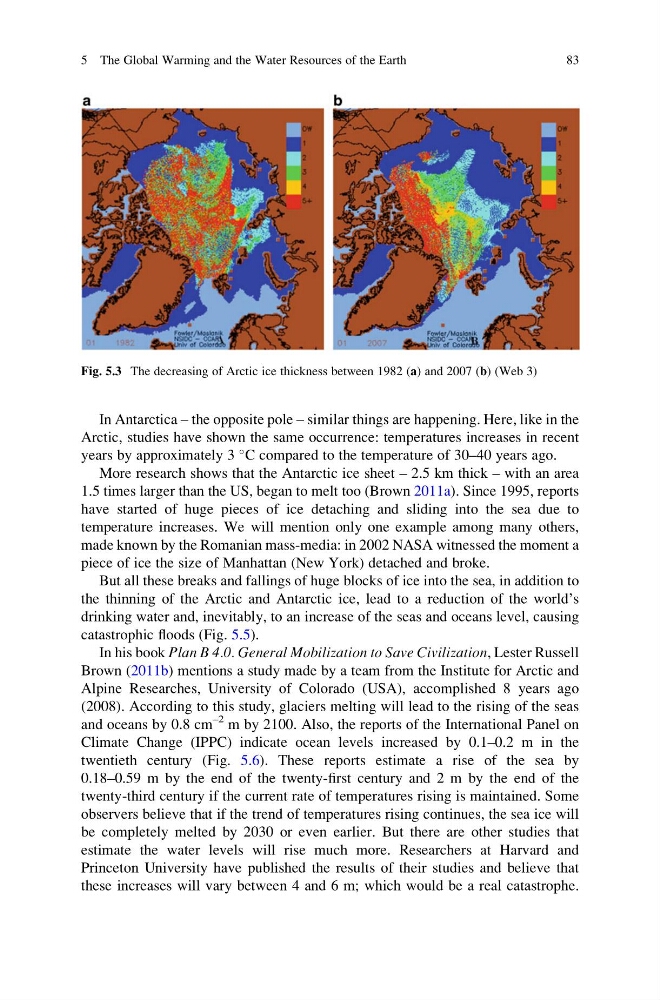
Fig. 5.3 The decreasing of Arctic ice thickness between 1982 (a) and 2007 (b) (Web 3)
5 The Global Warming and the Water Resources of the Earth
83
Arctic, studies have shown the same occurrence: temperatures increases in recent
years by approximately 3
C compared to the temperature of 30–40 years ago.
More research shows that the Antarctic ice sheet – 2.5 km thick – with an area
1.5 times larger than the US, began to melt too (Brown 2011a). Since 1995, reports
have started of huge pieces of ice detaching and sliding into the sea due to
temperature increases. We will mention only one example among many others,
made known by the Romanian mass-media: in 2002 NASA witnessed the moment a
piece of ice the size of Manhattan (New York) detached and broke.
But all these breaks and fallings of huge blocks of ice into the sea, in addition to
the thinning of the Arctic and Antarctic ice, lead to a reduction of the world’s
drinking water and, inevitably, to an increase of the seas and oceans level, causing
catastrophic floods (Fig. 5.5).
In his book Plan B 4.0. General Mobilization to Save Civilization, Lester Russell
Brown (2011b) mentions a study made by a team from the Institute for Arctic and
Alpine Researches, University of Colorado (USA), accomplished 8 years ago
(2008). According to this study, glaciers melting will lead to the rising of the seas
and oceans by 0.8 cm
–2 m by 2100. Also, the reports of the International Panel on
Climate Change (IPPC) indicate ocean levels increased by 0.1–0.2 m in the
twentieth century (Fig. 5.6). These reports estimate a rise of the sea by
0.18–0.59 m by the end of the twenty-first century and 2 m by the end of the
twenty-third century if the current rate of temperatures rising is maintained. Some
observers believe that if the trend of temperatures rising continues, the sea ice will
be completely melted by 2030 or even earlier. But there are other studies that
estimate the water levels will rise much more. Researchers at Harvard and
Princeton University have published the results of their studies and believe that
these increases will vary between 4 and 6 m; which would be a real catastrophe.
Fig. 5.3 The decreasing of Arctic ice thickness between 1982 (a) and 2007 (b) (Web 3)
5 The Global Warming and the Water Resources of the Earth
83