

Still sadder is the fact that the Arctic ice will no longer be restored over the next
winters, its thinning continuing year after year and questioning thus the future of the
Arctic ice cap.
Lester Russell Brown (2011b) again shows that the same researchers from the
National Snow and Ice Data Center (NSIDC) believe that we are witnessing a
shortening of the Arctic winter and, in the future, the Arctic Ocean could be free of
ice in the summer, facilitating thus navigation.
The ice layer in Greenland is in the same situation. A study of the University of
Colorado (USA) showed that within 2 years (2004–2006) Greenland lost its ice
2.5 times faster and this will continue in the future if the warming continues, while
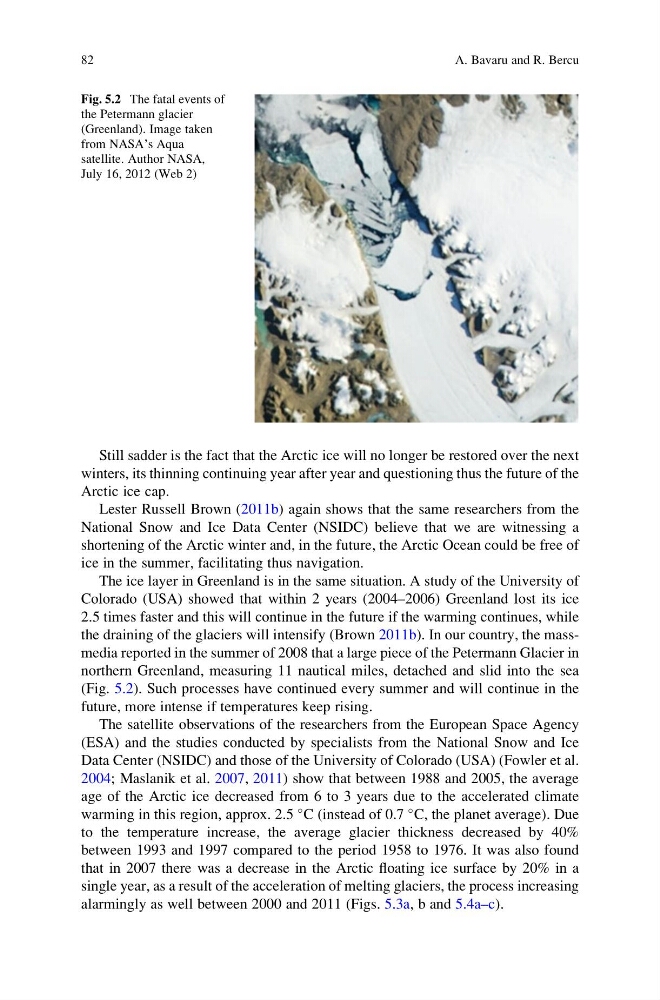
the draining of the glaciers will intensify (Brown 2011b). In our country, the massmedia reported in the summer of 2008 that a large piece of the Petermann Glacier in
northern Greenland, measuring 11 nautical miles, detached and slid into the sea
(Fig. 5.2). Such processes have continued every summer and will continue in the
future, more intense if temperatures keep rising.
The satellite observations of the researchers from the European Space Agency
(ESA) and the studies conducted by specialists from the National Snow and Ice
Data Center (NSIDC) and those of the University of Colorado (USA) (Fowler et al.
2004; Maslanik et al. 2007, 2011) show that between 1988 and 2005, the average
age of the Arctic ice decreased from 6 to 3 years due to the accelerated climate
warming in this region, approx. 2.5
C (instead of 0.7
C, the planet average). Due
to the temperature increase, the average glacier thickness decreased by 40%
between 1993 and 1997 compared to the period 1958 to 1976. It was also found
that in 2007 there was a decrease in the Arctic floating ice surface by 20% in a
single year, as a result of the acceleration of melting glaciers, the process increasing
alarmingly as well between 2000 and 2011 (Figs. 5.3a, b and 5.4a–c).
Fig. 5.2 The fatal events of
the Petermann glacier
(Greenland). Image taken
from NASA’s Aqua
satellite. Author NASA,
July 16, 2012 (Web 2)
82
A. Bavaru and R. Bercu
winters, its thinning continuing year after year and questioning thus the future of the
Arctic ice cap.
Lester Russell Brown (2011b) again shows that the same researchers from the
National Snow and Ice Data Center (NSIDC) believe that we are witnessing a
shortening of the Arctic winter and, in the future, the Arctic Ocean could be free of
ice in the summer, facilitating thus navigation.
The ice layer in Greenland is in the same situation. A study of the University of
Colorado (USA) showed that within 2 years (2004–2006) Greenland lost its ice
2.5 times faster and this will continue in the future if the warming continues, while
the draining of the glaciers will intensify (Brown 2011b). In our country, the massmedia reported in the summer of 2008 that a large piece of the Petermann Glacier in
northern Greenland, measuring 11 nautical miles, detached and slid into the sea
(Fig. 5.2). Such processes have continued every summer and will continue in the
future, more intense if temperatures keep rising.
The satellite observations of the researchers from the European Space Agency
(ESA) and the studies conducted by specialists from the National Snow and Ice
Data Center (NSIDC) and those of the University of Colorado (USA) (Fowler et al.
2004; Maslanik et al. 2007, 2011) show that between 1988 and 2005, the average
age of the Arctic ice decreased from 6 to 3 years due to the accelerated climate
warming in this region, approx. 2.5
C (instead of 0.7
C, the planet average). Due
to the temperature increase, the average glacier thickness decreased by 40%
between 1993 and 1997 compared to the period 1958 to 1976. It was also found
that in 2007 there was a decrease in the Arctic floating ice surface by 20% in a
single year, as a result of the acceleration of melting glaciers, the process increasing
alarmingly as well between 2000 and 2011 (Figs. 5.3a, b and 5.4a–c).
Fig. 5.2 The fatal events of
the Petermann glacier
(Greenland). Image taken
from NASA’s Aqua
satellite. Author NASA,
July 16, 2012 (Web 2)
82
A. Bavaru and R. Bercu