

78
5 Challenges: Sectoral Descriptions
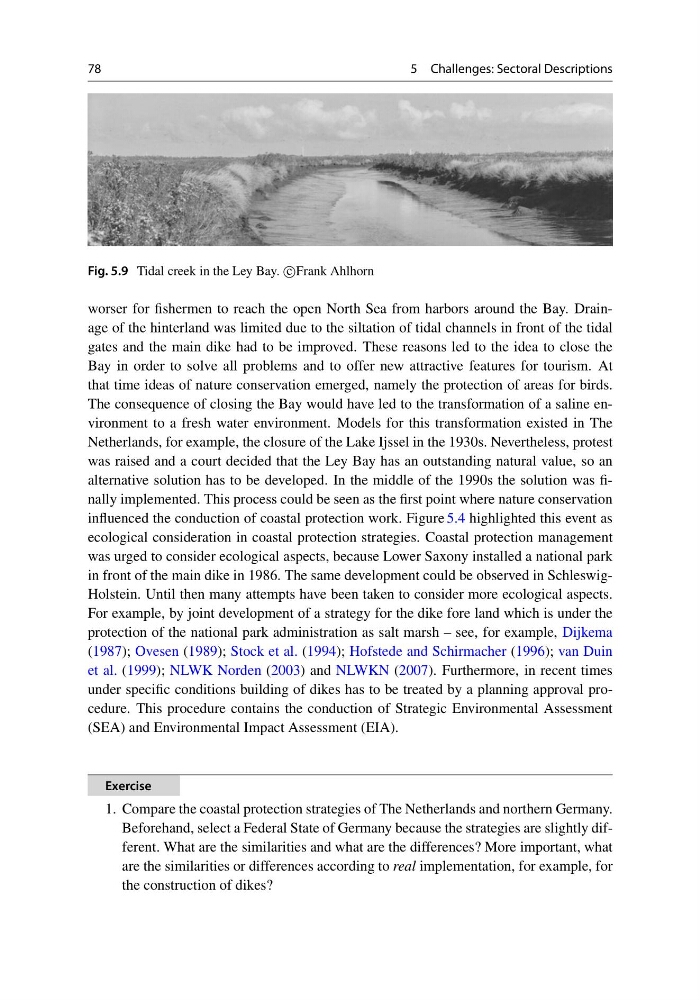
Fig. 5.9 Tidal creek in the Ley Bay. c
Ahlhorn
worser for fishermen to reach the open North Sea from harbors around the Bay. Drainage of the hinterland was limited due to the siltation of tidal channels in front of the tidal
gates and the main dike had to be improved. These reasons led to the idea to close the
Bay in order to solve all problems and to offer new attractive features for tourism. At
that time ideas of nature conservation emerged, namely the protection of areas for birds.
The consequence of closing the Bay would have led to the transformation of a saline environment to a fresh water environment. Models for this transformation existed in The
Netherlands, for example, the closure of the Lake Ijssel in the 1930s. Nevertheless, protest
was raised and a court decided that the Ley Bay has an outstanding natural value, so an
alternative solution has to be developed. In the middle of the 1990s the solution was finally implemented. This process could be seen as the first point where nature conservation
influenced the conduction of coastal protection work. Figure 5.4 highlighted this event as
ecological consideration in coastal protection strategies. Coastal protection management
was urged to consider ecological aspects, because Lower Saxony installed a national park
in front of the main dike in 1986. The same development could be observed in SchleswigHolstein. Until then many attempts have been taken to consider more ecological aspects.
For example, by joint development of a strategy for the dike fore land which is under the
protection of the national park administration as salt marsh – see, for example, Dijkema
(1987); Ovesen (1989); Stock et al. (1994); Hofstede and Schirmacher (1996); van Duin
et al. (1999); NLWK Norden (2003) and NLWKN (2007). Furthermore, in recent times
under specific conditions building of dikes has to be treated by a planning approval procedure. This procedure contains the conduction of Strategic Environmental Assessment
(SEA) and Environmental Impact Assessment (EIA).
Exercise
1. Compare the coastal protection strategies of The Netherlands and northern Germany.
Beforehand, select a Federal State of Germany because the strategies are slightly different. What are the similarities and what are the differences? More important, what
are the similarities or differences according to real implementation, for example, for
the construction of dikes?
5 Challenges: Sectoral Descriptions
Fig. 5.9 Tidal creek in the Ley Bay. c
Ahlhorn
worser for fishermen to reach the open North Sea from harbors around the Bay. Drainage of the hinterland was limited due to the siltation of tidal channels in front of the tidal
gates and the main dike had to be improved. These reasons led to the idea to close the
Bay in order to solve all problems and to offer new attractive features for tourism. At
that time ideas of nature conservation emerged, namely the protection of areas for birds.
The consequence of closing the Bay would have led to the transformation of a saline environment to a fresh water environment. Models for this transformation existed in The
Netherlands, for example, the closure of the Lake Ijssel in the 1930s. Nevertheless, protest
was raised and a court decided that the Ley Bay has an outstanding natural value, so an
alternative solution has to be developed. In the middle of the 1990s the solution was finally implemented. This process could be seen as the first point where nature conservation
influenced the conduction of coastal protection work. Figure 5.4 highlighted this event as
ecological consideration in coastal protection strategies. Coastal protection management
was urged to consider ecological aspects, because Lower Saxony installed a national park
in front of the main dike in 1986. The same development could be observed in SchleswigHolstein. Until then many attempts have been taken to consider more ecological aspects.
For example, by joint development of a strategy for the dike fore land which is under the
protection of the national park administration as salt marsh – see, for example, Dijkema
(1987); Ovesen (1989); Stock et al. (1994); Hofstede and Schirmacher (1996); van Duin
et al. (1999); NLWK Norden (2003) and NLWKN (2007). Furthermore, in recent times
under specific conditions building of dikes has to be treated by a planning approval procedure. This procedure contains the conduction of Strategic Environmental Assessment
(SEA) and Environmental Impact Assessment (EIA).
Exercise
1. Compare the coastal protection strategies of The Netherlands and northern Germany.
Beforehand, select a Federal State of Germany because the strategies are slightly different. What are the similarities and what are the differences? More important, what
are the similarities or differences according to real implementation, for example, for
the construction of dikes?