

168
7 Prospects: Methodologies of Integration
Resource
Predominant Sector
Medium/Tool
Motivation
Money
Economy
Capital transfer
Economic incentives
Power
Politics
Authority, force
Fear for punishment
Social prestige
Social system
Reputation, award
Solidarity, support
Cultural accountability
Culture
Belief, sense
Trust, snugness
Evidence
Science
Proof, truth
Insight in expected
consequences
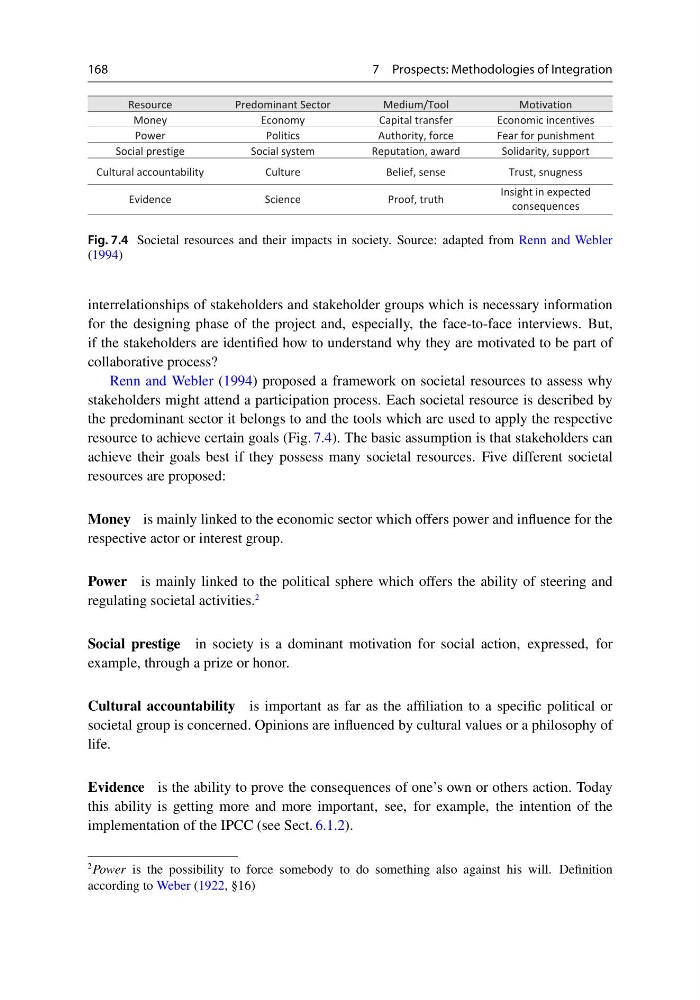
Fig. 7.4 Societal resources and their impacts in society. Source: adapted from Renn and Webler
(1994)
interrelationships of stakeholders and stakeholder groups which is necessary information
for the designing phase of the project and, especially, the face-to-face interviews. But,
if the stakeholders are identified how to understand why they are motivated to be part of
collaborative process?
Renn and Webler (1994) proposed a framework on societal resources to assess why
stakeholders might attend a participation process. Each societal resource is described by
the predominant sector it belongs to and the tools which are used to apply the respective
resource to achieve certain goals (Fig. 7.4). The basic assumption is that stakeholders can
achieve their goals best if they possess many societal resources. Five different societal
resources are proposed:
Money is mainly linked to the economic sector which offers power and influence for the
respective actor or interest group.
Power is mainly linked to the political sphere which offers the ability of steering and
regulating societal activities.
2
Social prestige in society is a dominant motivation for social action, expressed, for
example, through a prize or honor.
Cultural accountability is important as far as the affiliation to a specific political or
societal group is concerned. Opinions are influenced by cultural values or a philosophy of
life.
Evidence is the ability to prove the consequences of one’s own or others action. Today
this ability is getting more and more important, see, for example, the intention of the
implementation of the IPCC (see Sect. 6.1.2).
2 Power is the possibility to force somebody to do something also against his will. Definition
according to Weber (1922, §16)
7 Prospects: Methodologies of Integration
Resource
Predominant Sector
Medium/Tool
Motivation
Money
Economy
Capital transfer
Economic incentives
Power
Politics
Authority, force
Fear for punishment
Social prestige
Social system
Reputation, award
Solidarity, support
Cultural accountability
Culture
Belief, sense
Trust, snugness
Evidence
Science
Proof, truth
Insight in expected
consequences
Fig. 7.4 Societal resources and their impacts in society. Source: adapted from Renn and Webler
(1994)
interrelationships of stakeholders and stakeholder groups which is necessary information
for the designing phase of the project and, especially, the face-to-face interviews. But,
if the stakeholders are identified how to understand why they are motivated to be part of
collaborative process?
Renn and Webler (1994) proposed a framework on societal resources to assess why
stakeholders might attend a participation process. Each societal resource is described by
the predominant sector it belongs to and the tools which are used to apply the respective
resource to achieve certain goals (Fig. 7.4). The basic assumption is that stakeholders can
achieve their goals best if they possess many societal resources. Five different societal
resources are proposed:
Money is mainly linked to the economic sector which offers power and influence for the
respective actor or interest group.
Power is mainly linked to the political sphere which offers the ability of steering and
regulating societal activities.
2
Social prestige in society is a dominant motivation for social action, expressed, for
example, through a prize or honor.
Cultural accountability is important as far as the affiliation to a specific political or
societal group is concerned. Opinions are influenced by cultural values or a philosophy of
life.
Evidence is the ability to prove the consequences of one’s own or others action. Today
this ability is getting more and more important, see, for example, the intention of the
implementation of the IPCC (see Sect. 6.1.2).
2 Power is the possibility to force somebody to do something also against his will. Definition
according to Weber (1922, §16)