

6.1 Integrated Water Management for Quality and Quantity
131
• Delay effect (time period between the event and the damage)
• Mobilization (risks lead to severe conflicts and dread among the general public)
The WBGU differentiates between eight types of risk and suggests a decision tree to classify these types. Three areas were identified for the different types of risk: (a) normal, (b)
transitional and (c) prohibited area (see Fig. 6.5 and see also Renn and Klinke 2013). The
classification of these areas is determined by the probability of occurrence and the extent
of the damage. Normal comprises risk of every day life which might be handled by simple
measures. The risk area transition contains risks which can develop over time to one of
the other areas and, therefore, either decrease or increase in intensity. Risk types assigned
to the prohibited area are severe catastrophic events which show high extend of damage
and low probability of occurrence. Markau (2003) concludes after the determination and
evaluation of the risk of flooding, that storm surges are of the cyclops type and hence are
located on the border between the transitional and prohibited area.
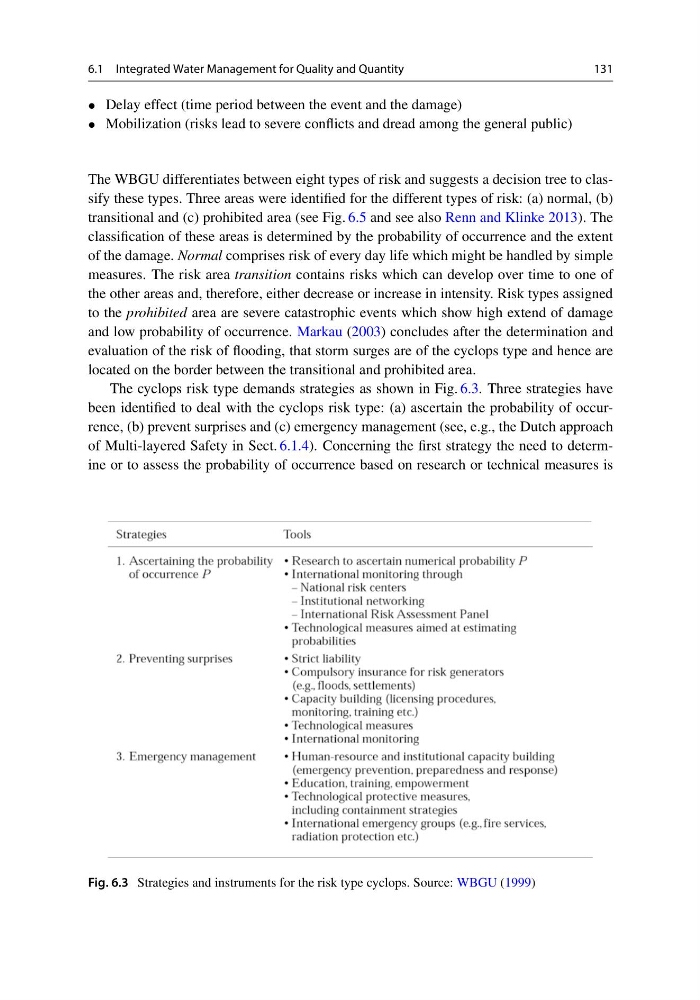
The cyclops risk type demands strategies as shown in Fig. 6.3. Three strategies have
been identified to deal with the cyclops risk type: (a) ascertain the probability of occurrence, (b) prevent surprises and (c) emergency management (see, e.g., the Dutch approach
of Multi-layered Safety in Sect. 6.1.4). Concerning the first strategy the need to determine or to assess the probability of occurrence based on research or technical measures is
Fig. 6.3 Strategies and instruments for the risk type cyclops. Source: WBGU (1999)
131
• Delay effect (time period between the event and the damage)
• Mobilization (risks lead to severe conflicts and dread among the general public)
The WBGU differentiates between eight types of risk and suggests a decision tree to classify these types. Three areas were identified for the different types of risk: (a) normal, (b)
transitional and (c) prohibited area (see Fig. 6.5 and see also Renn and Klinke 2013). The
classification of these areas is determined by the probability of occurrence and the extent
of the damage. Normal comprises risk of every day life which might be handled by simple
measures. The risk area transition contains risks which can develop over time to one of
the other areas and, therefore, either decrease or increase in intensity. Risk types assigned
to the prohibited area are severe catastrophic events which show high extend of damage
and low probability of occurrence. Markau (2003) concludes after the determination and
evaluation of the risk of flooding, that storm surges are of the cyclops type and hence are
located on the border between the transitional and prohibited area.
The cyclops risk type demands strategies as shown in Fig. 6.3. Three strategies have
been identified to deal with the cyclops risk type: (a) ascertain the probability of occurrence, (b) prevent surprises and (c) emergency management (see, e.g., the Dutch approach
of Multi-layered Safety in Sect. 6.1.4). Concerning the first strategy the need to determine or to assess the probability of occurrence based on research or technical measures is
Fig. 6.3 Strategies and instruments for the risk type cyclops. Source: WBGU (1999)