

5.4 Estuaries in the Southern North Sea Region
89
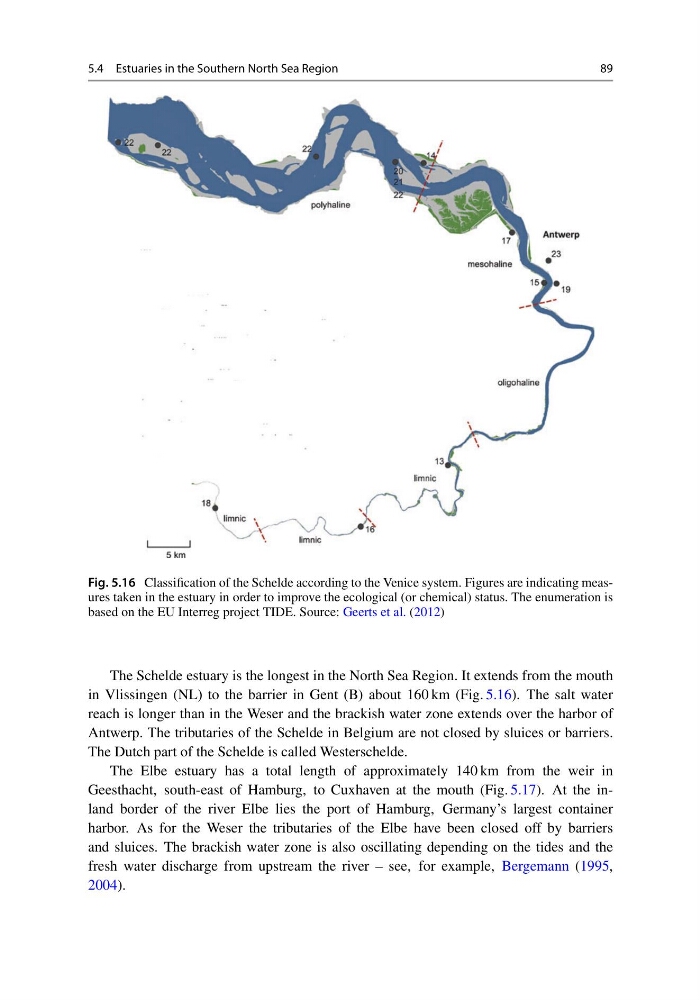
Fig. 5.16 Classification of the Schelde according to the Venice system. Figures are indicating measures taken in the estuary in order to improve the ecological (or chemical) status. The enumeration is
based on the EU Interreg project TIDE. Source: Geerts et al. (2012)
The Schelde estuary is the longest in the North Sea Region. It extends from the mouth
in Vlissingen (NL) to the barrier in Gent (B) about 160 km (Fig. 5.16). The salt water
reach is longer than in the Weser and the brackish water zone extends over the harbor of
Antwerp. The tributaries of the Schelde in Belgium are not closed by sluices or barriers.
The Dutch part of the Schelde is called Westerschelde.
The Elbe estuary has a total length of approximately 140 km from the weir in
Geesthacht, south-east of Hamburg, to Cuxhaven at the mouth (Fig. 5.17). At the inland border of the river Elbe lies the port of Hamburg, Germany’s largest container
harbor. As for the Weser the tributaries of the Elbe have been closed off by barriers
and sluices. The brackish water zone is also oscillating depending on the tides and the
fresh water discharge from upstream the river – see, for example, Bergemann (1995,
2004).
89
Fig. 5.16 Classification of the Schelde according to the Venice system. Figures are indicating measures taken in the estuary in order to improve the ecological (or chemical) status. The enumeration is
based on the EU Interreg project TIDE. Source: Geerts et al. (2012)
The Schelde estuary is the longest in the North Sea Region. It extends from the mouth
in Vlissingen (NL) to the barrier in Gent (B) about 160 km (Fig. 5.16). The salt water
reach is longer than in the Weser and the brackish water zone extends over the harbor of
Antwerp. The tributaries of the Schelde in Belgium are not closed by sluices or barriers.
The Dutch part of the Schelde is called Westerschelde.
The Elbe estuary has a total length of approximately 140 km from the weir in
Geesthacht, south-east of Hamburg, to Cuxhaven at the mouth (Fig. 5.17). At the inland border of the river Elbe lies the port of Hamburg, Germany’s largest container
harbor. As for the Weser the tributaries of the Elbe have been closed off by barriers
and sluices. The brackish water zone is also oscillating depending on the tides and the
fresh water discharge from upstream the river – see, for example, Bergemann (1995,
2004).