

Morphology and Flow in Streams
57
Two first-order tributaries combine to produce a second-order stream, two secondorder tributaries produce a third order, and so on (Fig. 5.2). The order of the trunk
stream is not changed by the addition of a stream of lower order. Only when two
tributaries of equal order are joined is the order increased. Practical limitations for this
method include: (1) hydrological and ecological conditions may not be represented
adequately since numerous tributaries can enter the main stream without changing
order, and (2) ephemeral headwater streams or topographic maps of different scales
can change significantly the order within the drainage network.
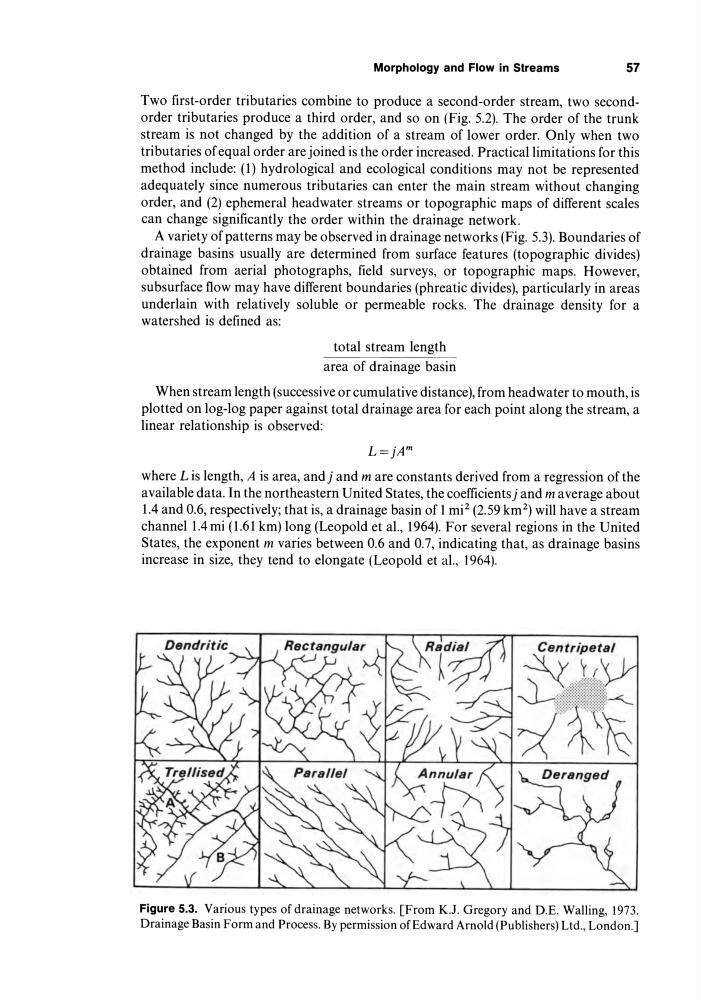
A variety of patterns may be observed in drainage networks (Fig. 5.3). Boundaries of
drainage basins usually are determined from surface features (topographic divides)
obtained from aerial photographs, field surveys, or topographic maps. However,
subsurface flow may have different boundaries (phreatic divides), particularly in areas
underlain with relatively soluble or permeable rocks. The drainage density for a
watershed is defined as:
total stream length
area of drainage basin
When stream length (successive or cumulative distance), from headwater to mouth, is
plotted on log-log paper against total drainage area for each point along the stream, a
linear relationship is observed:
L=jA m
where L is length, A is area, andj and m are constants derived from a regression of the
available data. In the northeastern United States, the coefficientsj and m average about
1.4 and 0.6, respectively; that is, a drainage basin of 1 mi 2 (2.59 km 2 ) will have a stream
channel 1.4 mi (1.61 km) long (Leopold et aI., 1964). For several regions in the United
States, the exponent m varies between 0.6 and 0.7, indicating that, as drainage basins
increase in size, they tend to elongate (Leopold et aI., 1964).
Centripetal
1tt~
Figure 5.3. Various types of drainage networks. [From KJ. Gregory and D.E. Walling, 1973.
Drainage Basin Form and Process. By permission of Edward Arnold (Publishers) Ltd., London.]
57
Two first-order tributaries combine to produce a second-order stream, two secondorder tributaries produce a third order, and so on (Fig. 5.2). The order of the trunk
stream is not changed by the addition of a stream of lower order. Only when two
tributaries of equal order are joined is the order increased. Practical limitations for this
method include: (1) hydrological and ecological conditions may not be represented
adequately since numerous tributaries can enter the main stream without changing
order, and (2) ephemeral headwater streams or topographic maps of different scales
can change significantly the order within the drainage network.
A variety of patterns may be observed in drainage networks (Fig. 5.3). Boundaries of
drainage basins usually are determined from surface features (topographic divides)
obtained from aerial photographs, field surveys, or topographic maps. However,
subsurface flow may have different boundaries (phreatic divides), particularly in areas
underlain with relatively soluble or permeable rocks. The drainage density for a
watershed is defined as:
total stream length
area of drainage basin
When stream length (successive or cumulative distance), from headwater to mouth, is
plotted on log-log paper against total drainage area for each point along the stream, a
linear relationship is observed:
L=jA m
where L is length, A is area, andj and m are constants derived from a regression of the
available data. In the northeastern United States, the coefficientsj and m average about
1.4 and 0.6, respectively; that is, a drainage basin of 1 mi 2 (2.59 km 2 ) will have a stream
channel 1.4 mi (1.61 km) long (Leopold et aI., 1964). For several regions in the United
States, the exponent m varies between 0.6 and 0.7, indicating that, as drainage basins
increase in size, they tend to elongate (Leopold et aI., 1964).
Centripetal
1tt~
Figure 5.3. Various types of drainage networks. [From KJ. Gregory and D.E. Walling, 1973.
Drainage Basin Form and Process. By permission of Edward Arnold (Publishers) Ltd., London.]