

The Heat Budget of Lakes
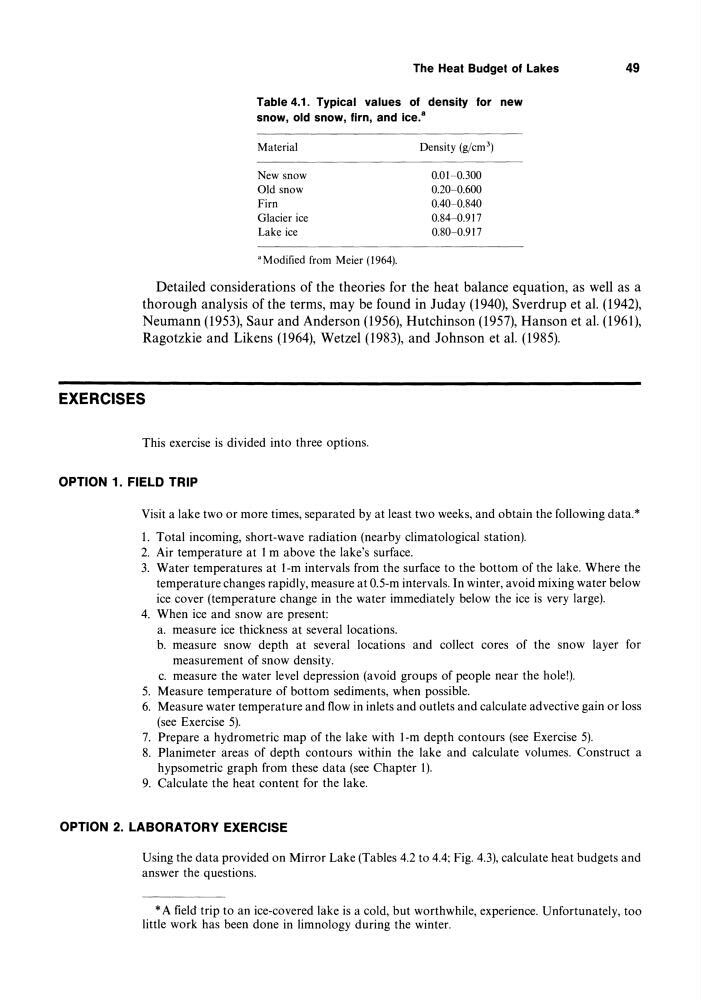
Table 4.1. Typical values of density for new
snow, old snow, firn, and ice. a
Material
New snow
Old snow
Firn
Glacier ice
Lake ice
aModified from Meier (1964).
Density (g/cm 3 )
0.01-0.300
0.20-0.600
0.40-0.840
0.84-0.917
0.80-0.917
49
Detailed considerations of the theories for the heat balance equation, as well as a
thorough analysis of the terms, may be found in Juday (1940), Sverdrup et al. (1942),
Neumann (1953), Saur and Anderson (1956), Hutchinson (1957), Hanson et al. (1961),
Ragotzkie and Likens (1964), Wetzel (1983), and Johnson et al. (1985).
EXERCISES
This exercise is divided into three options.
OPTION 1. FIELD TRIP
Visit a lake two or more times, separated by at least two weeks, and obtain the following data.*
1. Total incoming, short-wave radiation (nearby climatological station).
2. Air temperature at I m above the lake's surface.
3. Water temperatures at I-m intervals from the surface to the bottom of the lake. Where the
temperature changes rapidly, measure at O.5-m intervals. In winter, avoid mixing water below
ice cover (temperature change in the water immediately below the ice is very large).
4. When ice and snow are present:
a. measure ice thickness at several locations.
b. measure snow depth at several locations and collect cores of the snow layer for
measurement of snow density.
c. measure the water level depression (avoid groups of people near the hole!).
5. Measure temperature of bottom sediments, when possible.
6. Measure water temperature and flow in inlets and outlets and calculate advective gain or loss
(see Exercise 5).
7. Prepare a hydrometric map of the lake with I-m depth contours (see Exercise 5).
8. Planimeter areas of depth contours within the lake and calculate volumes. Construct a
hypsometric graph from these data (see Chapter 1).
9. Calculate the heat content for the lake.
OPTION 2. LABORATORY EXERCISE
Using the data provided on Mirror Lake (Tables 4.2 to 4.4; Fig. 4.3), calculate heat budgets and
answer the questions.
* A field trip to an ice-covered lake is a cold, but worthwhile, experience. Unfortunately, too
little work has been done in limnology during the winter.
Table 4.1. Typical values of density for new
snow, old snow, firn, and ice. a
Material
New snow
Old snow
Firn
Glacier ice
Lake ice
aModified from Meier (1964).
Density (g/cm 3 )
0.01-0.300
0.20-0.600
0.40-0.840
0.84-0.917
0.80-0.917
49
Detailed considerations of the theories for the heat balance equation, as well as a
thorough analysis of the terms, may be found in Juday (1940), Sverdrup et al. (1942),
Neumann (1953), Saur and Anderson (1956), Hutchinson (1957), Hanson et al. (1961),
Ragotzkie and Likens (1964), Wetzel (1983), and Johnson et al. (1985).
EXERCISES
This exercise is divided into three options.
OPTION 1. FIELD TRIP
Visit a lake two or more times, separated by at least two weeks, and obtain the following data.*
1. Total incoming, short-wave radiation (nearby climatological station).
2. Air temperature at I m above the lake's surface.
3. Water temperatures at I-m intervals from the surface to the bottom of the lake. Where the
temperature changes rapidly, measure at O.5-m intervals. In winter, avoid mixing water below
ice cover (temperature change in the water immediately below the ice is very large).
4. When ice and snow are present:
a. measure ice thickness at several locations.
b. measure snow depth at several locations and collect cores of the snow layer for
measurement of snow density.
c. measure the water level depression (avoid groups of people near the hole!).
5. Measure temperature of bottom sediments, when possible.
6. Measure water temperature and flow in inlets and outlets and calculate advective gain or loss
(see Exercise 5).
7. Prepare a hydrometric map of the lake with I-m depth contours (see Exercise 5).
8. Planimeter areas of depth contours within the lake and calculate volumes. Construct a
hypsometric graph from these data (see Chapter 1).
9. Calculate the heat content for the lake.
OPTION 2. LABORATORY EXERCISE
Using the data provided on Mirror Lake (Tables 4.2 to 4.4; Fig. 4.3), calculate heat budgets and
answer the questions.
* A field trip to an ice-covered lake is a cold, but worthwhile, experience. Unfortunately, too
little work has been done in limnology during the winter.