

48
Exercise 4
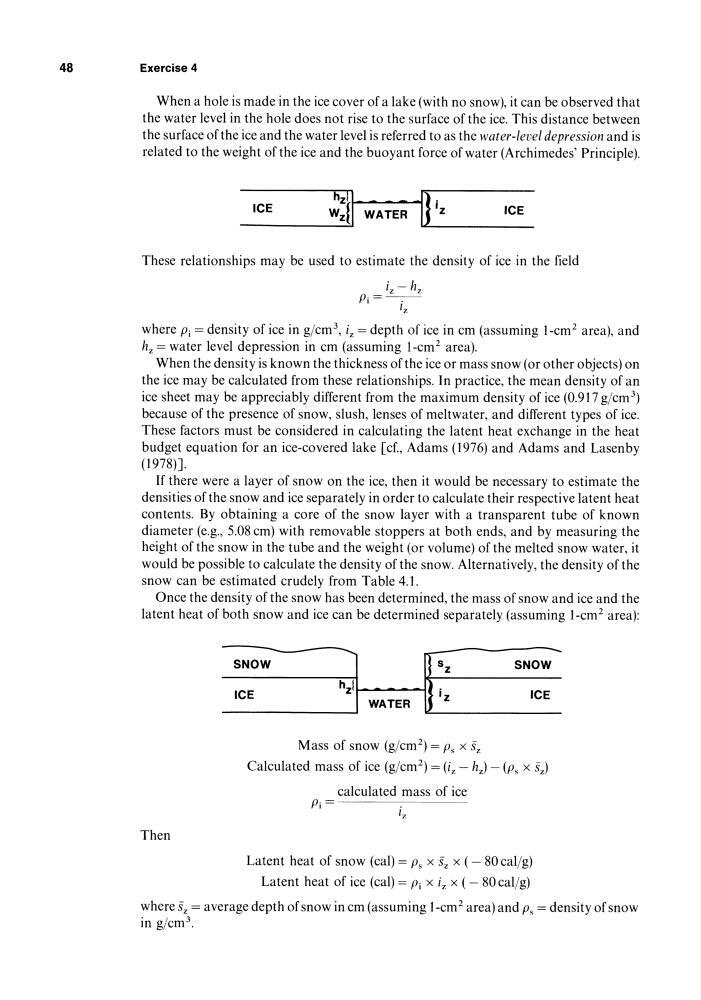
When a hole is made in the ice cover of a lake (with no snow), it can be observed that
the water level in the hole does not rise to the surface of the ice. This distance between
the surface of the ice and the water level is referred to as the water-level depression and is
related to the weight ofthe ice and the buoyant force of water (Archimedes' Principle).
hz'l
_ ~}.
_C_E _ _ _ _ W_z..::J{ WATER I~_'_Z ____ I_C_E_
These relationships may be used to estimate the density of ice in the field
where Pi = density of ice in gjcm 3 , iz = depth of ice in cm (assuming l-cm 2 area), and
hz = water level depression in cm (assuming l-cm 2 area).
When the density is known the thickness of the ice or mass snow (or other objects) on
the ice may be calculated from these relationships. In practice, the mean density of an
ice sheet may be appreciably different from the maximum density of ice (0.917 gjcm 3 )
because of the presence of snow, slush, lenses of meltwater, and different types of ice.
These factors must be considered in calculating the latent heat exchange in the heat
budget equation for an ice-covered lake [cf., Adams (1976) and Adams and Lasenby
(1978)].
If there were a layer of snow on the ice, then it would be necessary to estimate the
densities ofthe snow and ice separately in order to calculate their respective latent heat
contents. By obtaining a core of the snow layer with a transparent tube of known
diameter (e.g., 5.08 cm) with removable stoppers at both ends, and by measuring the
height of the snow in the tube and the weight (or volume) of the melted snow water, it
would be possible to calculate the density of the snow. Alternatively, the density of the
snow can be estimated crudely from Table 4.1.
Once the density of the snow has been determined, the mass of snow and ice and the
latent heat of both snow and ice can be determined separately (assuming l-cm 2 area):
Then
SNOW
SNOW
ICE
WATER
ICE
Mass of snow (gjcm2) = Ps X Sz
Calculated mass of ice (gjcm2) = (iz - hz) - (Ps x sz)
calculated mass of ice
Pi=
Latent heat of snow (cal) = Ps x Sz x ( - 80 caljg)
Latent heat of ice (cal) = Pi x iz x ( - 80 caljg)
-
where 5z = average depth of snow in cm (assuming l-cm 2 area) and Ps = density of snow
in gjcm 3 .
Exercise 4
When a hole is made in the ice cover of a lake (with no snow), it can be observed that
the water level in the hole does not rise to the surface of the ice. This distance between
the surface of the ice and the water level is referred to as the water-level depression and is
related to the weight ofthe ice and the buoyant force of water (Archimedes' Principle).
hz'l
_ ~}.
_C_E _ _ _ _ W_z..::J{ WATER I~_'_Z ____ I_C_E_
These relationships may be used to estimate the density of ice in the field
where Pi = density of ice in gjcm 3 , iz = depth of ice in cm (assuming l-cm 2 area), and
hz = water level depression in cm (assuming l-cm 2 area).
When the density is known the thickness of the ice or mass snow (or other objects) on
the ice may be calculated from these relationships. In practice, the mean density of an
ice sheet may be appreciably different from the maximum density of ice (0.917 gjcm 3 )
because of the presence of snow, slush, lenses of meltwater, and different types of ice.
These factors must be considered in calculating the latent heat exchange in the heat
budget equation for an ice-covered lake [cf., Adams (1976) and Adams and Lasenby
(1978)].
If there were a layer of snow on the ice, then it would be necessary to estimate the
densities ofthe snow and ice separately in order to calculate their respective latent heat
contents. By obtaining a core of the snow layer with a transparent tube of known
diameter (e.g., 5.08 cm) with removable stoppers at both ends, and by measuring the
height of the snow in the tube and the weight (or volume) of the melted snow water, it
would be possible to calculate the density of the snow. Alternatively, the density of the
snow can be estimated crudely from Table 4.1.
Once the density of the snow has been determined, the mass of snow and ice and the
latent heat of both snow and ice can be determined separately (assuming l-cm 2 area):
Then
SNOW
SNOW
ICE
WATER
ICE
Mass of snow (gjcm2) = Ps X Sz
Calculated mass of ice (gjcm2) = (iz - hz) - (Ps x sz)
calculated mass of ice
Pi=
Latent heat of snow (cal) = Ps x Sz x ( - 80 caljg)
Latent heat of ice (cal) = Pi x iz x ( - 80 caljg)
-
where 5z = average depth of snow in cm (assuming l-cm 2 area) and Ps = density of snow
in gjcm 3 .