

46
Exercise 4
water has a mass of 1 g. Thus, volume in cm 3 times temperature in C is approximately
equal to calories, since the specific heat of water is 1 cal/g-C. Heat gain or loss in
calories can then be computed simply by multiplying the volume of water in cm 3
entering or leaving the basin by the temperature of the water in "c.
Storage
The total heat content of a lake consists of the caloric content of the water minus the
amount of heat necessary to warm and then melt any ice or snow ("negative heat"). Any
change in water temperature or in ice thickness constitutes a change in the heat storage
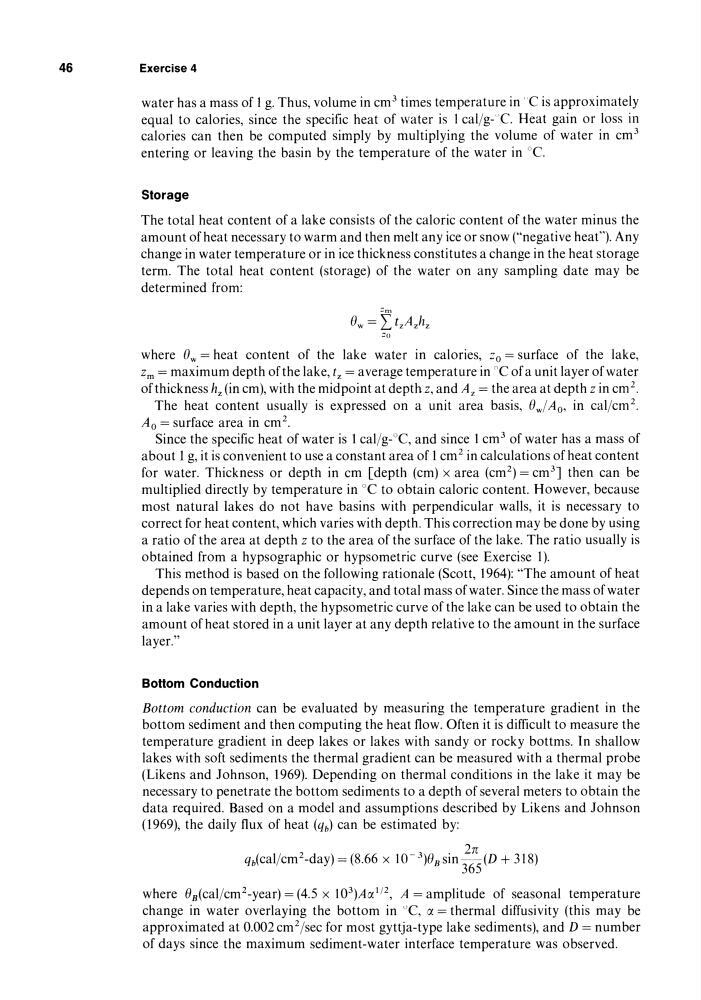
term. The total heat content (storage) of the water on any sampling date may be
determined from:
=0
where 8 w = heat content of the lake water in calories, 20 = surface of the lake,
Zm = maximum depth of the lake, t z = average temperature in nc of a unit layer of water
of thickness h z (in cm), with the midpoint at depth z, and A z = the area at depth Z in cm 2 .
The heat content usually is expressed on a unit area basis, 8w1 A 0' in cal/cm 2 .
Ao = surface area in cm 2 •
Since the specific heat of water is 1 cal/g-°c, and since 1 cm 3 of water has a mass of
about 1 g, it is convenient to use a constant area of 1 cm 2 in calculations of heat content
for water. Thickness or depth in cm [depth (cm) x area (cm 2 ) = cm 3 ] then can be
multiplied directly by temperature in °c to obtain caloric content. However, because
most natural lakes do not have basins with perpendicular walls, it is necessary to
correct for heat content, which varies with depth. This correction may be done by using
a ratio of the area at depth Z to the area of the surface of the lake. The ratio usually is
obtained from a hypsographic or hypsometric curve (see Exercise 1).
This method is based on the following rationale (Scott, 1964): 'The amount of heat
depends on temperature, heat capacity, and total mass of water. Since the mass of water
in a lake varies with depth, the hypsometric curve of the lake can be used to obtain the
amount of heat stored in a unit layer at any depth relative to the amount in the surface
layer."
Bottom Conduction
Bottom conduction can be evaluated by measuring the temperature gradient in the
bottom sediment and then computing the heat flow. Often it is difficult to measure the
temperature gradient in deep lakes or lakes with sandy or rocky bottms. In shallow
lakes with soft sediments the thermal gradient can be measured with a thermal probe
(Likens and Johnson, 1969). Depending on thermal conditions in the lake it may be
necessary to penetrate the bottom sediments to a depth of several meters to obtain the
data required. Based on a model and assumptions described by Likens and Johnson
(1969), the daily flux of heat (qb) can be estimated by:
qb(cal!cm 2 -day) = (8.66 x 10 - 3)8 B sin 3 2 Z5; (D + 318)
where 8 B (cal/cm 2 -year) = (4.5 x 10³)AO(l/2, A = amplitude of seasonal temperature
change in water overlaying the bottom in "c, 0( = thermal diffusivity (this may be
approximated at 0.002 cm 2 /sec for most gyttja-type lake sediments), and D = number
of days since the maximum sediment-water interface temperature was observed.
Exercise 4
water has a mass of 1 g. Thus, volume in cm 3 times temperature in C is approximately
equal to calories, since the specific heat of water is 1 cal/g-C. Heat gain or loss in
calories can then be computed simply by multiplying the volume of water in cm 3
entering or leaving the basin by the temperature of the water in "c.
Storage
The total heat content of a lake consists of the caloric content of the water minus the
amount of heat necessary to warm and then melt any ice or snow ("negative heat"). Any
change in water temperature or in ice thickness constitutes a change in the heat storage
term. The total heat content (storage) of the water on any sampling date may be
determined from:
=0
where 8 w = heat content of the lake water in calories, 20 = surface of the lake,
Zm = maximum depth of the lake, t z = average temperature in nc of a unit layer of water
of thickness h z (in cm), with the midpoint at depth z, and A z = the area at depth Z in cm 2 .
The heat content usually is expressed on a unit area basis, 8w1 A 0' in cal/cm 2 .
Ao = surface area in cm 2 •
Since the specific heat of water is 1 cal/g-°c, and since 1 cm 3 of water has a mass of
about 1 g, it is convenient to use a constant area of 1 cm 2 in calculations of heat content
for water. Thickness or depth in cm [depth (cm) x area (cm 2 ) = cm 3 ] then can be
multiplied directly by temperature in °c to obtain caloric content. However, because
most natural lakes do not have basins with perpendicular walls, it is necessary to
correct for heat content, which varies with depth. This correction may be done by using
a ratio of the area at depth Z to the area of the surface of the lake. The ratio usually is
obtained from a hypsographic or hypsometric curve (see Exercise 1).
This method is based on the following rationale (Scott, 1964): 'The amount of heat
depends on temperature, heat capacity, and total mass of water. Since the mass of water
in a lake varies with depth, the hypsometric curve of the lake can be used to obtain the
amount of heat stored in a unit layer at any depth relative to the amount in the surface
layer."
Bottom Conduction
Bottom conduction can be evaluated by measuring the temperature gradient in the
bottom sediment and then computing the heat flow. Often it is difficult to measure the
temperature gradient in deep lakes or lakes with sandy or rocky bottms. In shallow
lakes with soft sediments the thermal gradient can be measured with a thermal probe
(Likens and Johnson, 1969). Depending on thermal conditions in the lake it may be
necessary to penetrate the bottom sediments to a depth of several meters to obtain the
data required. Based on a model and assumptions described by Likens and Johnson
(1969), the daily flux of heat (qb) can be estimated by:
qb(cal!cm 2 -day) = (8.66 x 10 - 3)8 B sin 3 2 Z5; (D + 318)
where 8 B (cal/cm 2 -year) = (4.5 x 10³)AO(l/2, A = amplitude of seasonal temperature
change in water overlaying the bottom in "c, 0( = thermal diffusivity (this may be
approximated at 0.002 cm 2 /sec for most gyttja-type lake sediments), and D = number
of days since the maximum sediment-water interface temperature was observed.