

The Heat Budget of Lakes
45
year to year. Values are usually measured in cal/cm 2 , or langleys (I langley =
1 cal/cm Z ).
Often it is difficult, requires sophisticated equipment or both, to measure all of the
terms in the above equation (Fig. 4.1). Moreover, the addition of an ice and snow cover
presents special problems (Fig. 4.2). However, the largest terms, BR and B s , can be
measured readily, and several of the remaining terms can be estimated with some
reliability (see Johnson et aI., 1985).
Net Radiation
Net radiation can be measured directly by a net radiometer positioned over the
surface of the lake. These data can be recorded continuously. Alternatively, net
radiation may be estimated from
OR = (8s - 8r) + Oln
where Bs = total incoming short-wave radiation (~0.3 to 2.2/lm), 8r = radiation
reflected from the lake surface (albedo), and Oln = net long-wave radiation (~ 6.8 to
lOO/lm).
For our purposes, 8 s can be obtained from a nearby climatological station, and 8 r will
vary between about 3 and 90% of 8 s depending upon the nature of the lake surface
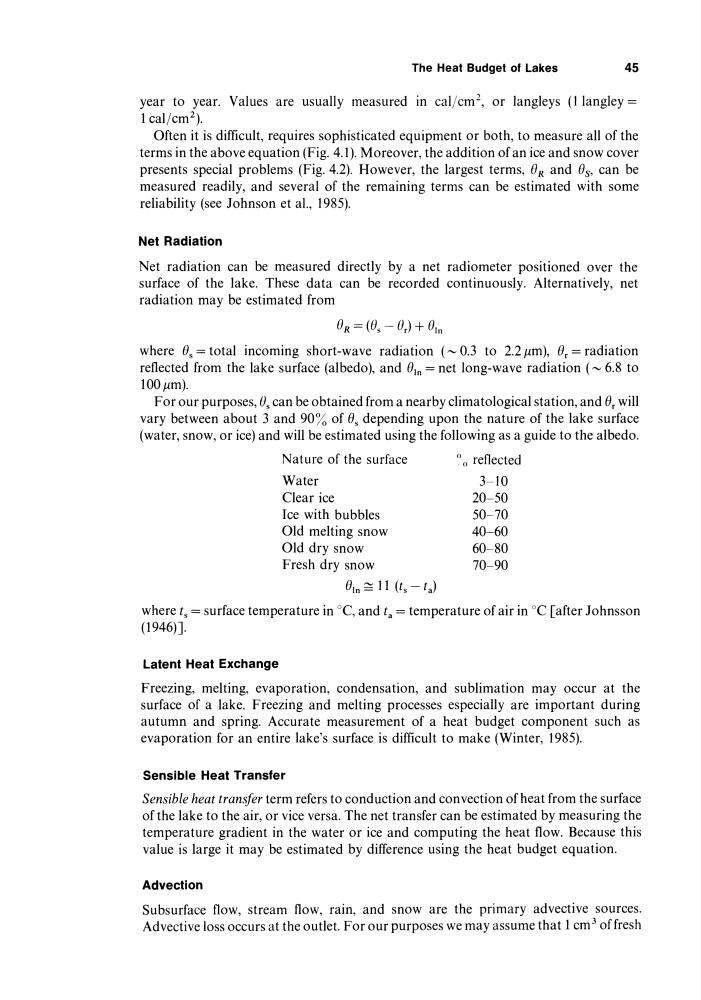
(water, snow, or ice) and will be estimated using the following as a guide to the albedo.
Nature of the surface
Water
Clear ice
Ice with bubbles
Old melting snow
Old dry snow
Fresh dry snow
81n~ 11 (ts-t a)
0" re/lected
3-10
20-50
50-70
40-60
60-80
70-90
where ts = surface temperature in °C, and ta = temperature of air in °C [after Johnsson
(1946)].
Latent Heat Exchange
Freezing, melting, evaporation, condensation, and sublimation may occur at the
surface of a lake. Freezing and melting processes especially are important during
autumn and spring. Accurate measurement of a heat budget component such as
evaporation for an entire lake's surface is difficult to make (Winter, 1985).
Sensible Heat Transfer
Sensible heat transfer term refers to conduction and convection of heat from the surface
of the lake to the air, or vice versa. The net transfer can be estimated by measuring the
temperature gradient in the water or ice and computing the heat /low. Because this
value is large it may be estimated by difference using the heat budget equation.
Advection
Subsurface /low, stream /low, rain, and snow are the primary advective sources.
Advective loss occurs at the outlet. For our purposes we may assume that 1 cm 3 offresh
45
year to year. Values are usually measured in cal/cm 2 , or langleys (I langley =
1 cal/cm Z ).
Often it is difficult, requires sophisticated equipment or both, to measure all of the
terms in the above equation (Fig. 4.1). Moreover, the addition of an ice and snow cover
presents special problems (Fig. 4.2). However, the largest terms, BR and B s , can be
measured readily, and several of the remaining terms can be estimated with some
reliability (see Johnson et aI., 1985).
Net Radiation
Net radiation can be measured directly by a net radiometer positioned over the
surface of the lake. These data can be recorded continuously. Alternatively, net
radiation may be estimated from
OR = (8s - 8r) + Oln
where Bs = total incoming short-wave radiation (~0.3 to 2.2/lm), 8r = radiation
reflected from the lake surface (albedo), and Oln = net long-wave radiation (~ 6.8 to
lOO/lm).
For our purposes, 8 s can be obtained from a nearby climatological station, and 8 r will
vary between about 3 and 90% of 8 s depending upon the nature of the lake surface
(water, snow, or ice) and will be estimated using the following as a guide to the albedo.
Nature of the surface
Water
Clear ice
Ice with bubbles
Old melting snow
Old dry snow
Fresh dry snow
81n~ 11 (ts-t a)
0" re/lected
3-10
20-50
50-70
40-60
60-80
70-90
where ts = surface temperature in °C, and ta = temperature of air in °C [after Johnsson
(1946)].
Latent Heat Exchange
Freezing, melting, evaporation, condensation, and sublimation may occur at the
surface of a lake. Freezing and melting processes especially are important during
autumn and spring. Accurate measurement of a heat budget component such as
evaporation for an entire lake's surface is difficult to make (Winter, 1985).
Sensible Heat Transfer
Sensible heat transfer term refers to conduction and convection of heat from the surface
of the lake to the air, or vice versa. The net transfer can be estimated by measuring the
temperature gradient in the water or ice and computing the heat /low. Because this
value is large it may be estimated by difference using the heat budget equation.
Advection
Subsurface /low, stream /low, rain, and snow are the primary advective sources.
Advective loss occurs at the outlet. For our purposes we may assume that 1 cm 3 offresh