

Physical Characteristics: Lake Models
35
the results in graphic form. Note the pronounced difference between the two situations
of no wind and wind. What do you infer about turbulence and vertical currents in the
thermocline region? Recall the dye trails you saw near the surface when catechol violet
crystals were first added (before the wind was introduced). How do you now explain
them?
4. Periods of internal seiches. The period of a seiche is the time required for an
oscillation to complete one cycle of up-and-down motion. You have determined such
periods for two separate situations, one with a high (near-surface) thermocline and the
other with a lower thermocline. Were the periods identical? Why?
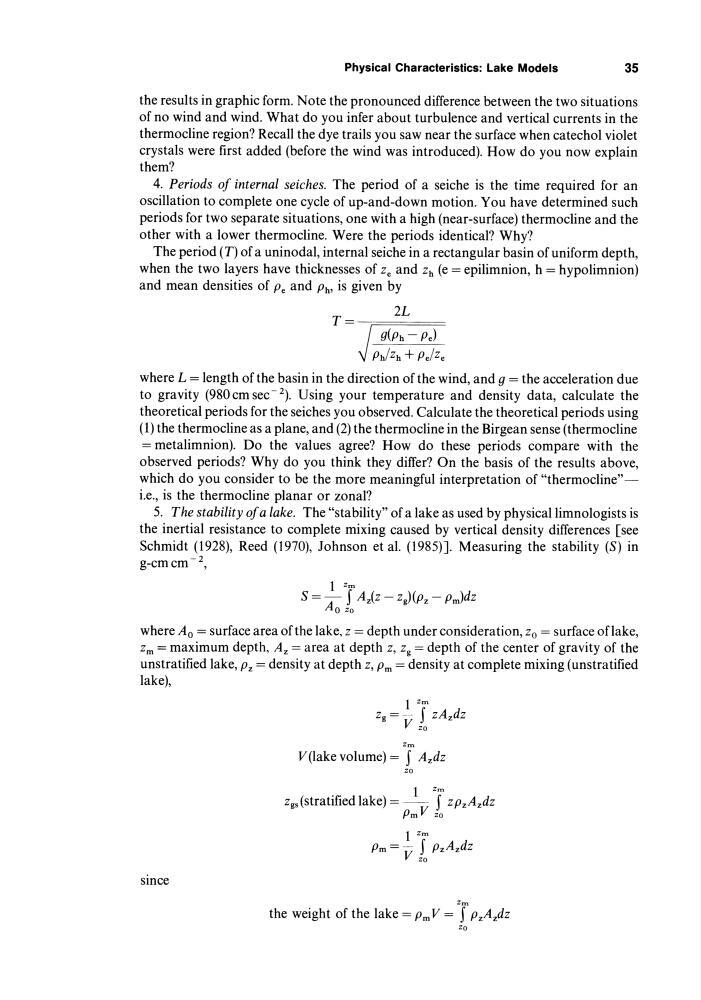
The period (T) of a uninodal, internal seiche in a rectangular basin of uniform depth,
when the two layers have thicknesses of Ze and Zh (e = epilimnion, h = hypolimnion)
and mean densities of Pe and Ph' is given by
2L
T=-;=====
g(Ph - Pe)
pJZh + Pe/ze
where L = length of the basin in the direction of the wind, and 9 = the acceleration due
to gravity (980cmsec- 2 ). Using your temperature and density data, calculate the
theoretical periods for the seiches you observed. Calculate the theoretical periods using
(1) the thermocline as a plane, and (2) the thermocline in the Birgean sense (thermocline
= metalimnion). Do the values agree? How do these periods compare with the
observed periods? Why do you think they differ? On the basis of the results above,
which do you consider to be the more meaningful interpretation of "thermocline"i.e., is the thermocline planar or zonal?
5. The stability of a lake. The "stability" of a lake as used by physicallimnologists is
the inertial resistance to complete mixing caused by vertical density differences [see
Schmidt (1928), Reed (1970), Johnson et al. (1985)]. Measuring the stability (S) in
g-cmcm- 2 ,
where Ao = surface area ofthe lake, Z = depth under consideration, Zo = surface oflake,
Zm = maximum depth, A z = area at depth z, Zg = depth of the center of gravity of the
unstratified lake, pz = density at depth z, Pm = density at complete mixing (unstratified
lake),
sInce
V (lake volume) = f Azdz
zo
1 Zm
zgs(stratifiedlake) = - - f zPzAzdz
Pm V zo
the weight of the lake = Pm V = zr pzAzdz
Zo
35
the results in graphic form. Note the pronounced difference between the two situations
of no wind and wind. What do you infer about turbulence and vertical currents in the
thermocline region? Recall the dye trails you saw near the surface when catechol violet
crystals were first added (before the wind was introduced). How do you now explain
them?
4. Periods of internal seiches. The period of a seiche is the time required for an
oscillation to complete one cycle of up-and-down motion. You have determined such
periods for two separate situations, one with a high (near-surface) thermocline and the
other with a lower thermocline. Were the periods identical? Why?
The period (T) of a uninodal, internal seiche in a rectangular basin of uniform depth,
when the two layers have thicknesses of Ze and Zh (e = epilimnion, h = hypolimnion)
and mean densities of Pe and Ph' is given by
2L
T=-;=====
g(Ph - Pe)
pJZh + Pe/ze
where L = length of the basin in the direction of the wind, and 9 = the acceleration due
to gravity (980cmsec- 2 ). Using your temperature and density data, calculate the
theoretical periods for the seiches you observed. Calculate the theoretical periods using
(1) the thermocline as a plane, and (2) the thermocline in the Birgean sense (thermocline
= metalimnion). Do the values agree? How do these periods compare with the
observed periods? Why do you think they differ? On the basis of the results above,
which do you consider to be the more meaningful interpretation of "thermocline"i.e., is the thermocline planar or zonal?
5. The stability of a lake. The "stability" of a lake as used by physicallimnologists is
the inertial resistance to complete mixing caused by vertical density differences [see
Schmidt (1928), Reed (1970), Johnson et al. (1985)]. Measuring the stability (S) in
g-cmcm- 2 ,
where Ao = surface area ofthe lake, Z = depth under consideration, Zo = surface oflake,
Zm = maximum depth, A z = area at depth z, Zg = depth of the center of gravity of the
unstratified lake, pz = density at depth z, Pm = density at complete mixing (unstratified
lake),
sInce
V (lake volume) = f Azdz
zo
1 Zm
zgs(stratifiedlake) = - - f zPzAzdz
Pm V zo
the weight of the lake = Pm V = zr pzAzdz
Zo