

372
Appendix 3
substance:
or
k' = index of absorption
n = index of refraction
), = wavelength (in vacuum)
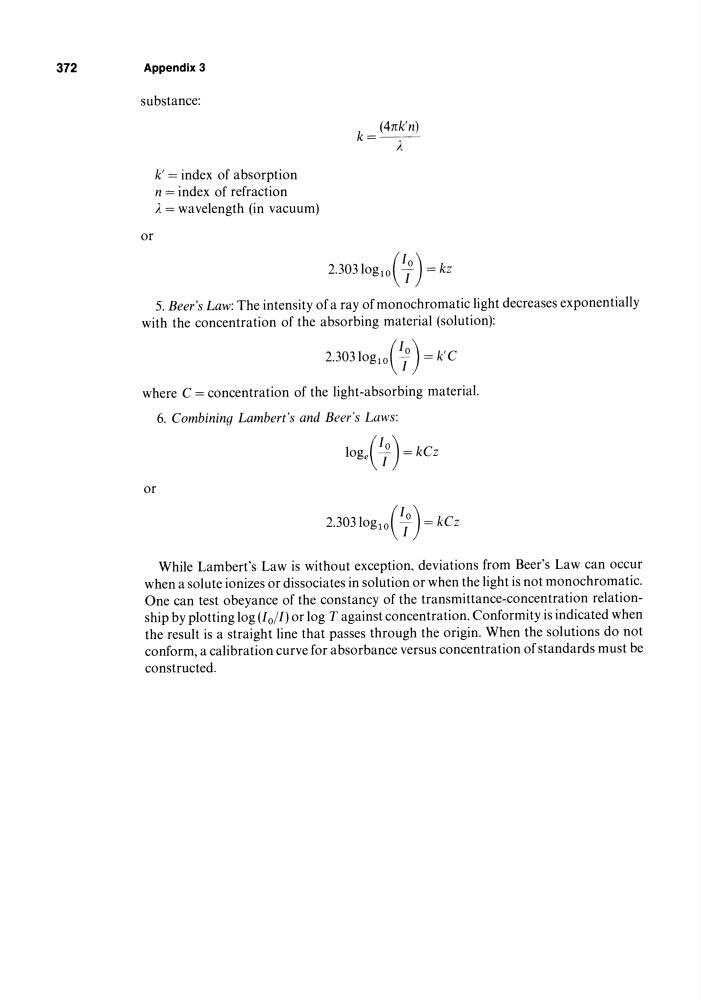
k = (4nk'n)
A
2.303 IOgIO( //0) = kz
5. Beer's Law: The intensity of a ray of monochromatic light decreases exponentially
with the concentration of the absorbing material (solution):
2.303 loglO ( /f ) = k' C
where C = concentration of the light-absorbing material.
6. Combining Lambert's and Beer's Laws:
[Oge( I/o ) = kCz
or
2.303 IOglO( I; ) = kCz
While Lambert's Law is without exception, deviations from Beer's Law can occur
when a solute ionizes or dissociates in solution or when the light is not monochromatic.
One can test obeyance of the constancy of the transmittance-concentration relationship by plotting log (/0/ I) or log T against concentration. Conformity is indicated when
the result is a straight line that passes through the origin. When the solutions do not
conform, a calibration curve for absorbance versus concentration of standards must be
constructed.
Appendix 3
substance:
or
k' = index of absorption
n = index of refraction
), = wavelength (in vacuum)
k = (4nk'n)
A
2.303 IOgIO( //0) = kz
5. Beer's Law: The intensity of a ray of monochromatic light decreases exponentially
with the concentration of the absorbing material (solution):
2.303 loglO ( /f ) = k' C
where C = concentration of the light-absorbing material.
6. Combining Lambert's and Beer's Laws:
[Oge( I/o ) = kCz
or
2.303 IOglO( I; ) = kCz
While Lambert's Law is without exception, deviations from Beer's Law can occur
when a solute ionizes or dissociates in solution or when the light is not monochromatic.
One can test obeyance of the constancy of the transmittance-concentration relationship by plotting log (/0/ I) or log T against concentration. Conformity is indicated when
the result is a straight line that passes through the origin. When the solutions do not
conform, a calibration curve for absorbance versus concentration of standards must be
constructed.