

APPENDIX 3
Useful Relationships Relative
to the Use of Colorimeters
and Spectrophotometers
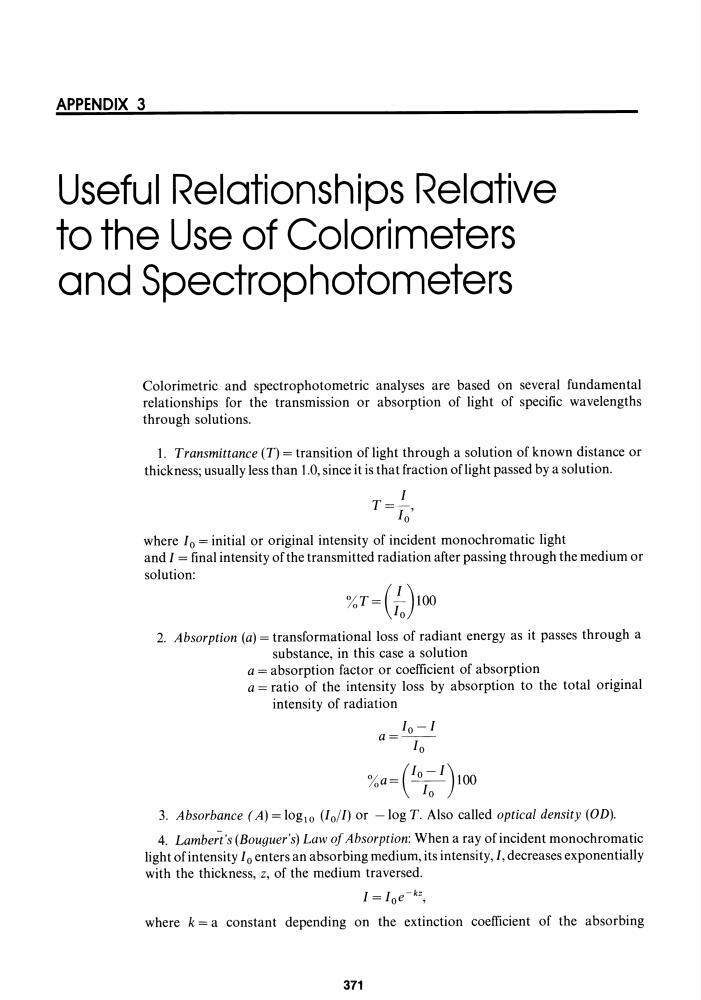
Colorimetric and spectrophotometric analyses are based on several fundamental
relationships for the transmission or absorption of light of specific wavelengths
through solutions.
1. Transmittance (T) = transition of light through a solution of known distance or
thickness; usually less than 1.0, since it is that fraction oflight passed by a solution.
I
T=- 10'
where 10 = initial or original intensity of incident monochromatic light
and I = final intensity of the transmitted radiation after passing through the medium or
solution:
%T=(:J100
2. Absorption (a) = transformational loss of radiant energy as it passes through a
substance, in this case a solution
a = absorption factor or coefficient of absorption
a = ratio of the intensity loss by absorption to the total original
intensity of radiation
10- 1
a=-- 10
%a= (/0/~ 1)100
3. Absorbance (A) = loglo (lo/I) or -log T. Also called optical density (OD).
4. Lambert's (Bouguer's) Law of Absorption: When a ray of incident monochromatic
light of intensity 10 enters an absorbing medium, its intensity, I, decreases exponentially
with the thickness, z, of the medium traversed.
where k = a constant depending on the extinction coefficient of the absorbing
371
Useful Relationships Relative
to the Use of Colorimeters
and Spectrophotometers
Colorimetric and spectrophotometric analyses are based on several fundamental
relationships for the transmission or absorption of light of specific wavelengths
through solutions.
1. Transmittance (T) = transition of light through a solution of known distance or
thickness; usually less than 1.0, since it is that fraction oflight passed by a solution.
I
T=- 10'
where 10 = initial or original intensity of incident monochromatic light
and I = final intensity of the transmitted radiation after passing through the medium or
solution:
%T=(:J100
2. Absorption (a) = transformational loss of radiant energy as it passes through a
substance, in this case a solution
a = absorption factor or coefficient of absorption
a = ratio of the intensity loss by absorption to the total original
intensity of radiation
10- 1
a=-- 10
%a= (/0/~ 1)100
3. Absorbance (A) = loglo (lo/I) or -log T. Also called optical density (OD).
4. Lambert's (Bouguer's) Law of Absorption: When a ray of incident monochromatic
light of intensity 10 enters an absorbing medium, its intensity, I, decreases exponentially
with the thickness, z, of the medium traversed.
where k = a constant depending on the extinction coefficient of the absorbing
371