

Estimates of Whole Lake Metabolism
351
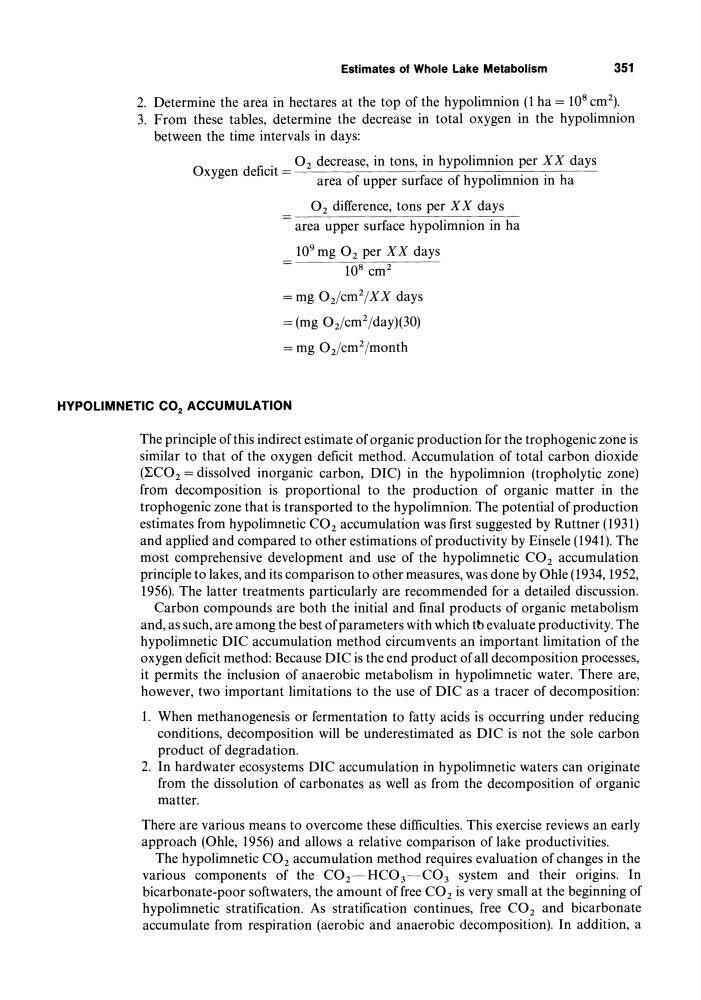
2. Determine the area in hectares at the top of the hypolimnion (1 ha = lOB cm 2 ).
3. From these tables, determine the decrease in total oxygen in the hypolimnion
between the time intervals in days:
. O 2 decrease, in tons, in hypolimnion per XX days
Oxygen deficIt =
f h r '
. h
area of upper surface 0 ypo Immon III a
O 2 difference, tons per XX days
area upper surface hypolimnion in ha
10 9 mg O 2 per X X days
10 8 cm 2
= mg 02/cm2/XX days
= (mg 02/cm2/day)(30)
= mg 02/cm2/month
HYPOLIMNETIC CO 2 ACCUMULATION
The principle of this indirect estimate of organic production for the trophogenic zone is
similar to that of the oxygen deficit method. Accumulation of total carbon dioxide
(LC0 2 = dissolved inorganic carbon, DIC) in the hypolimnion (tropholytic zone)
from decomposition is proportional to the production of organic matter in the
trophogenic zone that is transported to the hypolimnion. The potential of production
estimates from hypolimnetic CO 2 accumulation was first suggested by Ruttner (1931)
and applied and compared to other estimations of productivity by Einsele (1941). The
most comprehensive development and use of the hypolimnetic CO 2 accumulation
principle to lakes, and its comparison to other measures, was done by Ohle (1934, 1952,
1956). The latter treatments particularly are recommended for a detailed discussion.
Carbon compounds are both the initial and final products of organic metabolism
and, as such, are among the best of parameters with which tb evaluate productivity. The
hypolimnetic DIC accumulation method circumvents an important limitation of the
oxygen deficit method: Because DIC is the end product of all decomposition processes,
it permits the inclusion of anaerobic metabolism in hypolimnetic water. There are,
however, two important limitations to the use of DIC as a tracer of decomposition:
1. When methanogenesis or fermentation to fatty acids is occurring under reducing
conditions, decomposition will be underestimated as DIC is not the sole carbon
product of degradation.
2. In hardwater ecosystems DIC accumulation in hypolimnetic waters can originate
from the dissolution of carbonates as well as from the decomposition of organic
matter.
There are various means to overcome these difficulties. This exercise reviews an early
approach (Ohle, 1956) and allows a relative comparison of lake productivities.
The hypolimnetic CO 2 accumulation method requires evaluation of changes in the
various components of the CO 2 -HC0 3 -C0 3 system and their origins. In
bicarbonate-poor softwaters, the amount offree CO 2 is very small at the beginning of
hypolimnetic stratification. As stratification continues, free CO2 and bicarbonate
accumulate from respiration (aerobic and anaerobic decomposition). In addition, a
351
2. Determine the area in hectares at the top of the hypolimnion (1 ha = lOB cm 2 ).
3. From these tables, determine the decrease in total oxygen in the hypolimnion
between the time intervals in days:
. O 2 decrease, in tons, in hypolimnion per XX days
Oxygen deficIt =
f h r '
. h
area of upper surface 0 ypo Immon III a
O 2 difference, tons per XX days
area upper surface hypolimnion in ha
10 9 mg O 2 per X X days
10 8 cm 2
= mg 02/cm2/XX days
= (mg 02/cm2/day)(30)
= mg 02/cm2/month
HYPOLIMNETIC CO 2 ACCUMULATION
The principle of this indirect estimate of organic production for the trophogenic zone is
similar to that of the oxygen deficit method. Accumulation of total carbon dioxide
(LC0 2 = dissolved inorganic carbon, DIC) in the hypolimnion (tropholytic zone)
from decomposition is proportional to the production of organic matter in the
trophogenic zone that is transported to the hypolimnion. The potential of production
estimates from hypolimnetic CO 2 accumulation was first suggested by Ruttner (1931)
and applied and compared to other estimations of productivity by Einsele (1941). The
most comprehensive development and use of the hypolimnetic CO 2 accumulation
principle to lakes, and its comparison to other measures, was done by Ohle (1934, 1952,
1956). The latter treatments particularly are recommended for a detailed discussion.
Carbon compounds are both the initial and final products of organic metabolism
and, as such, are among the best of parameters with which tb evaluate productivity. The
hypolimnetic DIC accumulation method circumvents an important limitation of the
oxygen deficit method: Because DIC is the end product of all decomposition processes,
it permits the inclusion of anaerobic metabolism in hypolimnetic water. There are,
however, two important limitations to the use of DIC as a tracer of decomposition:
1. When methanogenesis or fermentation to fatty acids is occurring under reducing
conditions, decomposition will be underestimated as DIC is not the sole carbon
product of degradation.
2. In hardwater ecosystems DIC accumulation in hypolimnetic waters can originate
from the dissolution of carbonates as well as from the decomposition of organic
matter.
There are various means to overcome these difficulties. This exercise reviews an early
approach (Ohle, 1956) and allows a relative comparison of lake productivities.
The hypolimnetic CO 2 accumulation method requires evaluation of changes in the
various components of the CO 2 -HC0 3 -C0 3 system and their origins. In
bicarbonate-poor softwaters, the amount offree CO 2 is very small at the beginning of
hypolimnetic stratification. As stratification continues, free CO2 and bicarbonate
accumulate from respiration (aerobic and anaerobic decomposition). In addition, a