

350
Exercise 29
hypolimnetic changes. The advantages of these matter. The approaches treated here obviously
approaches are that they provide whole eco- are not applicable to lakes that do not stratify
system values and integrate diverse processes of or to those that are stratified permanently (i.e.,
production and decomposition of organic meromictic lakes).
COMPUTATION OF OXYGEN DEFICITS
The amount of oxygen lost from the hypolimnion of a thermally stratified dimictic lake
during the summer stratification period is a useful relative measure oflake productivity
[cf., Wetzel, 1983)]. The difference in amount of oxygen present below a given depth at
the beginning and at the end of the stratification period is referred to as the oxygen
deficit. Although there are several possible procedures for the computation of the
oxygen deficit, the basic method is to calculate the total quantity of oxygen in the
hypolimnion on two dates. The difference in oxygen content then is expressed as a rate
of oxygen change per cm 2 of hypolimnetic surface.
Procedures
1. Collect samples of water at close intervals of depth in a stratified lake soon after the
onset of stratification and determine the dissolved oxygen concentrations. Repeat
after time intervals of about three to four weeks, preferably throughout the period of
stratification. The method cannot be used when a portion of the hypolimnion
becomes anaerobic.
2. From the bathymetric map ofthe lake under study, determine the area and volume
of water strata for small depth intervals (cf., Exercise 1).
3. Establish the boundary of the hypolimnion during the period from vertical profiles
of temperature [see Fig. 6.3 of Wetzel (1983, p. 75)].
Calculations
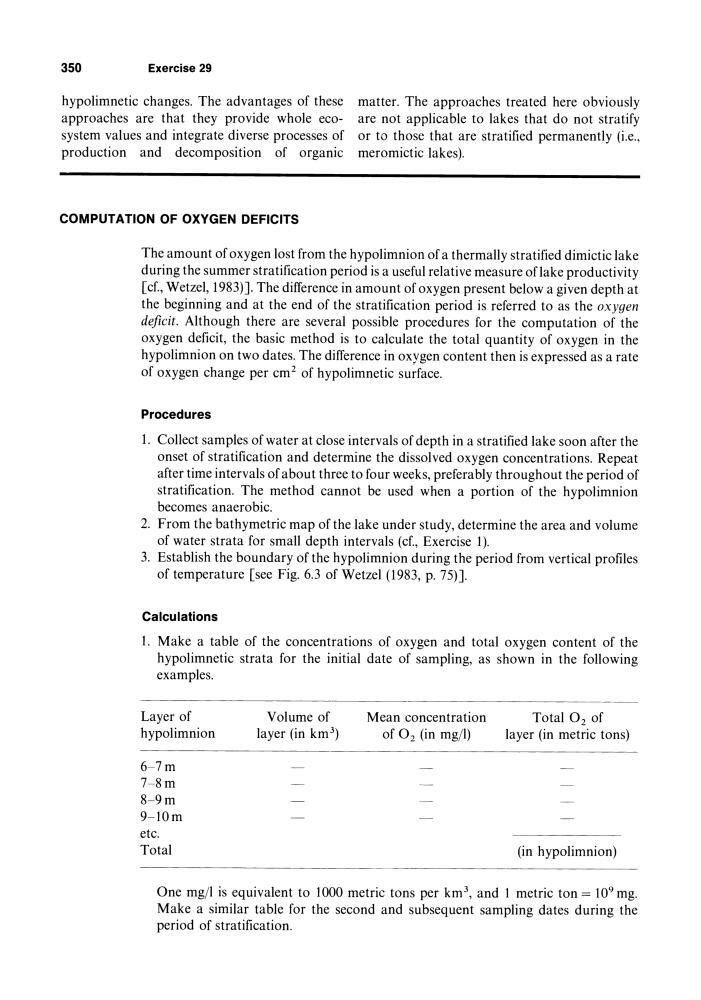
1. Make a table of the concentrations of oxygen and total oxygen content of the
hypolimnetic strata for the initial date of sampling, as shown in the following
examples.
Layer of
hypolimnion
6-7m
7-8m
8-9m
9-10m
etc.
Total
Volume of
layer (in km 3 )
Mean concentration
of O 2 (in mg/l)
Total O 2 of
layer (in metric tons)
(in hypolimnion)
One mgjl is equivalent to 1000 metric tons per km 3 , and 1 metric ton = 10 9 mg.
Make a similar table for the second and subsequent sampling dates during the
period of stratification.
Exercise 29
hypolimnetic changes. The advantages of these matter. The approaches treated here obviously
approaches are that they provide whole eco- are not applicable to lakes that do not stratify
system values and integrate diverse processes of or to those that are stratified permanently (i.e.,
production and decomposition of organic meromictic lakes).
COMPUTATION OF OXYGEN DEFICITS
The amount of oxygen lost from the hypolimnion of a thermally stratified dimictic lake
during the summer stratification period is a useful relative measure oflake productivity
[cf., Wetzel, 1983)]. The difference in amount of oxygen present below a given depth at
the beginning and at the end of the stratification period is referred to as the oxygen
deficit. Although there are several possible procedures for the computation of the
oxygen deficit, the basic method is to calculate the total quantity of oxygen in the
hypolimnion on two dates. The difference in oxygen content then is expressed as a rate
of oxygen change per cm 2 of hypolimnetic surface.
Procedures
1. Collect samples of water at close intervals of depth in a stratified lake soon after the
onset of stratification and determine the dissolved oxygen concentrations. Repeat
after time intervals of about three to four weeks, preferably throughout the period of
stratification. The method cannot be used when a portion of the hypolimnion
becomes anaerobic.
2. From the bathymetric map ofthe lake under study, determine the area and volume
of water strata for small depth intervals (cf., Exercise 1).
3. Establish the boundary of the hypolimnion during the period from vertical profiles
of temperature [see Fig. 6.3 of Wetzel (1983, p. 75)].
Calculations
1. Make a table of the concentrations of oxygen and total oxygen content of the
hypolimnetic strata for the initial date of sampling, as shown in the following
examples.
Layer of
hypolimnion
6-7m
7-8m
8-9m
9-10m
etc.
Total
Volume of
layer (in km 3 )
Mean concentration
of O 2 (in mg/l)
Total O 2 of
layer (in metric tons)
(in hypolimnion)
One mgjl is equivalent to 1000 metric tons per km 3 , and 1 metric ton = 10 9 mg.
Make a similar table for the second and subsequent sampling dates during the
period of stratification.