

Experimental Manipulation of Model Ecosystems
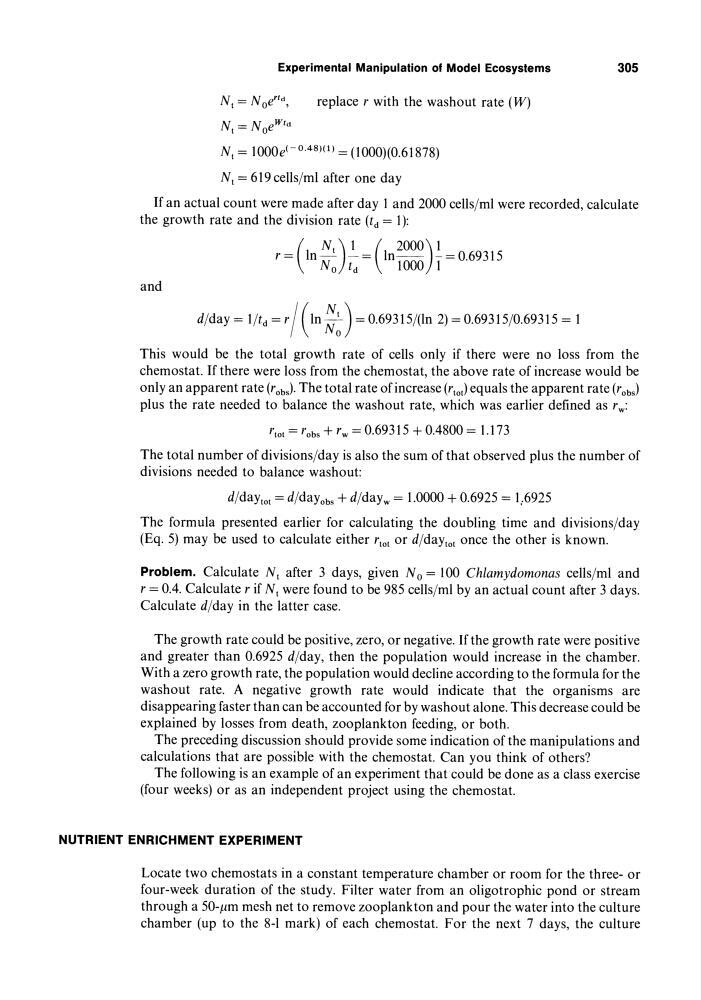
Nt = Noe rtd ,
Nt = Noe Wtd
replace r with the washout rate (W)
Nt = 1000e(-O.48)(1) = (1000)(0.61878)
Nt = 619cells/ml after one day
305
If an actual count were made after day 1 and 2000 cells/ml were recorded, calculate
the growth rate and the division rate (td = 1):
r= In- -= In-- -=0.69315
( Nt) 1 ( 2000) 1
No td
1000 1
and
d/day = l/td = r I (In Z: ) = 0.69315/(ln 2) = 0.69315/0.69315 = 1
This would be the total growth rate of cells only if there were no loss from the
chemostat. If there were loss from the chemostat, the above rate of increase would be
only an apparent rate (robs)' The total rate of increase (r tot ) equals the apparent rate (robs)
plus the rate needed to balance the washout rate, which was earlier defined as r w:
rtot = robs + r w = 0.69315 + 0.4800 = 1.173
The total number of divisions/day is also the sum of that observed plus the number of
divisions needed to balance washout:
d/daYtot = d/daYobs + d/dayw = 1.0000 + 0.6925 = 1,.6925
The formula presented earlier for calculating the doubling time and divisions/day
(Eq. 5) may be used to calculate either rtot or d/daYtot once the other is known.
Problem. Calculate Nt after 3 days, given No = 100 Chlamydomonas cells/ml and
r = 0.4. Calculate r if Nt were found to be 985 cells/ml by an actual count after 3 days.
Calculate d/day in the latter case.
The growth rate could be positive, zero, or negative. If the growth rate were positive
and greater than 0.6925 d/day, then the population would increase in the chamber.
With a zero growth rate, the population would decline according to the formula for the
washout rate. A negative growth rate would indicate that the organisms are
disappearing faster than can be accounted for by washout alone. This decrease could be
explained by losses from death, zooplankton feeding, or both.
The preceding discussion should provide some indication of the manipulations and
calculations that are possible with the chemostat. Can you think of others?
The following is an example of an experiment that could be done as a class exercise
(four weeks) or as an independent project using the chemostat.
NUTRIENT ENRICHMENT EXPERIMENT
Locate two chemostats in a constant temperature chamber or room for the three- or
four-week duration of the study. Filter water from an oligotrophic pond or stream
through a 50-,um mesh net to remove zooplankton and pour the water into the culture
chamber (up to the 8-1 mark) of each chemos tat. For the next 7 days, the culture
Nt = Noe rtd ,
Nt = Noe Wtd
replace r with the washout rate (W)
Nt = 1000e(-O.48)(1) = (1000)(0.61878)
Nt = 619cells/ml after one day
305
If an actual count were made after day 1 and 2000 cells/ml were recorded, calculate
the growth rate and the division rate (td = 1):
r= In- -= In-- -=0.69315
( Nt) 1 ( 2000) 1
No td
1000 1
and
d/day = l/td = r I (In Z: ) = 0.69315/(ln 2) = 0.69315/0.69315 = 1
This would be the total growth rate of cells only if there were no loss from the
chemostat. If there were loss from the chemostat, the above rate of increase would be
only an apparent rate (robs)' The total rate of increase (r tot ) equals the apparent rate (robs)
plus the rate needed to balance the washout rate, which was earlier defined as r w:
rtot = robs + r w = 0.69315 + 0.4800 = 1.173
The total number of divisions/day is also the sum of that observed plus the number of
divisions needed to balance washout:
d/daYtot = d/daYobs + d/dayw = 1.0000 + 0.6925 = 1,.6925
The formula presented earlier for calculating the doubling time and divisions/day
(Eq. 5) may be used to calculate either rtot or d/daYtot once the other is known.
Problem. Calculate Nt after 3 days, given No = 100 Chlamydomonas cells/ml and
r = 0.4. Calculate r if Nt were found to be 985 cells/ml by an actual count after 3 days.
Calculate d/day in the latter case.
The growth rate could be positive, zero, or negative. If the growth rate were positive
and greater than 0.6925 d/day, then the population would increase in the chamber.
With a zero growth rate, the population would decline according to the formula for the
washout rate. A negative growth rate would indicate that the organisms are
disappearing faster than can be accounted for by washout alone. This decrease could be
explained by losses from death, zooplankton feeding, or both.
The preceding discussion should provide some indication of the manipulations and
calculations that are possible with the chemostat. Can you think of others?
The following is an example of an experiment that could be done as a class exercise
(four weeks) or as an independent project using the chemostat.
NUTRIENT ENRICHMENT EXPERIMENT
Locate two chemostats in a constant temperature chamber or room for the three- or
four-week duration of the study. Filter water from an oligotrophic pond or stream
through a 50-,um mesh net to remove zooplankton and pour the water into the culture
chamber (up to the 8-1 mark) of each chemos tat. For the next 7 days, the culture