

304
Exercise 23
The actual concentration of dissolved inorganic phosphorus (P0 4 -P) will differ from
this theoretical value owing to a number of factors, including uptake and assimilation
by organisms in the chamber, precipitation or absorption after entering the chamber,
and existing concentration in the chamber at time O. With some of these factors
measured, others can be calculated. For example, the uptake rate of a particular
nutrient (N, P, K, Zn, and so on) by the organisms can be determined by comparing the
theoretical concentration with the actual concentration, the difference being the
amount taken up, assuming no precipitation or absorption.
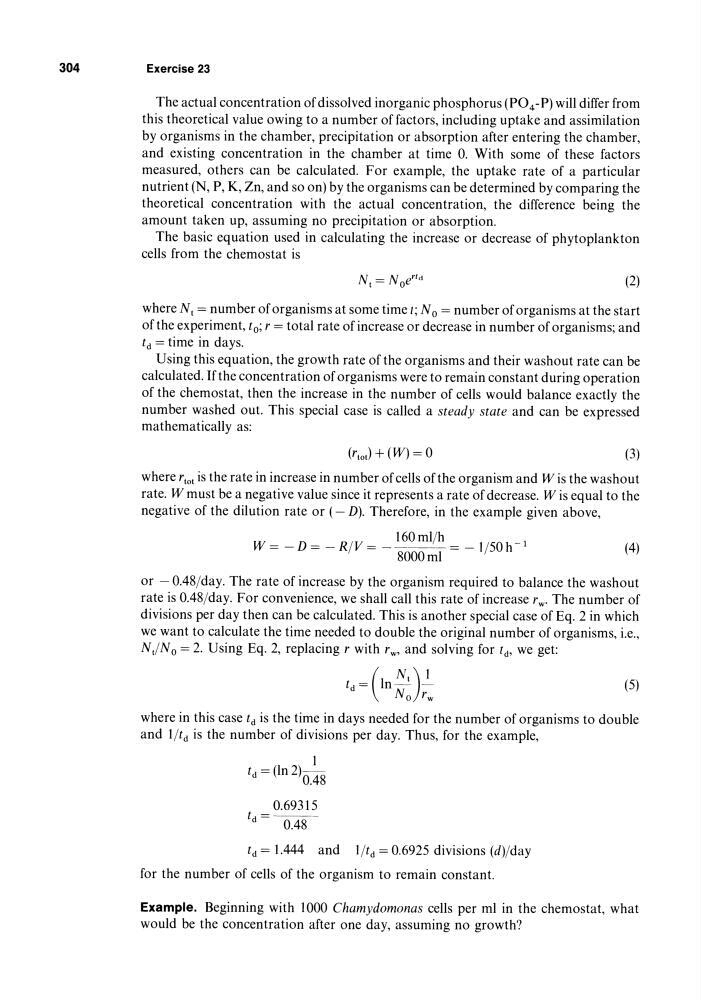
The basic equation used in calculating the increase or decrease of phytoplankton
cells from the chemostat is
(2)
where Nt = number of organisms at some time I; No = number of organisms at the start
of the experiment, to; r = total rate of increase or decrease in number of organisms; and
td = time in days.
Using this equation, the growth rate of the organisms and their washout rate can be
calculated. If the concentration of organisms were to remain constant during operation
of the chemostat, then the increase in the number of cells would balance exactly the
number washed out. This special case is called a steady state and can be expressed
mathematically as:
(3)
where rtot is the rate in increase in number of cells ofthe organism and W is the washout
rate. W must be a negative value since it represents a rate of decrease. W is equal to the
negative of the dilution rate or ( - D). Therefore, in the example given above,
W= -D= -RjV= _160mljh = -lj50h- 1
8000ml
(4)
or - 0.48jday. The rate of increase by the organism required to balance the washout
rate is 0.48jday. For convenience, we shall call this rate of increase r W' The number of
divisions per day then can be calculated. This is another special case of Eq. 2 in which
we want to calculate the time needed to double the original number of organisms, i.e.,
N IN 0 = 2. Using Eq. 2, replacing r with r W' and solving for t d , we get:
td = (In !!~)~
(5)
No rw
where in this case td is the time in days needed for the number of organisms to double
and Ijtd is the number of divisions per day. Thus, for the example,
1
td = (In 2) 0.48
0.69315
td = 0.48
td = 1.444 and 1jtd = 0.6925 divisions (d)jday
for the number of cells of the organism to remain constant.
Example. Beginning with 1000 Chamydomonas cells per ml in the chemostat, what
would be the concentration after one day, assuming no growth?
Exercise 23
The actual concentration of dissolved inorganic phosphorus (P0 4 -P) will differ from
this theoretical value owing to a number of factors, including uptake and assimilation
by organisms in the chamber, precipitation or absorption after entering the chamber,
and existing concentration in the chamber at time O. With some of these factors
measured, others can be calculated. For example, the uptake rate of a particular
nutrient (N, P, K, Zn, and so on) by the organisms can be determined by comparing the
theoretical concentration with the actual concentration, the difference being the
amount taken up, assuming no precipitation or absorption.
The basic equation used in calculating the increase or decrease of phytoplankton
cells from the chemostat is
(2)
where Nt = number of organisms at some time I; No = number of organisms at the start
of the experiment, to; r = total rate of increase or decrease in number of organisms; and
td = time in days.
Using this equation, the growth rate of the organisms and their washout rate can be
calculated. If the concentration of organisms were to remain constant during operation
of the chemostat, then the increase in the number of cells would balance exactly the
number washed out. This special case is called a steady state and can be expressed
mathematically as:
(3)
where rtot is the rate in increase in number of cells ofthe organism and W is the washout
rate. W must be a negative value since it represents a rate of decrease. W is equal to the
negative of the dilution rate or ( - D). Therefore, in the example given above,
W= -D= -RjV= _160mljh = -lj50h- 1
8000ml
(4)
or - 0.48jday. The rate of increase by the organism required to balance the washout
rate is 0.48jday. For convenience, we shall call this rate of increase r W' The number of
divisions per day then can be calculated. This is another special case of Eq. 2 in which
we want to calculate the time needed to double the original number of organisms, i.e.,
N IN 0 = 2. Using Eq. 2, replacing r with r W' and solving for t d , we get:
td = (In !!~)~
(5)
No rw
where in this case td is the time in days needed for the number of organisms to double
and Ijtd is the number of divisions per day. Thus, for the example,
1
td = (In 2) 0.48
0.69315
td = 0.48
td = 1.444 and 1jtd = 0.6925 divisions (d)jday
for the number of cells of the organism to remain constant.
Example. Beginning with 1000 Chamydomonas cells per ml in the chemostat, what
would be the concentration after one day, assuming no growth?