

262
Exercise 19
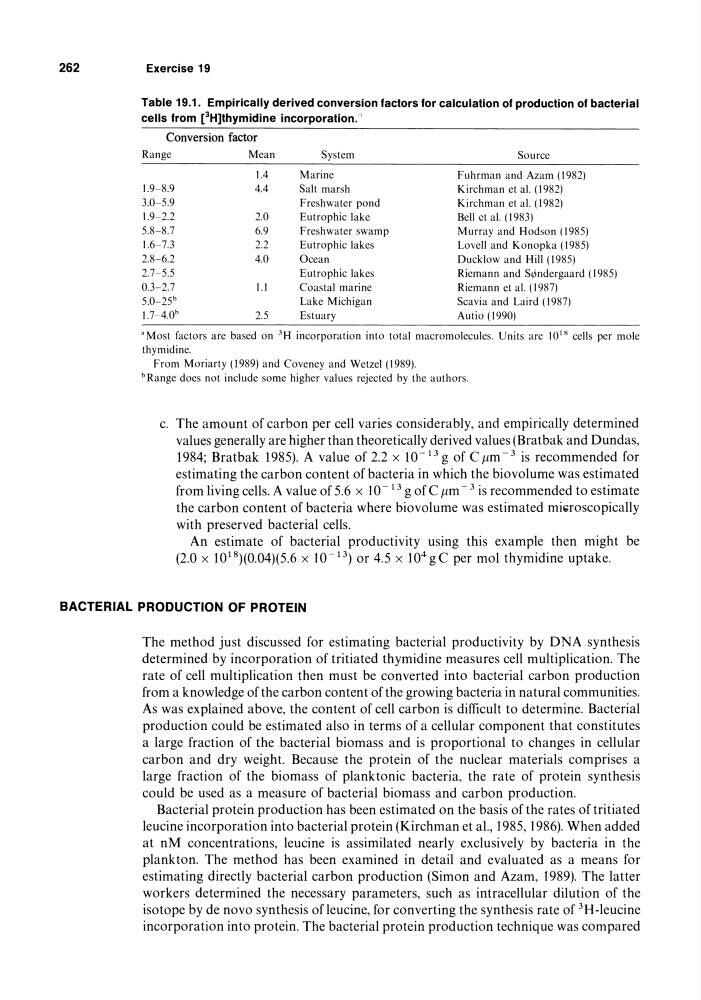
Table 19.1. Empirically derived conversion factors for calculation of production of bacterial
cells from [3H]thymidine incorporation.'
Conversion factor
Range
Mean
System
Source
1.4
Marine
Fuhrman and Azam (1982)
1.9-8.9
4.4
Salt marsh
Kirchman et al. (1982)
3.0-5.9
Freshwater pond
Kirchman et al. (1982)
1.9-2.2
2.0
Eutrophic lake
Bell ct al. (1983)
5.8-8.7
6.9
Freshwater swamp
Murray and Hodson (1985)
1.6-7.3
2.2
Eutrophic lakes
Lovell and Konopka (1985)
2.8-6.2
4.0
Ocean
Ducklow and Hill (1985)
2.7-5.5
Eutrophic lakes
Riemann and S¢ndergaard (1985)
0.3-2.7
1.1
Coastal marine
Riemann ct al. (1987)
5.0-25"
Lake Michigan
Scavia and Laird (1987)
1.7_4.0h
2.5
Estuary
Autio (1990)
"Most factors arc based on 3H incorporation into total macromolecules. Units arc lotH eells per mole
thymidine.
From Moriarty (1989) and Coveney and Wetzel (1989).
"Range does not include some higher values rejected by the authors.
c. The amount of carbon per cell varies considerably, and empirically determined
values generally are higher than theoretically derived values (Bratbak and Dundas,
1984; Bratbak 1985). A value of 2.2 x 10- 13 g of C ,urn - 3 is recommended for
estimating the carbon content of bacteria in which the biovolume was estimated
from living cells. A value of 5.6 x 10- 13 g of C ,urn - 3 is recommended to estimate
the carbon content of bacteria where biovolume was estimated miGroscopically
with preserved bacterial cells.
An estimate of bacterial productivity using this example then might be
(2.0 x 10 18 )(0.04)(5.6 x 10- 13 ) or 4.5 x 10 4 g C per mol thymidine uptake.
BACTERIAL PRODUCTION OF PROTEIN
The method just discussed for estimating bacterial productivity by DNA synthesis
determined by incorporation of tritiated thymidine measures cell multiplication. The
rate of cell multiplication then must be converted into bacterial carbon production
from a knowledge of the carbon content of the growing bacteria in natural communities.
As was explained above, the content of cell carbon is difficult to determine. Bacterial
production could be estimated also in terms of a cellular component that constitutes
a large fraction of the bacterial biomass and is proportional to changes in cellular
carbon and dry weight. Because the protein of the nuclear materials comprises a
large fraction of the biomass of planktonic bacteria, the rate of protein synthesis
could be used as a measure of bacterial biomass and carbon production.
Bacterial protein production has been estimated on the basis of the rates of tritiated
leucine incorporation into bacterial protein (Kirchman et ai., 1985, 1986). When added
at nM concentrations, leucine is assimilated nearly exclusively by bacteria in the
plankton. The method has been examined in detail and evaluated as a means for
estimating directly bacterial carbon production (Simon and Azam, 1989). The latter
workers determined the necessary parameters, such as intracellular dilution of the
isotope by de novo synthesis of leucine, for converting the synthesis rate of 3H-leucine
incorporation into protein. The bacterial protein production technique was compared
Exercise 19
Table 19.1. Empirically derived conversion factors for calculation of production of bacterial
cells from [3H]thymidine incorporation.'
Conversion factor
Range
Mean
System
Source
1.4
Marine
Fuhrman and Azam (1982)
1.9-8.9
4.4
Salt marsh
Kirchman et al. (1982)
3.0-5.9
Freshwater pond
Kirchman et al. (1982)
1.9-2.2
2.0
Eutrophic lake
Bell ct al. (1983)
5.8-8.7
6.9
Freshwater swamp
Murray and Hodson (1985)
1.6-7.3
2.2
Eutrophic lakes
Lovell and Konopka (1985)
2.8-6.2
4.0
Ocean
Ducklow and Hill (1985)
2.7-5.5
Eutrophic lakes
Riemann and S¢ndergaard (1985)
0.3-2.7
1.1
Coastal marine
Riemann ct al. (1987)
5.0-25"
Lake Michigan
Scavia and Laird (1987)
1.7_4.0h
2.5
Estuary
Autio (1990)
"Most factors arc based on 3H incorporation into total macromolecules. Units arc lotH eells per mole
thymidine.
From Moriarty (1989) and Coveney and Wetzel (1989).
"Range does not include some higher values rejected by the authors.
c. The amount of carbon per cell varies considerably, and empirically determined
values generally are higher than theoretically derived values (Bratbak and Dundas,
1984; Bratbak 1985). A value of 2.2 x 10- 13 g of C ,urn - 3 is recommended for
estimating the carbon content of bacteria in which the biovolume was estimated
from living cells. A value of 5.6 x 10- 13 g of C ,urn - 3 is recommended to estimate
the carbon content of bacteria where biovolume was estimated miGroscopically
with preserved bacterial cells.
An estimate of bacterial productivity using this example then might be
(2.0 x 10 18 )(0.04)(5.6 x 10- 13 ) or 4.5 x 10 4 g C per mol thymidine uptake.
BACTERIAL PRODUCTION OF PROTEIN
The method just discussed for estimating bacterial productivity by DNA synthesis
determined by incorporation of tritiated thymidine measures cell multiplication. The
rate of cell multiplication then must be converted into bacterial carbon production
from a knowledge of the carbon content of the growing bacteria in natural communities.
As was explained above, the content of cell carbon is difficult to determine. Bacterial
production could be estimated also in terms of a cellular component that constitutes
a large fraction of the bacterial biomass and is proportional to changes in cellular
carbon and dry weight. Because the protein of the nuclear materials comprises a
large fraction of the biomass of planktonic bacteria, the rate of protein synthesis
could be used as a measure of bacterial biomass and carbon production.
Bacterial protein production has been estimated on the basis of the rates of tritiated
leucine incorporation into bacterial protein (Kirchman et ai., 1985, 1986). When added
at nM concentrations, leucine is assimilated nearly exclusively by bacteria in the
plankton. The method has been examined in detail and evaluated as a means for
estimating directly bacterial carbon production (Simon and Azam, 1989). The latter
workers determined the necessary parameters, such as intracellular dilution of the
isotope by de novo synthesis of leucine, for converting the synthesis rate of 3H-leucine
incorporation into protein. The bacterial protein production technique was compared