

250
Exercise 18
1. Plot the estimates versus trial number. In those trials in which the estimate appears
to stabilize (Fig. 18.2), the proportion marked in the population can be estimated
as the proportion marked in the samples (R/S).
2. Plot the estimate versus the proportion marked in the sample (Fig. 18.3). Again,
the desired proportion of the population marked to obtain a stable estimate can
be approximated from the proportion of the sample that is marked.
CONFIDENCE INTERVALS ABOUT THE ESTIMATED POPULATION SIZE
Petersen Method
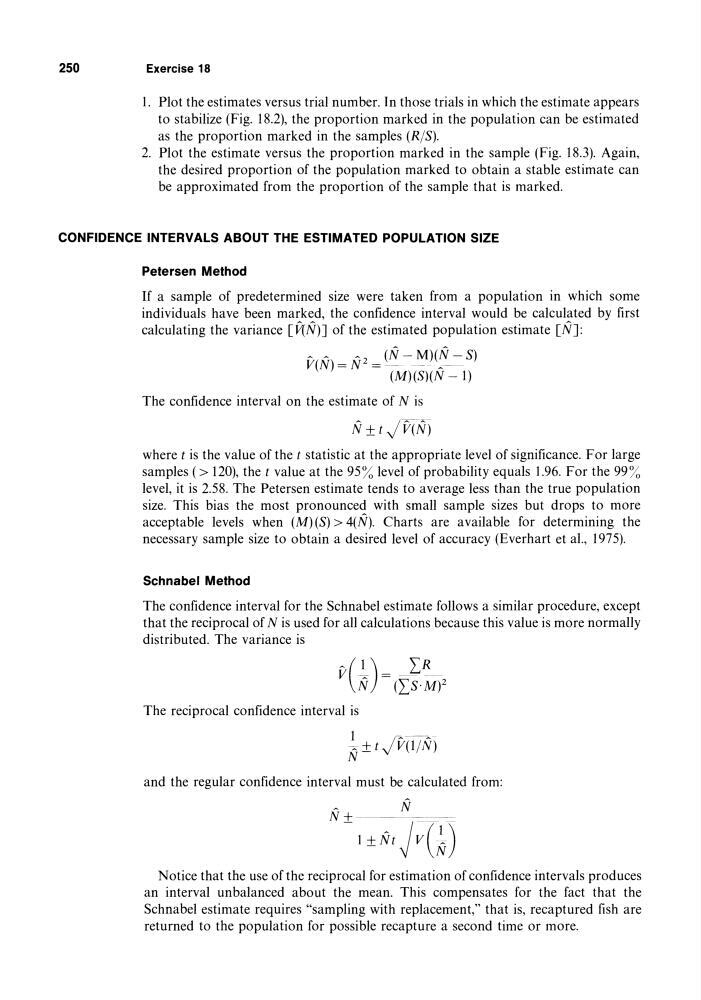
If a sample of predetermined size were taken from a population in which some
individuals have been marked, the confidence interval would be calculated by first
calculating the variance [MN)] of the estimated population estimate [N]:
~ ~
~ 2 (N ~ M)(N ~ S)
V(N) = N =---- ~-(M)(S)(N ~ 1)
The confidence interval on the estimate of N is
N±tJV(N)
where t is the value of the t statistic at the appropriate level of significance. For large
samples (> 120), the t value at the 95% level of probability equals 1.96. For the 99%
level, it is 2.58. The Petersen estimate tends to average less than the true population
size. This bias the most pronounced with small sample sizes but drops to more
acceptable levels when (M) (S) > 4(N). Charts are available for determining the
necessary sample size to obtain a desired level of accuracy (Everhart et ai., 1975).
Schnabel Method
The confidence interval for the Schnabel estimate follows a similar procedure, except
that the reciprocal of N is used for all calculations because this value is more normally
distributed. The variance is
The reciprocal confidence interval is
1
- - -
N ± t JV(1/N)
and the regular confidence interval must be calculated from:
N
N+~1±NtJV(~)
Notice that the use of the reciprocal for estimation of confidence intervals prod uces
an interval unbalanced about the mean. This compensates for the fact that the
Schnabel estimate requires "sampling with replacement," that is, recaptured fish are
returned to the population for possible recapture a second time or more.
Exercise 18
1. Plot the estimates versus trial number. In those trials in which the estimate appears
to stabilize (Fig. 18.2), the proportion marked in the population can be estimated
as the proportion marked in the samples (R/S).
2. Plot the estimate versus the proportion marked in the sample (Fig. 18.3). Again,
the desired proportion of the population marked to obtain a stable estimate can
be approximated from the proportion of the sample that is marked.
CONFIDENCE INTERVALS ABOUT THE ESTIMATED POPULATION SIZE
Petersen Method
If a sample of predetermined size were taken from a population in which some
individuals have been marked, the confidence interval would be calculated by first
calculating the variance [MN)] of the estimated population estimate [N]:
~ ~
~ 2 (N ~ M)(N ~ S)
V(N) = N =---- ~-(M)(S)(N ~ 1)
The confidence interval on the estimate of N is
N±tJV(N)
where t is the value of the t statistic at the appropriate level of significance. For large
samples (> 120), the t value at the 95% level of probability equals 1.96. For the 99%
level, it is 2.58. The Petersen estimate tends to average less than the true population
size. This bias the most pronounced with small sample sizes but drops to more
acceptable levels when (M) (S) > 4(N). Charts are available for determining the
necessary sample size to obtain a desired level of accuracy (Everhart et ai., 1975).
Schnabel Method
The confidence interval for the Schnabel estimate follows a similar procedure, except
that the reciprocal of N is used for all calculations because this value is more normally
distributed. The variance is
The reciprocal confidence interval is
1
- - -
N ± t JV(1/N)
and the regular confidence interval must be calculated from:
N
N+~1±NtJV(~)
Notice that the use of the reciprocal for estimation of confidence intervals prod uces
an interval unbalanced about the mean. This compensates for the fact that the
Schnabel estimate requires "sampling with replacement," that is, recaptured fish are
returned to the population for possible recapture a second time or more.