

Enumeration of Fish or Other Aquatic Animals
249
SCHUMACHER-ESCHMEYER METHOD
If a population were to be sampled indefinitely using a mark-and-recapture technique,
eventually all of the fish in the population would become marked. Keeping this in mind,
and using the proportion of fish marked in a sample as an estimate of the proportion
of fish marked in the population, the total number of fish in a population (i.e., the
number of fish marked when 100% of the population is marked) can be estimated
(after several trials). This approach is done by constructing a Schumacher-Eschmeyer
plot (Fig. 18.1). Note that, in this plot, any factor that changes the slope of the
regression line will change the population estimate. Thus, an increase in slope will
result in a lower population estimate, while a decrease in slope will result in a higher
estimate. In the case of "trap-happy" animals, a greater proportion of marked animals
are seen in the sample. This problem would increase the slope of the line and thus
decrease the population estimate.
RELIABILITY OF POPULATION ESTIMATES
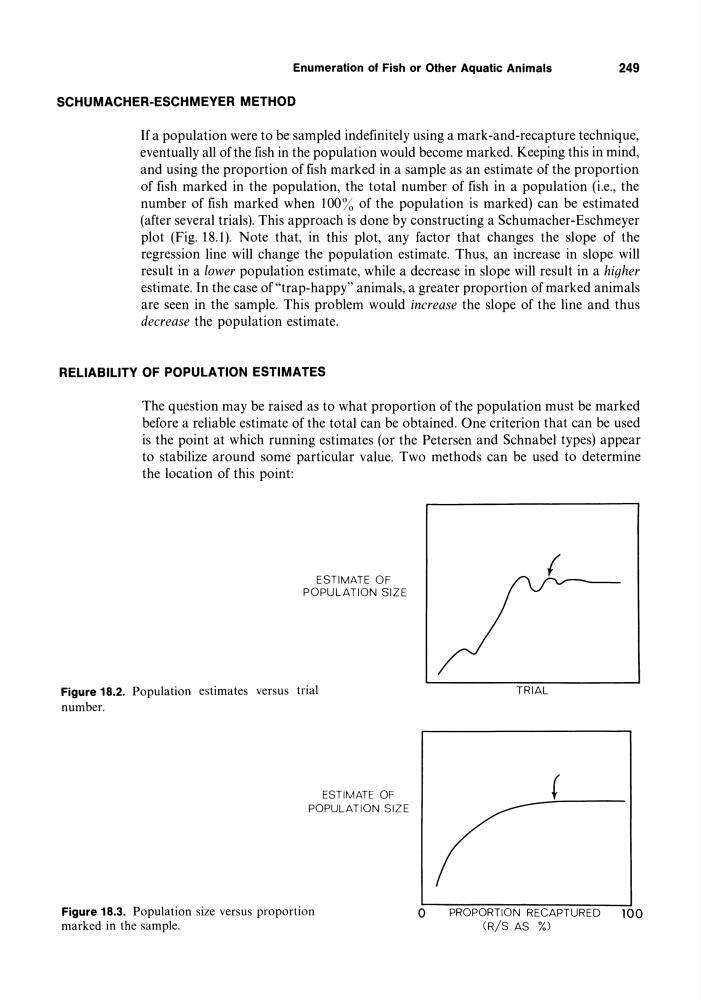
The question may be raised as to what proportion of the population must be marked
before a reliable estimate of the total can be obtained. One criterion that can be used
is the point at which running estimates (or the Petersen and Schnabel types) appear
to stabilize around some particular value. Two methods can be used to determine
the location of this point:
ESTIMATE OF
POPULATION SIZE
Figure 18.2. Population estimates versus trial
number.
ESTIMATE OF
POPULATION SIZE
Figure 18.3. Population size versus proportion
marked in the sample.
a PROPORTION RECAPTURED 100
(R/S AS %)
249
SCHUMACHER-ESCHMEYER METHOD
If a population were to be sampled indefinitely using a mark-and-recapture technique,
eventually all of the fish in the population would become marked. Keeping this in mind,
and using the proportion of fish marked in a sample as an estimate of the proportion
of fish marked in the population, the total number of fish in a population (i.e., the
number of fish marked when 100% of the population is marked) can be estimated
(after several trials). This approach is done by constructing a Schumacher-Eschmeyer
plot (Fig. 18.1). Note that, in this plot, any factor that changes the slope of the
regression line will change the population estimate. Thus, an increase in slope will
result in a lower population estimate, while a decrease in slope will result in a higher
estimate. In the case of "trap-happy" animals, a greater proportion of marked animals
are seen in the sample. This problem would increase the slope of the line and thus
decrease the population estimate.
RELIABILITY OF POPULATION ESTIMATES
The question may be raised as to what proportion of the population must be marked
before a reliable estimate of the total can be obtained. One criterion that can be used
is the point at which running estimates (or the Petersen and Schnabel types) appear
to stabilize around some particular value. Two methods can be used to determine
the location of this point:
ESTIMATE OF
POPULATION SIZE
Figure 18.2. Population estimates versus trial
number.
ESTIMATE OF
POPULATION SIZE
Figure 18.3. Population size versus proportion
marked in the sample.
a PROPORTION RECAPTURED 100
(R/S AS %)