

236
Exercise 16
half on the following day, i.e., the number of
individuals in a given stage will be inversely
proportional to the duration of that stage. It is
assumed that the animals have a uniform age
distribution, which is not always the case.
future population size of the species can be
predicted on the basis of its present population
structure and size, observed size-specific production of eggs, and certain assumed or known
information on biomass and survival. This
procedure will be demonstrated using Daphnia.
For precise results, detailed information on birth,
growth rates, and mortality would be required
for each species under investigation.
The objective of this exercise is to construct a
realistic, logical model of zooplankton production. The model then can be used to estimate
the production of a sample zooplankton species
over a given time interval. By this means, the
PROCEDURES
1. From a large reservoir of a very well-mixed, nearly monospecific population of
Daphnia, collect a sample of known volume (approximately 11). Pass the sample
through a stacked series of screens of known mesh size to separate the zooplankton
into four or more size categories [e.g., large (>2.0mm in length), medium «2.0
to > 1.5 mm), small « 1.5 to > 1.0 mm), and very small « 1.0 mm)]. Carefully
wash all zooplankton from the screens into labeled petri dishes. Each student or
pair of students should obtain size-fractionated samples in this manner.
2. The more live animals, the better the results that are obtained; disregard any dead
(inactive) animals. When time does not permit immediate analysis, preserve with
a cold (ca. 6°C) mixture of 40 gil sucrose and 4% formalin to prevent carapace
distortion and loss of eggs (Haney and Hall, 1973; Prepas, 1978).
3. Enumerate the Daphnia in each of the size categories. When your sample contains
more than 100 individuals in a size group, count the number of Daphnia in several
subsamples (see Exercise 11). Calculate the number per liter in each size category
for the total sample volume.
4. Determine the average length of the carapace (head to base of anal spine) of each
size category and estimate the biomass by:
Dry wt (mg) = (0.0052)(mm)3.012
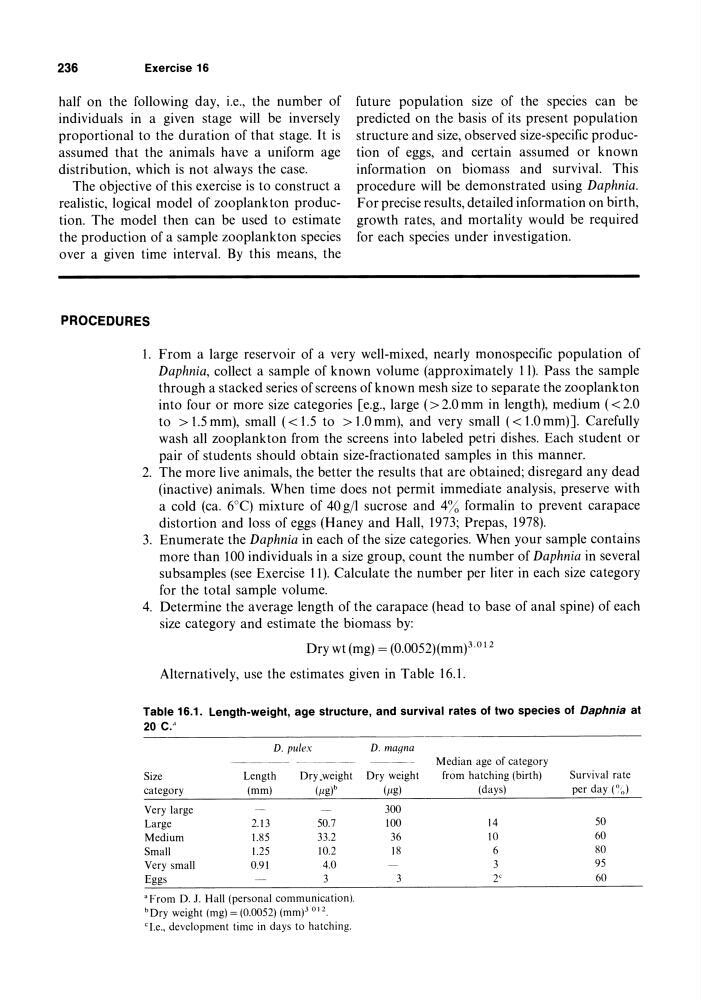
Alternatively, use the estimates given in Table 16.1.
Table 16.1. Length-weight, age structure, and survival rates of two species of Daphnia at
20C."
D. pulex
Size
Length
Dry.weight
category
(mm)
(Ilg)b
Very large
Large
2.13
50.7
Medium
1.85
33.2
Small
1.25
10.2
Very small
0.91
4.0
Eggs
3
a From D. J. Hall (personal communication).
bDry weight (mg) = (0.0052) (mm)3 012
cI.e., development time in days to hatching.
D. magna
Dry weight
(Ilg)
300
100
36
18
3
Median age of category
from hatching (birth)
(days)
14
10
6
3
2'
Survival rate
per day C,~)
50
60
80
95
60
Exercise 16
half on the following day, i.e., the number of
individuals in a given stage will be inversely
proportional to the duration of that stage. It is
assumed that the animals have a uniform age
distribution, which is not always the case.
future population size of the species can be
predicted on the basis of its present population
structure and size, observed size-specific production of eggs, and certain assumed or known
information on biomass and survival. This
procedure will be demonstrated using Daphnia.
For precise results, detailed information on birth,
growth rates, and mortality would be required
for each species under investigation.
The objective of this exercise is to construct a
realistic, logical model of zooplankton production. The model then can be used to estimate
the production of a sample zooplankton species
over a given time interval. By this means, the
PROCEDURES
1. From a large reservoir of a very well-mixed, nearly monospecific population of
Daphnia, collect a sample of known volume (approximately 11). Pass the sample
through a stacked series of screens of known mesh size to separate the zooplankton
into four or more size categories [e.g., large (>2.0mm in length), medium «2.0
to > 1.5 mm), small « 1.5 to > 1.0 mm), and very small « 1.0 mm)]. Carefully
wash all zooplankton from the screens into labeled petri dishes. Each student or
pair of students should obtain size-fractionated samples in this manner.
2. The more live animals, the better the results that are obtained; disregard any dead
(inactive) animals. When time does not permit immediate analysis, preserve with
a cold (ca. 6°C) mixture of 40 gil sucrose and 4% formalin to prevent carapace
distortion and loss of eggs (Haney and Hall, 1973; Prepas, 1978).
3. Enumerate the Daphnia in each of the size categories. When your sample contains
more than 100 individuals in a size group, count the number of Daphnia in several
subsamples (see Exercise 11). Calculate the number per liter in each size category
for the total sample volume.
4. Determine the average length of the carapace (head to base of anal spine) of each
size category and estimate the biomass by:
Dry wt (mg) = (0.0052)(mm)3.012
Alternatively, use the estimates given in Table 16.1.
Table 16.1. Length-weight, age structure, and survival rates of two species of Daphnia at
20C."
D. pulex
Size
Length
Dry.weight
category
(mm)
(Ilg)b
Very large
Large
2.13
50.7
Medium
1.85
33.2
Small
1.25
10.2
Very small
0.91
4.0
Eggs
3
a From D. J. Hall (personal communication).
bDry weight (mg) = (0.0052) (mm)3 012
cI.e., development time in days to hatching.
D. magna
Dry weight
(Ilg)
300
100
36
18
3
Median age of category
from hatching (birth)
(days)
14
10
6
3
2'
Survival rate
per day C,~)
50
60
80
95
60