

Zooplankton Feeding
229
4. At the beginning of the experiment, remove an aliquot (e.g., 1 ml) of the algal or
yeast cell suspension for radioassay. Filter onto a membrane filter for radio assay
with scintillation procedures (see Exercise 14 and below).
5. At the end of the incubation period, kill the zooplankton immediately by bringing
the culture solutions to a boil (use a vented hood). Then remove the zooplankton
from the media by filtration through fine-meshed sieves as instructed (see Exercise
11). Wash the zooplankton rapidly with a small volume of water and place them
with fine forceps and dissecting needles into containers suitable for counting the
radioactive disintegrations. Transfer the zooplankton directly to scintillation vials
and solubilize with an appropriate solubilizer reagent (see "Apparatus and
Supplies," p. 232).
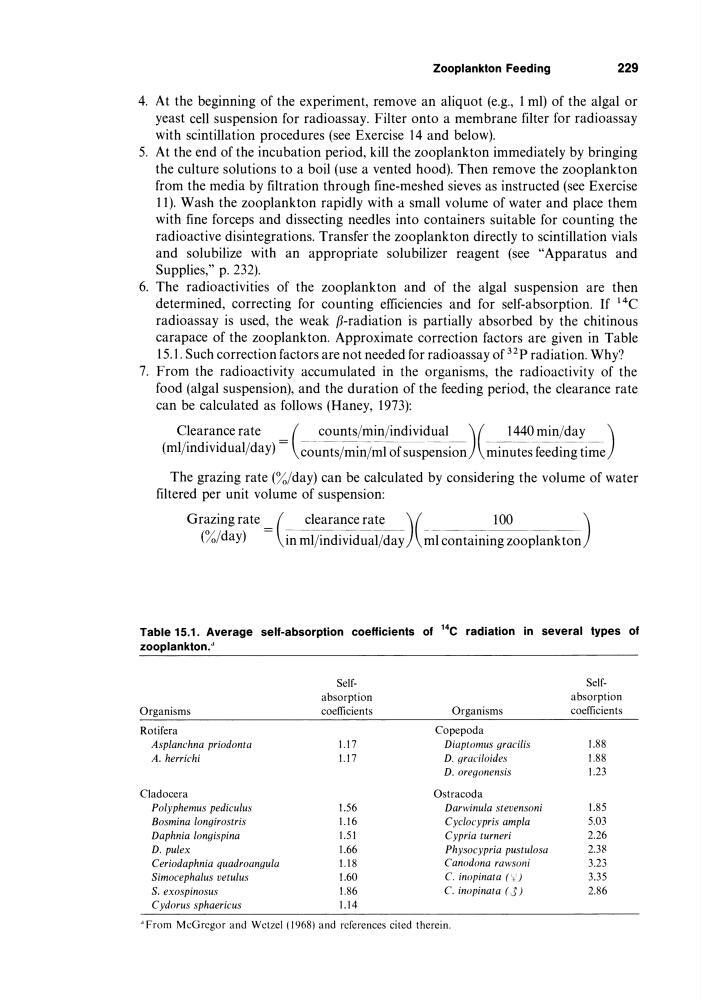
6. The radioactivities of the zooplankton and of the algal suspension are then
determined, correcting for counting efficiencies and for self-absorption. If 14C
radioassay is used, the weak f3-radiation is partially absorbed by the chitinous
carapace of the zooplankton. Approximate correction factors are given in Table
15.1. Such correction factors are not needed for radioassay of 32p radiation. Why?
7. From the radioactivity accumulated in the organisms, the radioactivity of the
food (algal suspension), and the duration of the feeding period, the clearance rate
can be calculated as follows (Haney, 1973):
Clearance rate
(counts/min/individual) (
1440 min/day
)
(mljindividual/day) = ~~~nts/min7~l of suspension minutes feeding time
The grazing rate (%/day) can be calculated by considering the volume of water
filtered per unit volume of suspension:
Grazing rate (
clearance rate
) (
100
)
(%/day) = in ~l/indi;Tdual/day ~l containing zooplankton
Table 15.1. Average self-absorption coefficients of 14C radiation in several types of
zooplankton:'
Selfabsorption
absorption
Organisms
coefficients
Organisms
coefficients
Rotifera
Copepoda
Asplanchna priodonta
1.17
Diaptomus gracilis
1.88
A. herrichi
1.17
D. qraci!oides
1.88
D. oregonensis
1.23
Cladocera
Ostracoda
Polyphemus pediculus
1.56
Darwinula stevensoni
1.85
Bosmina longirostris
1.16
Cyciocypris ampla
5.03
Daphnia longispina
1.51
Cypria turneri
2.26
D. pulex
1.66
Physocypria pustu!osa
2.38
Ceriodaphnia quadroangula
1.18
Canodona rawsoni
3.23
Simocephalus vetulus
1.60
C. inopinata ('!')
3.35
S. exospinosus
1.86
C. inopinata (J)
2.86
Cydorus sphaericus
1.14
., From McGregor and Wetzel (1968) and references cited therein.
229
4. At the beginning of the experiment, remove an aliquot (e.g., 1 ml) of the algal or
yeast cell suspension for radioassay. Filter onto a membrane filter for radio assay
with scintillation procedures (see Exercise 14 and below).
5. At the end of the incubation period, kill the zooplankton immediately by bringing
the culture solutions to a boil (use a vented hood). Then remove the zooplankton
from the media by filtration through fine-meshed sieves as instructed (see Exercise
11). Wash the zooplankton rapidly with a small volume of water and place them
with fine forceps and dissecting needles into containers suitable for counting the
radioactive disintegrations. Transfer the zooplankton directly to scintillation vials
and solubilize with an appropriate solubilizer reagent (see "Apparatus and
Supplies," p. 232).
6. The radioactivities of the zooplankton and of the algal suspension are then
determined, correcting for counting efficiencies and for self-absorption. If 14C
radioassay is used, the weak f3-radiation is partially absorbed by the chitinous
carapace of the zooplankton. Approximate correction factors are given in Table
15.1. Such correction factors are not needed for radioassay of 32p radiation. Why?
7. From the radioactivity accumulated in the organisms, the radioactivity of the
food (algal suspension), and the duration of the feeding period, the clearance rate
can be calculated as follows (Haney, 1973):
Clearance rate
(counts/min/individual) (
1440 min/day
)
(mljindividual/day) = ~~~nts/min7~l of suspension minutes feeding time
The grazing rate (%/day) can be calculated by considering the volume of water
filtered per unit volume of suspension:
Grazing rate (
clearance rate
) (
100
)
(%/day) = in ~l/indi;Tdual/day ~l containing zooplankton
Table 15.1. Average self-absorption coefficients of 14C radiation in several types of
zooplankton:'
Selfabsorption
absorption
Organisms
coefficients
Organisms
coefficients
Rotifera
Copepoda
Asplanchna priodonta
1.17
Diaptomus gracilis
1.88
A. herrichi
1.17
D. qraci!oides
1.88
D. oregonensis
1.23
Cladocera
Ostracoda
Polyphemus pediculus
1.56
Darwinula stevensoni
1.85
Bosmina longirostris
1.16
Cyciocypris ampla
5.03
Daphnia longispina
1.51
Cypria turneri
2.26
D. pulex
1.66
Physocypria pustu!osa
2.38
Ceriodaphnia quadroangula
1.18
Canodona rawsoni
3.23
Simocephalus vetulus
1.60
C. inopinata ('!')
3.35
S. exospinosus
1.86
C. inopinata (J)
2.86
Cydorus sphaericus
1.14
., From McGregor and Wetzel (1968) and references cited therein.