

228
Exercise 15
PARTICLE REMOVAL
1. Fill small breakers with algal cells or yeast uniformly mixed in a known volume
of water.
2. Determine the initial cell concentrations (see Exercise 10).
3. Add a known number of zooplankton to each container and incubate at room
temperature under constant light for a known period of time. Maintain a control
to which no zooplankton is added.
4. Manipulate food types, food particle concentrations, zooplankton types and
concentrations, and environmental parameters as discussed below.
5. Determine the final concentrations of food cells.
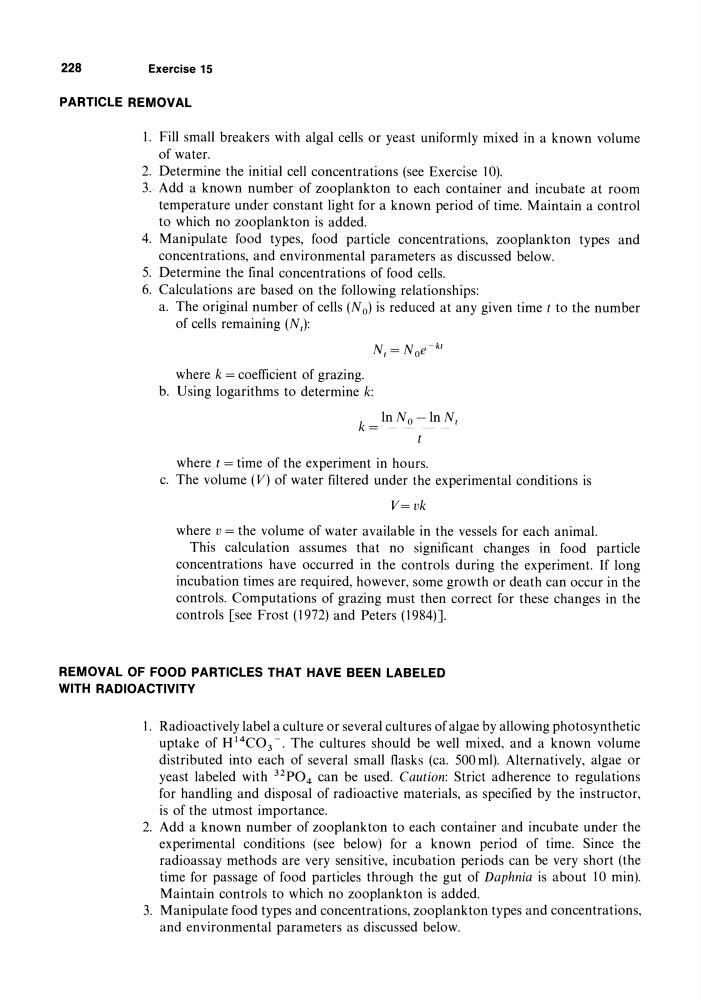
6. Calculations are based on the following relationships:
a. The original number of cells (No) is reduced at any given time t to the number
of cells remaining (Nt):
where k = coefficient of grazing.
b. Using logarithms to determine k:
k = l~ l\T~ -_~n !it
t
where t = time of the experiment in hours.
c. The volume (V) of water filtered under the experimental conditions is
V=vk
where v = the volume of water available in the vessels for each animal.
This calculation assumes that no significant changes in food particle
concentrations have occurred in the controls during the experiment. If long
incubation times are required, however, some growth or death can occur in the
controls. Computations of grazing must then correct for these changes in the
controls [see Frost (1972) and Peters (1984)].
REMOVAL OF FOOD PARTICLES THAT HAVE BEEN LABELED
WITH RADIOACTIVITY
1. Radioactively label a culture or several cultures of algae by allowing photosynthetic
uptake of H 14 C0 3 -. The cultures should be well mixed, and a known volume
distributed into each of several small flasks (ca. 500 ml). Alternatively, algae or
yeast labeled with 32P04 can be used. Caution: Strict adherence to regulations
for handling and disposal of radioactive materials, as specified by the instructor,
is of the utmost importance.
2. Add a known number of zooplankton to each container and incubate under the
experimental conditions (see below) for a known period of time. Since the
radioassay methods are very sensitive, incubation periods can be very short (the
time for passage of food particles through the gut of Daphnia is about 10 min).
Maintain controls to which no zooplankton is added.
3. Manipulate food types and concentrations, zooplankton types and concentrations,
and environmental parameters as discussed below.
Exercise 15
PARTICLE REMOVAL
1. Fill small breakers with algal cells or yeast uniformly mixed in a known volume
of water.
2. Determine the initial cell concentrations (see Exercise 10).
3. Add a known number of zooplankton to each container and incubate at room
temperature under constant light for a known period of time. Maintain a control
to which no zooplankton is added.
4. Manipulate food types, food particle concentrations, zooplankton types and
concentrations, and environmental parameters as discussed below.
5. Determine the final concentrations of food cells.
6. Calculations are based on the following relationships:
a. The original number of cells (No) is reduced at any given time t to the number
of cells remaining (Nt):
where k = coefficient of grazing.
b. Using logarithms to determine k:
k = l~ l\T~ -_~n !it
t
where t = time of the experiment in hours.
c. The volume (V) of water filtered under the experimental conditions is
V=vk
where v = the volume of water available in the vessels for each animal.
This calculation assumes that no significant changes in food particle
concentrations have occurred in the controls during the experiment. If long
incubation times are required, however, some growth or death can occur in the
controls. Computations of grazing must then correct for these changes in the
controls [see Frost (1972) and Peters (1984)].
REMOVAL OF FOOD PARTICLES THAT HAVE BEEN LABELED
WITH RADIOACTIVITY
1. Radioactively label a culture or several cultures of algae by allowing photosynthetic
uptake of H 14 C0 3 -. The cultures should be well mixed, and a known volume
distributed into each of several small flasks (ca. 500 ml). Alternatively, algae or
yeast labeled with 32P04 can be used. Caution: Strict adherence to regulations
for handling and disposal of radioactive materials, as specified by the instructor,
is of the utmost importance.
2. Add a known number of zooplankton to each container and incubate under the
experimental conditions (see below) for a known period of time. Since the
radioassay methods are very sensitive, incubation periods can be very short (the
time for passage of food particles through the gut of Daphnia is about 10 min).
Maintain controls to which no zooplankton is added.
3. Manipulate food types and concentrations, zooplankton types and concentrations,
and environmental parameters as discussed below.