

188
Exercise 12
8000r----.----,----.,----.----,
STD. AREA
N
6000
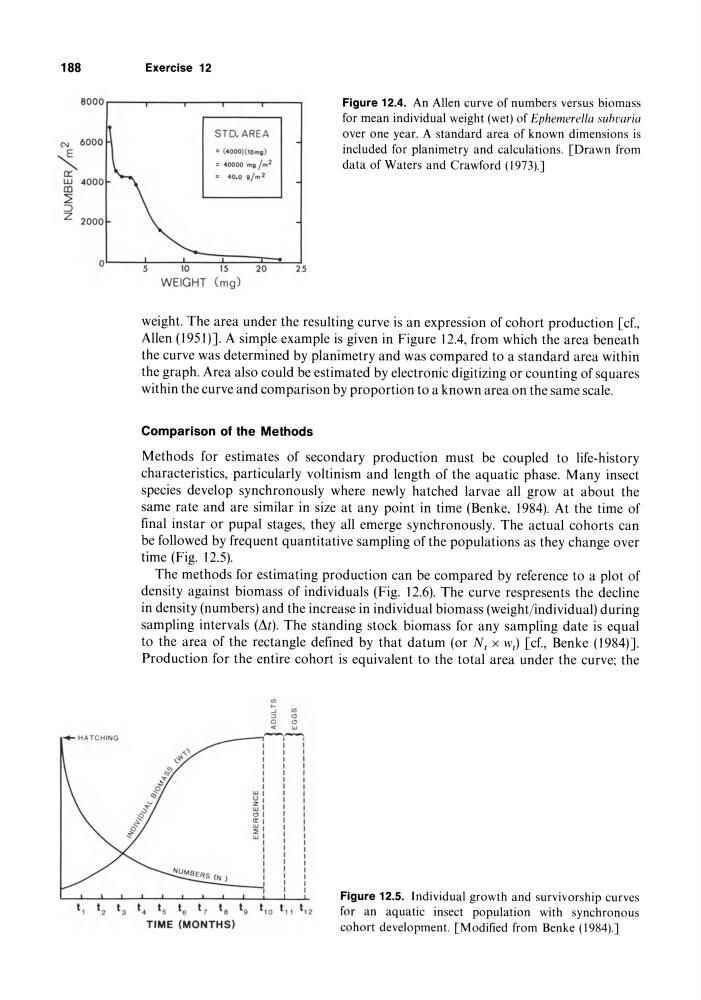
Figure 12.4. An Allen curve of numbers versus biomass
for mean individual weight (wet) of Ephemerella suhvaria
over one year. A standard area of known dimensions is
included for planimetry and calculations. [Drawn from
data of Waters and Crawford (1973).]
~ a:: w
CD
~
::>
z
= (.OOO)(.Omg)
= .0000 m ij 1m 2
.: 40.0 81m 2
5
10
15
20
25
WEIGHT (mg)
weight. The area under the resulting curve is an expression of cohort production [cf.,
Allen (\951)]. A simple example is given in Figure 12.4, from which the area beneath
the curve was determined by planimetry and was compared to a standard area within
the graph. Area also could be estimated by electronic digitizing or counting of squares
within the curve and comparison by proportion to a known area on the same scale.
Comparison of the Methods
Methods for estimates of secondary production must be coupled to life-history
characteristics, particularly voltinism and length of the aquatic phase. Many insect
species develop synchronously where newly hatched larvae all grow at about the
same rate and are similar in size at any point in time (Benke, 1984). At the time of
final instar or pupal stages, they all emerge synchronously. The actual cohorts can
be followed by frequent quantitative sampling of the populations as they change over
time (Fig. 12.5).
The methods for estimating production can be compared by reference to a plot of
density against biomass of individuals (Fig. 12.6). The curve respresents the decline
in density (numbers) and the increase in individual biomass (weight/ individual) during
sampling intervals (~t). The standing stock biomass for any sampling date is equal
to the area of the rectangle defined by that datum (or Nt x wJ [cf., Benke (1984)].
Production for the entire cohort is equivalent to the total area under the curve; the
'" " " w
,--.,
i
• 1
I , t 2 I J t 4 Is Ie t 7 18 19 t ,o I I! '2
TIME (MONTHS)
Figure 12.5. Individual growth and survivorship curves
for an aquatic insect population with synchronous
cohort development. [Modified from Benke (1984).]
Exercise 12
8000r----.----,----.,----.----,
STD. AREA
N
6000
Figure 12.4. An Allen curve of numbers versus biomass
for mean individual weight (wet) of Ephemerella suhvaria
over one year. A standard area of known dimensions is
included for planimetry and calculations. [Drawn from
data of Waters and Crawford (1973).]
~ a:: w
CD
~
::>
z
= (.OOO)(.Omg)
= .0000 m ij 1m 2
.: 40.0 81m 2
5
10
15
20
25
WEIGHT (mg)
weight. The area under the resulting curve is an expression of cohort production [cf.,
Allen (\951)]. A simple example is given in Figure 12.4, from which the area beneath
the curve was determined by planimetry and was compared to a standard area within
the graph. Area also could be estimated by electronic digitizing or counting of squares
within the curve and comparison by proportion to a known area on the same scale.
Comparison of the Methods
Methods for estimates of secondary production must be coupled to life-history
characteristics, particularly voltinism and length of the aquatic phase. Many insect
species develop synchronously where newly hatched larvae all grow at about the
same rate and are similar in size at any point in time (Benke, 1984). At the time of
final instar or pupal stages, they all emerge synchronously. The actual cohorts can
be followed by frequent quantitative sampling of the populations as they change over
time (Fig. 12.5).
The methods for estimating production can be compared by reference to a plot of
density against biomass of individuals (Fig. 12.6). The curve respresents the decline
in density (numbers) and the increase in individual biomass (weight/ individual) during
sampling intervals (~t). The standing stock biomass for any sampling date is equal
to the area of the rectangle defined by that datum (or Nt x wJ [cf., Benke (1984)].
Production for the entire cohort is equivalent to the total area under the curve; the
'" " " w
,--.,
i
• 1
I , t 2 I J t 4 Is Ie t 7 18 19 t ,o I I! '2
TIME (MONTHS)
Figure 12.5. Individual growth and survivorship curves
for an aquatic insect population with synchronous
cohort development. [Modified from Benke (1984).]