

150
Exercise 10
except that the length-width dimensions are determined using the calibrated Whipple
field.
Palmer-Maloney (P-M) Nannoplankton and Other Counting Cells
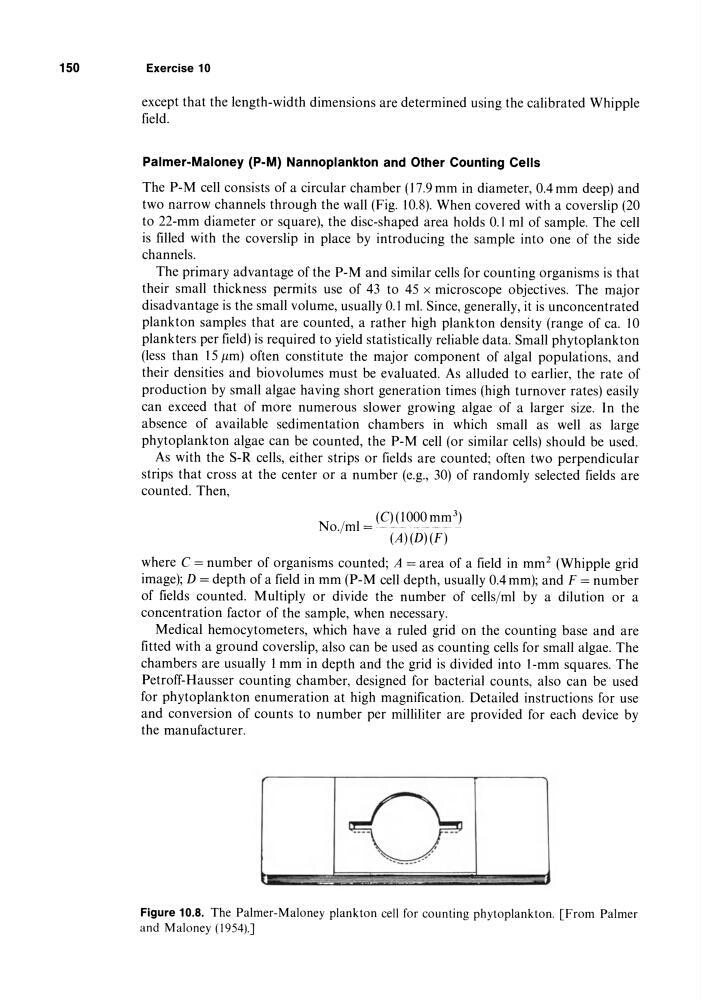
The P-M cell consists of a circular chamber (17.9 mm in diameter, 0.4 mm deep) and
two narrow channels through the wall (Fig. 10.8). When covered with a coverslip (20
to 22-mm diameter or square), the disc-shaped area holds 0.1 ml of sample. The cell
is filled with the coverslip in place by introducing the sample into one of the side
channels.
The primary advantage of the P-M and similar cells for counting organisms is that
their small thickness permits use of 43 to 45 x microscope objectives. The major
disadvantage is the small volume, usually 0.1 m!. Since, generally, it is unconcentrated
plankton samples that are counted, a rather high plankton density (range of ca. 10
plankters per field) is required to yield statistically reliable data. Small phytoplankton
(less than 15/tm) often constitute the major component of algal populations, and
their densities and biovolumes must be evaluated. As alluded to earlier, the rate of
production by small algae having short generation times (high turnover rates) easily
can exceed that of more numerous slower growing algae of a larger size. In the
absence of available sedimentation chambers in which small as well as large
phytoplankton algae can be counted, the P-M cell (or similar cells) should be used.
As with the S-R cells, either strips or fields are counted; often two perpendicular
strips that cross at the center or a number (e.g., 30) of randomly selected fields are
counted. Then,
where C = number of organisms counted; A = area of a field in mm 2 (Whipple grid
image); D = depth of a field in mm (P-M cell depth, usually 0.4 mm); and F = number
of fields counted. Multiply or divide the number of cells/ml by a dilution or a
concentration factor of the sample, when necessary.
Medical hemocytometers, which have a ruled grid on the counting base and are
fitted with a ground coverslip, also can be used as counting cells for small algae. The
chambers are usually 1 mm in depth and the grid is divided into I-mm squares. The
Petroff-Hausser counting chamber, designed for bacterial counts, also can be used
for phytoplankton enumeration at high magnification. Detailed instructions for use
and conversion of counts to number per milliliter are provided for each device by
the manufacturer.
Figure 10.8. The Palmer-Maloney plankton cell for counting phytoplankton. [From Palmer
and Maloney (I954).J
Exercise 10
except that the length-width dimensions are determined using the calibrated Whipple
field.
Palmer-Maloney (P-M) Nannoplankton and Other Counting Cells
The P-M cell consists of a circular chamber (17.9 mm in diameter, 0.4 mm deep) and
two narrow channels through the wall (Fig. 10.8). When covered with a coverslip (20
to 22-mm diameter or square), the disc-shaped area holds 0.1 ml of sample. The cell
is filled with the coverslip in place by introducing the sample into one of the side
channels.
The primary advantage of the P-M and similar cells for counting organisms is that
their small thickness permits use of 43 to 45 x microscope objectives. The major
disadvantage is the small volume, usually 0.1 m!. Since, generally, it is unconcentrated
plankton samples that are counted, a rather high plankton density (range of ca. 10
plankters per field) is required to yield statistically reliable data. Small phytoplankton
(less than 15/tm) often constitute the major component of algal populations, and
their densities and biovolumes must be evaluated. As alluded to earlier, the rate of
production by small algae having short generation times (high turnover rates) easily
can exceed that of more numerous slower growing algae of a larger size. In the
absence of available sedimentation chambers in which small as well as large
phytoplankton algae can be counted, the P-M cell (or similar cells) should be used.
As with the S-R cells, either strips or fields are counted; often two perpendicular
strips that cross at the center or a number (e.g., 30) of randomly selected fields are
counted. Then,
where C = number of organisms counted; A = area of a field in mm 2 (Whipple grid
image); D = depth of a field in mm (P-M cell depth, usually 0.4 mm); and F = number
of fields counted. Multiply or divide the number of cells/ml by a dilution or a
concentration factor of the sample, when necessary.
Medical hemocytometers, which have a ruled grid on the counting base and are
fitted with a ground coverslip, also can be used as counting cells for small algae. The
chambers are usually 1 mm in depth and the grid is divided into I-mm squares. The
Petroff-Hausser counting chamber, designed for bacterial counts, also can be used
for phytoplankton enumeration at high magnification. Detailed instructions for use
and conversion of counts to number per milliliter are provided for each device by
the manufacturer.
Figure 10.8. The Palmer-Maloney plankton cell for counting phytoplankton. [From Palmer
and Maloney (I954).J