

Composition and Biomass of Phytoplankton
149
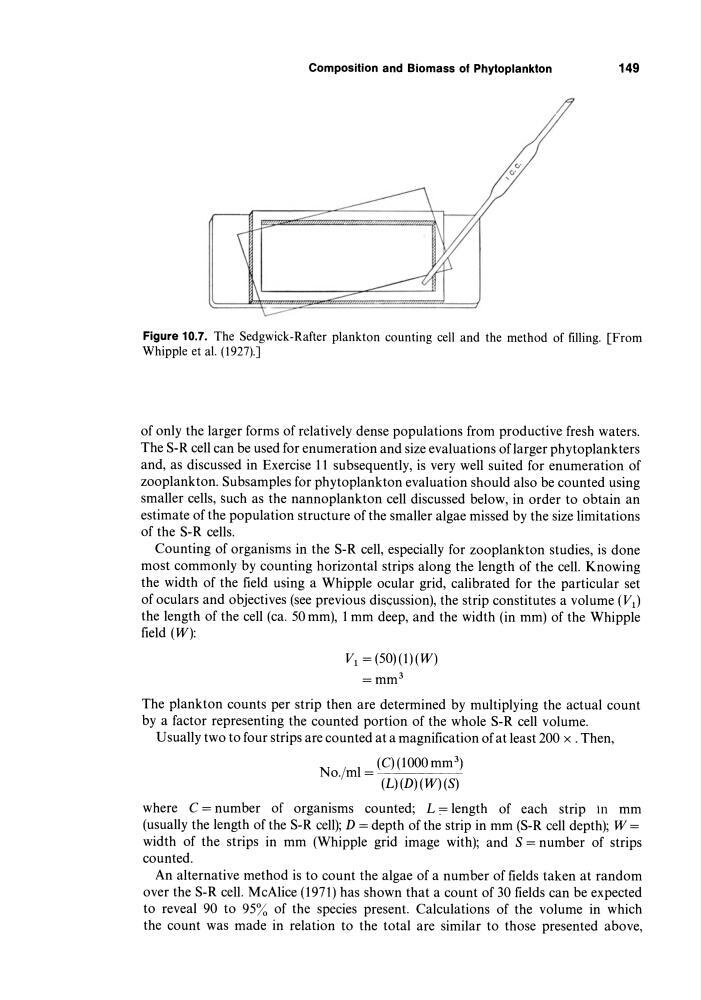
Figure 10.7. The Sedgwick-Rafter plankton counting cell and the method of filling. [From
Whipple et al. (1927).J
of only the larger forms of relatively dense populations from productive fresh waters.
The S-R cell can be used for enumeration and size evaluations oflarger phytoplankters
and, as discussed in Exercise 11 subsequently, is very well suited for enumeration of
zooplankton. Subsamples for phytoplankton evaluation should also be counted using
smaller cells, such as the nannoplankton cell discussed below, in order to obtain an
estimate of the population structure of the smaller algae missed by the size limitations
of the S-R cells.
Counting of organisms in the S-R cell, especially for zooplankton studies, is done
most commonly by counting horizontal strips along the length of the cell. Knowing
the width of the field using a Whipple ocular grid, calibrated for the particular set
of oculars and objectives (see previous discussion), the strip constitutes a volume (VI)
the length of the cell (ca. 50 mm), 1 mm deep, and the width (in mm) of the Whipple
field (W):
VI = (50)(1)(W)
=mm 3
The plankton counts per strip then are determined by multiplying the actual count
by a factor representing the counted portion of the whole S-R cell volume.
Usually two to four strips are counted at a magnification of at least 200 x . Then,
No.jml = (C)(1000mm3)
(L)(D)(W)(S)
where C = number of organisms counted; L:= length of each strip In mm
(usually the length of the S-R cell); D = depth of the strip in mm (S-R cell depth); W =
width of the strips in mm (Whipple grid image with); and S = number of strips
counted.
An alternative method is to count the algae of a number of fields taken at random
over the S-R cell. McAlice (1971) has shown that a count of 30 fields can be expected
to reveal 90 to 95% of the species present. Calculations of the volume in which
the count was made in relation to the total are similar to those presented above,
149
Figure 10.7. The Sedgwick-Rafter plankton counting cell and the method of filling. [From
Whipple et al. (1927).J
of only the larger forms of relatively dense populations from productive fresh waters.
The S-R cell can be used for enumeration and size evaluations oflarger phytoplankters
and, as discussed in Exercise 11 subsequently, is very well suited for enumeration of
zooplankton. Subsamples for phytoplankton evaluation should also be counted using
smaller cells, such as the nannoplankton cell discussed below, in order to obtain an
estimate of the population structure of the smaller algae missed by the size limitations
of the S-R cells.
Counting of organisms in the S-R cell, especially for zooplankton studies, is done
most commonly by counting horizontal strips along the length of the cell. Knowing
the width of the field using a Whipple ocular grid, calibrated for the particular set
of oculars and objectives (see previous discussion), the strip constitutes a volume (VI)
the length of the cell (ca. 50 mm), 1 mm deep, and the width (in mm) of the Whipple
field (W):
VI = (50)(1)(W)
=mm 3
The plankton counts per strip then are determined by multiplying the actual count
by a factor representing the counted portion of the whole S-R cell volume.
Usually two to four strips are counted at a magnification of at least 200 x . Then,
No.jml = (C)(1000mm3)
(L)(D)(W)(S)
where C = number of organisms counted; L:= length of each strip In mm
(usually the length of the S-R cell); D = depth of the strip in mm (S-R cell depth); W =
width of the strips in mm (Whipple grid image with); and S = number of strips
counted.
An alternative method is to count the algae of a number of fields taken at random
over the S-R cell. McAlice (1971) has shown that a count of 30 fields can be expected
to reveal 90 to 95% of the species present. Calculations of the volume in which
the count was made in relation to the total are similar to those presented above,