

134
Exercise 9
Centrifuge at 2000 rpm for about 5 min to remove the remaining glass fibers and
particles of undigested inorganic materials.
8. Pour the solution into a spectrophotometer cell and measure the extinction at a
wavelength of 440 nm. The blank solution (with a higher extinction than the sample
solution) should be placed in the spectrophotometer cell normally used for the
samples and the sample solution in the cell normally used for the reference liquid. In
this manner the difference between the sample and blank, i.e., a measure of the
bleaching of the dichromate, is measured directly in the most sensitive range of the
spectrophotometer. The result is a more precise value than would be obtained if two
relatively large extinction coefficients were measured separately against water and
then subtracted.
Calculations
1. Oxidant calibration with glucose standards:
F = 120/Ec
where F = calibration factor and Ec = mean corrected extinction of the three
standards [i.e., mean absorption (OD) of distilled water blanks minus mean
absorption of glucose standards]. F should be approximately 275 and need not be
redetermined for the same batch of oxidant.
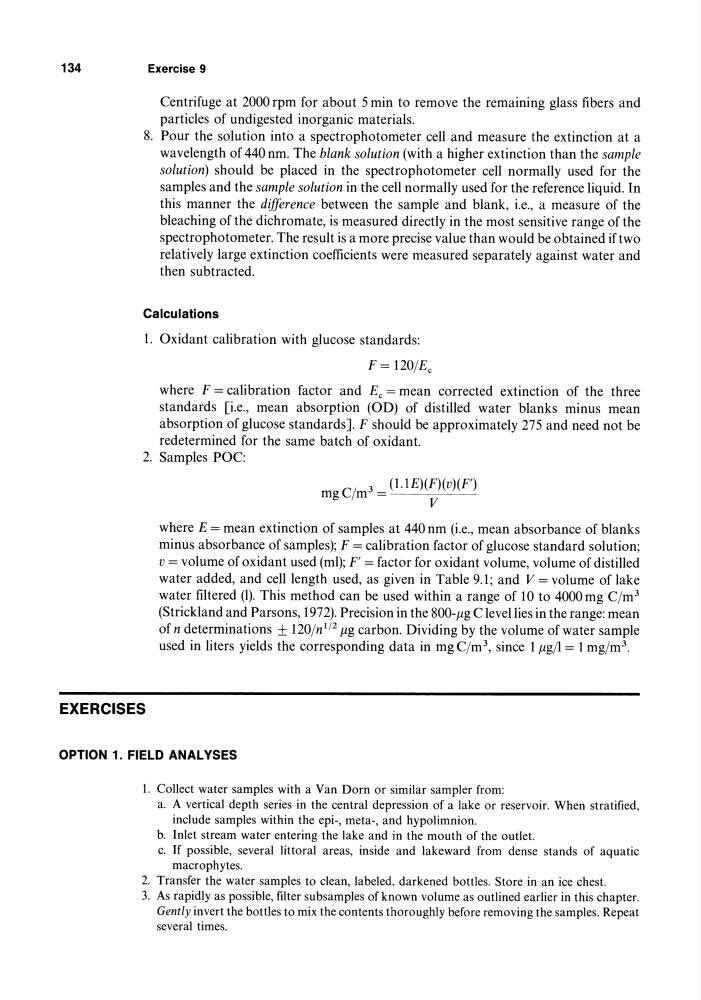
2. Samples POC:
where E = mean extinction of samples at 440 nm (i.e., mean absorbance of blanks
minus absorbance of samples); F = calibration factor of glucose standard solution;
v = volume of oxidant used (ml); F' = factor for oxidant volume, volume of distilled
water added, and cell length used, as given in Table 9.1; and V = volume of lake
water filtered (1). This method can be used within a range of 10 to 4000 mg C/m 3
(Strickland and Parsons, 1972). Precision in the 800-flg C level lies in the range: mean
of n determinations ± 120/n 1 / 2 flg carbon. Dividing by the volume of water sample
used in liters yields the corresponding data in mg C/m 3 , since 1 flg/l = 1 mg/m 3 .
EXERCISES
OPTION 1. FIELD ANALYSES
1. Collect water samples with a Van Dorn or similar sampler from:
a. A vertical depth series in the central depression of a lake or reservoir. When stratified,
include samples within the epi-, meta-, and hypolimnion.
b. Inlet stream water entering the lake and in the mouth of the outlet.
c. If possible, several littoral areas, inside and lakeward from dense stands of aquatic
macrophytes.
2. Transfer the water samples to clean, labeled, darkened bottles. Store in an ice chest.
3. As rapidly as possible, filter subsamples of known volume as outlined earlier in this chapter.
Gently invert the bottles to mix the contents thoroughly before removing the samples. Repeat
several times.
Exercise 9
Centrifuge at 2000 rpm for about 5 min to remove the remaining glass fibers and
particles of undigested inorganic materials.
8. Pour the solution into a spectrophotometer cell and measure the extinction at a
wavelength of 440 nm. The blank solution (with a higher extinction than the sample
solution) should be placed in the spectrophotometer cell normally used for the
samples and the sample solution in the cell normally used for the reference liquid. In
this manner the difference between the sample and blank, i.e., a measure of the
bleaching of the dichromate, is measured directly in the most sensitive range of the
spectrophotometer. The result is a more precise value than would be obtained if two
relatively large extinction coefficients were measured separately against water and
then subtracted.
Calculations
1. Oxidant calibration with glucose standards:
F = 120/Ec
where F = calibration factor and Ec = mean corrected extinction of the three
standards [i.e., mean absorption (OD) of distilled water blanks minus mean
absorption of glucose standards]. F should be approximately 275 and need not be
redetermined for the same batch of oxidant.
2. Samples POC:
where E = mean extinction of samples at 440 nm (i.e., mean absorbance of blanks
minus absorbance of samples); F = calibration factor of glucose standard solution;
v = volume of oxidant used (ml); F' = factor for oxidant volume, volume of distilled
water added, and cell length used, as given in Table 9.1; and V = volume of lake
water filtered (1). This method can be used within a range of 10 to 4000 mg C/m 3
(Strickland and Parsons, 1972). Precision in the 800-flg C level lies in the range: mean
of n determinations ± 120/n 1 / 2 flg carbon. Dividing by the volume of water sample
used in liters yields the corresponding data in mg C/m 3 , since 1 flg/l = 1 mg/m 3 .
EXERCISES
OPTION 1. FIELD ANALYSES
1. Collect water samples with a Van Dorn or similar sampler from:
a. A vertical depth series in the central depression of a lake or reservoir. When stratified,
include samples within the epi-, meta-, and hypolimnion.
b. Inlet stream water entering the lake and in the mouth of the outlet.
c. If possible, several littoral areas, inside and lakeward from dense stands of aquatic
macrophytes.
2. Transfer the water samples to clean, labeled, darkened bottles. Store in an ice chest.
3. As rapidly as possible, filter subsamples of known volume as outlined earlier in this chapter.
Gently invert the bottles to mix the contents thoroughly before removing the samples. Repeat
several times.