

Organic Matter
133
to 20% ofthe oxidation value given by this procedure. Thus, the "oxidizable carbon" is
a realistic measure of the energy stored in the particulate organic matter.
The particulate organic matter is filtered onto precombusted glass fiber filters, as
discussed earlier. Carbon content then is determined by oxidation with a mixture of
potassium dichromate and concentrated sulfuric acid. The decrease in extinction ofthe
yellow dichromate solution resulting from reduction by the organic matter is measured
spectrophotometrically.
Procedures
1. Place dry filters into the bottom of small (e.g., 50 or 125 ml) Erlenmeyer flasks with
clean forceps. The filter should be flat on the bottom of the flask with the organic
material upward.
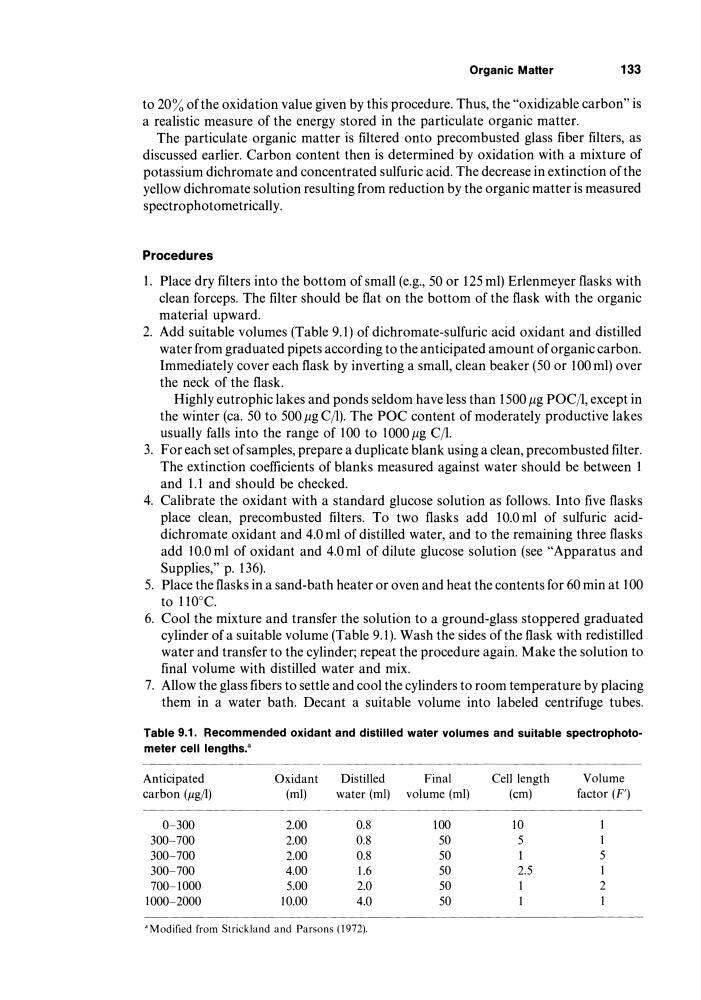
2. Add suitable volumes (Table 9.1) of dichromate-sulfuric acid oxidant and distilled
water from graduated pipets according to the anticipated amount of organic carbon.
Immediately cover each flask by inverting a small, clean beaker (50 or 100 ml) over
the neck of the flask.
Highly eutrophic lakes and ponds seldom have less than 1500 j1g POCjI, except in
the winter (ca. 50 to 500 j1g C/I). The POC content of moderately productive lakes
usually falls into the range of 100 to 1000 j1g Cjl.
3. For each set of samples, prepare a duplicate blank using a clean, precombusted filter.
The extinction coefficients of blanks measured against water should be between 1
and 1.1 and should be checked.
4. Calibrate the oxidant with a standard glucose solution as follows. Into five flasks
place clean, precombusted filters. To two flasks add 10.0 ml of sulfuric aciddichromate oxidant and 4.0 ml of distilled water, and to the remaining three flasks
add 10.0 ml of oxidant and 4.0 ml of dilute glucose solution (see "Apparatus and
Supplies," p. 136).
5. Place the flasks in a sand-bath heater or oven and heat the contents for 60 min at 100
to 110°C.
6. Cool the mixture and transfer the solution to a ground-glass stoppered graduated
cylinder of a suitable volume (Table 9.1). Wash the sides of the flask with redistilled
water and transfer to the cylinder; repeat the procedure again. Make the solution to
final volume with distilled water and mix.
7. Allow the glass fibers to settle and cool the cylinders to room temperature by placing
them in a water bath. Decant a suitable volume into labeled centrifuge tubes.
Table 9.1. Recommended oxidant and distilled water volumes and suitable spectrophotometer cell lengths."
--------------~- - - - - -
Anticipated
Oxidant
Distilled
Final
carbon (J-tg/l)
(ml)
water (ml) volume (ml)
- - - - - - - - - - - - _ ...
0-300
2.00
0.8
100
300-700
2.00
0.8
50
300-700
2.00
0.8
50
300-700
4.00
1.6
50
700-1000
5.00
2.0
50
1000-2000
10.00
4.0
50
'Modified from Strickland and Parsons (1972).
Cell length
(cm)
10
5
1
2.5
Volume
factor (F')
5
1
2
133
to 20% ofthe oxidation value given by this procedure. Thus, the "oxidizable carbon" is
a realistic measure of the energy stored in the particulate organic matter.
The particulate organic matter is filtered onto precombusted glass fiber filters, as
discussed earlier. Carbon content then is determined by oxidation with a mixture of
potassium dichromate and concentrated sulfuric acid. The decrease in extinction ofthe
yellow dichromate solution resulting from reduction by the organic matter is measured
spectrophotometrically.
Procedures
1. Place dry filters into the bottom of small (e.g., 50 or 125 ml) Erlenmeyer flasks with
clean forceps. The filter should be flat on the bottom of the flask with the organic
material upward.
2. Add suitable volumes (Table 9.1) of dichromate-sulfuric acid oxidant and distilled
water from graduated pipets according to the anticipated amount of organic carbon.
Immediately cover each flask by inverting a small, clean beaker (50 or 100 ml) over
the neck of the flask.
Highly eutrophic lakes and ponds seldom have less than 1500 j1g POCjI, except in
the winter (ca. 50 to 500 j1g C/I). The POC content of moderately productive lakes
usually falls into the range of 100 to 1000 j1g Cjl.
3. For each set of samples, prepare a duplicate blank using a clean, precombusted filter.
The extinction coefficients of blanks measured against water should be between 1
and 1.1 and should be checked.
4. Calibrate the oxidant with a standard glucose solution as follows. Into five flasks
place clean, precombusted filters. To two flasks add 10.0 ml of sulfuric aciddichromate oxidant and 4.0 ml of distilled water, and to the remaining three flasks
add 10.0 ml of oxidant and 4.0 ml of dilute glucose solution (see "Apparatus and
Supplies," p. 136).
5. Place the flasks in a sand-bath heater or oven and heat the contents for 60 min at 100
to 110°C.
6. Cool the mixture and transfer the solution to a ground-glass stoppered graduated
cylinder of a suitable volume (Table 9.1). Wash the sides of the flask with redistilled
water and transfer to the cylinder; repeat the procedure again. Make the solution to
final volume with distilled water and mix.
7. Allow the glass fibers to settle and cool the cylinders to room temperature by placing
them in a water bath. Decant a suitable volume into labeled centrifuge tubes.
Table 9.1. Recommended oxidant and distilled water volumes and suitable spectrophotometer cell lengths."
--------------~- - - - - -
Anticipated
Oxidant
Distilled
Final
carbon (J-tg/l)
(ml)
water (ml) volume (ml)
- - - - - - - - - - - - _ ...
0-300
2.00
0.8
100
300-700
2.00
0.8
50
300-700
2.00
0.8
50
300-700
4.00
1.6
50
700-1000
5.00
2.0
50
1000-2000
10.00
4.0
50
'Modified from Strickland and Parsons (1972).
Cell length
(cm)
10
5
1
2.5
Volume
factor (F')
5
1
2