

86
The Radiocarbon Method to Estimate Primary Production
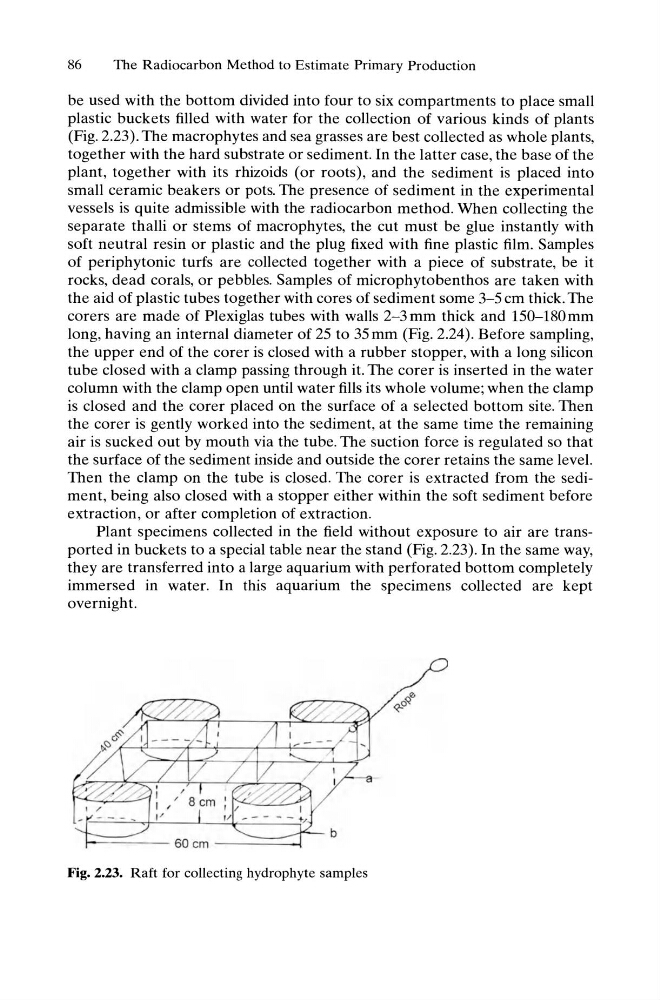
be used with the bottom divided into four to six compartments to place small
plastic buckets filled with water for the collection of various kinds of plants
(Fig. 2.23). The macrophytes and sea grasses are best collected as whole plants,
together with the hard substrate or sediment. In the latter case, the base of the
plant, together with its rhizoids (or roots), and the sediment is placed into
small ceramic beakers or pots. The presence of sediment in the experimental
vessels is quite admissible with the radiocarbon method. When collecting the
separate thalli or stems of macrophytes, the cut must be glue instantly with
soft neutral resin or plastic and the plug fixed with fine plastic film. Samples
of periphytonic turfs are collected together with a piece of substrate, be it
rocks, dead corals, or pebbles. Samples of microphytobenthos are taken with
the aid of plastic tubes together with cores of sediment some 3-5 cm thick. The
corers are made of Plexiglas tubes with walls 2-3mm thick and 150-180mm
long, having an internal diameter of 25 to 35mm (Fig. 2.24). Before sampling,
the upper end of the corer is closed with a rubber stopper, with a long silicon
tube closed with a clamp passing through it. The corer is inserted in the water
column with the clamp open until water fills its whole volume; when the clamp
is closed and the corer placed on the surface of a selected bottom site. Then
the corer is gently worked into the sediment, at the same time the remaining
air is sucked out by mouth via the tube. The suction force is regulated so that
the surface of the sediment inside and outside the corer retains the same level.
Then the clamp on the tube is closed. The corer is extracted from the sediment, being also closed with a stopper either within the soft sediment before
extraction, or after completion of extraction.
Plant specimens collected in the field without exposure to air are transported in buckets to a special table near the stand (Fig. 2.23). In the same way,
they are transferred into a large aquarium with perforated bottom completely
immersed in water. In this aquarium the specimens collected are kept
overnight.
Fig. 2.23. Raft for collecting hydrophyte samples
The Radiocarbon Method to Estimate Primary Production
be used with the bottom divided into four to six compartments to place small
plastic buckets filled with water for the collection of various kinds of plants
(Fig. 2.23). The macrophytes and sea grasses are best collected as whole plants,
together with the hard substrate or sediment. In the latter case, the base of the
plant, together with its rhizoids (or roots), and the sediment is placed into
small ceramic beakers or pots. The presence of sediment in the experimental
vessels is quite admissible with the radiocarbon method. When collecting the
separate thalli or stems of macrophytes, the cut must be glue instantly with
soft neutral resin or plastic and the plug fixed with fine plastic film. Samples
of periphytonic turfs are collected together with a piece of substrate, be it
rocks, dead corals, or pebbles. Samples of microphytobenthos are taken with
the aid of plastic tubes together with cores of sediment some 3-5 cm thick. The
corers are made of Plexiglas tubes with walls 2-3mm thick and 150-180mm
long, having an internal diameter of 25 to 35mm (Fig. 2.24). Before sampling,
the upper end of the corer is closed with a rubber stopper, with a long silicon
tube closed with a clamp passing through it. The corer is inserted in the water
column with the clamp open until water fills its whole volume; when the clamp
is closed and the corer placed on the surface of a selected bottom site. Then
the corer is gently worked into the sediment, at the same time the remaining
air is sucked out by mouth via the tube. The suction force is regulated so that
the surface of the sediment inside and outside the corer retains the same level.
Then the clamp on the tube is closed. The corer is extracted from the sediment, being also closed with a stopper either within the soft sediment before
extraction, or after completion of extraction.
Plant specimens collected in the field without exposure to air are transported in buckets to a special table near the stand (Fig. 2.23). In the same way,
they are transferred into a large aquarium with perforated bottom completely
immersed in water. In this aquarium the specimens collected are kept
overnight.
Fig. 2.23. Raft for collecting hydrophyte samples