

80
The Radiocarbon Method to Estimate Primary Production
with a clamp to let out the air. The top part of the plant is coated in situ with
the bag, the neck of which is fixed on to the stem with a rubber band and a
sealer. Then the radioisotope working solution is injected into it by hypodermic syringe, and the experiment is started (Towle and Pearse 1973). For the
same kind of experiment, Cattaneo and Kalff (1980) used Plexiglas chambers
made of two halves, which are put together III situ around the plant's lhallus
and fixed together with a rubber band, thus providing hermetization of the
chamber by lying between them. The hole around the stem is closed with a
sealer.
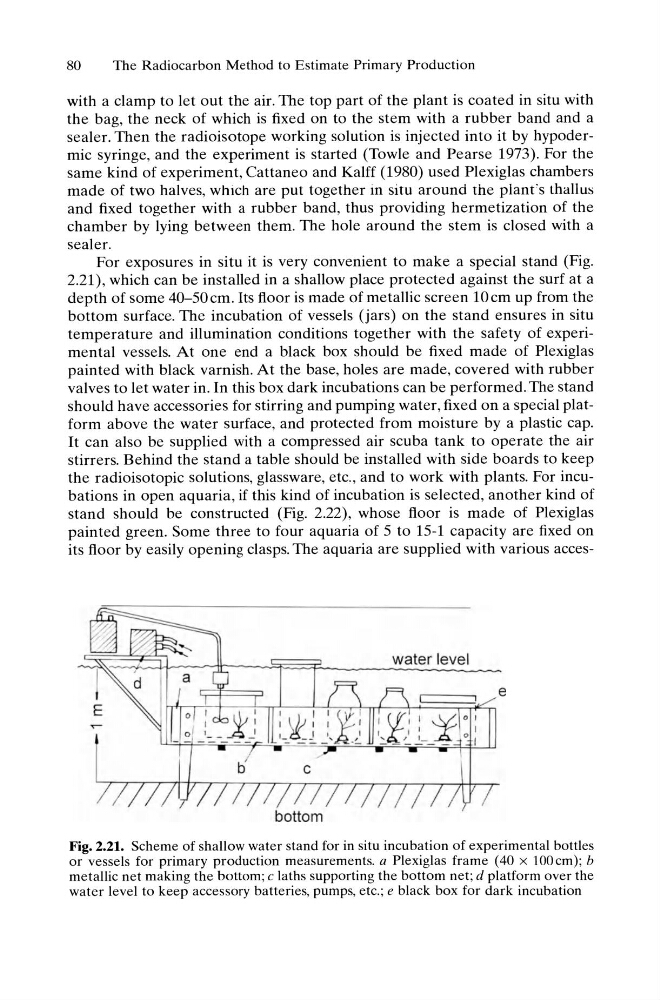
For exposures in situ it is very convenient to make a special stand (Fig.
2.21), which can be installed in a shallow place protected against the surf at a
depth of some 40-50cm. lts floor is made of metallic screen lOcm up from the
bottom surface. The incubation of vessels (jars) on the stand ensures in situ
temperature and illumination conditions together with the safety of experimental vessels. At one end a black box should be fixed made of Plexiglas
painted with black varnish. At the base, holes are made, covered with rubber
valves to let water in. In this box dark incubations can be performed. The stand
should have accessories for stirring and pumping water, fixed on a special platform above the water surface, and protected from moisture by a plastic cap.
It can also be supplied with a compressed air scuba tank to operate the air
stirrers. Behind the stand a table should be installed with side boards to keep
the radioisotopic solutions, glassware, etc. , and to work with plants. For incubations in open aquaria, if this kind of incubation is selected, another kind of
stand should be constructed (Fig. 2.22), whose floor is made of Plexiglas
painted green. Some three to four aquaria of 5 to 15-1 capacity are fixed on
its floor by easily opening clasps. The aquaria are supplied with various acceswater level
bottom
Fig.2.21. Scheme of shallow water stand for in situ incubation of experimental bottles
or vessels for primary production measurements. a Plexiglas frame (40 x IOOcm); b
metallic net making the bottom; c laths supporting the bottom net; d platform over the
water level to keep accessory batteries, pumps, etc.; e black box for dark incubation
The Radiocarbon Method to Estimate Primary Production
with a clamp to let out the air. The top part of the plant is coated in situ with
the bag, the neck of which is fixed on to the stem with a rubber band and a
sealer. Then the radioisotope working solution is injected into it by hypodermic syringe, and the experiment is started (Towle and Pearse 1973). For the
same kind of experiment, Cattaneo and Kalff (1980) used Plexiglas chambers
made of two halves, which are put together III situ around the plant's lhallus
and fixed together with a rubber band, thus providing hermetization of the
chamber by lying between them. The hole around the stem is closed with a
sealer.
For exposures in situ it is very convenient to make a special stand (Fig.
2.21), which can be installed in a shallow place protected against the surf at a
depth of some 40-50cm. lts floor is made of metallic screen lOcm up from the
bottom surface. The incubation of vessels (jars) on the stand ensures in situ
temperature and illumination conditions together with the safety of experimental vessels. At one end a black box should be fixed made of Plexiglas
painted with black varnish. At the base, holes are made, covered with rubber
valves to let water in. In this box dark incubations can be performed. The stand
should have accessories for stirring and pumping water, fixed on a special platform above the water surface, and protected from moisture by a plastic cap.
It can also be supplied with a compressed air scuba tank to operate the air
stirrers. Behind the stand a table should be installed with side boards to keep
the radioisotopic solutions, glassware, etc. , and to work with plants. For incubations in open aquaria, if this kind of incubation is selected, another kind of
stand should be constructed (Fig. 2.22), whose floor is made of Plexiglas
painted green. Some three to four aquaria of 5 to 15-1 capacity are fixed on
its floor by easily opening clasps. The aquaria are supplied with various acceswater level
bottom
Fig.2.21. Scheme of shallow water stand for in situ incubation of experimental bottles
or vessels for primary production measurements. a Plexiglas frame (40 x IOOcm); b
metallic net making the bottom; c laths supporting the bottom net; d platform over the
water level to keep accessory batteries, pumps, etc.; e black box for dark incubation