

52
The Radiocarbon Method to Estimate Primary Production
0
0.3
0.6
PO,P
8; 12· 16· 20· t· 0.5 1.0
.
1.5
0 0.25 0.5 0.75
KI
,
H,m O 0 20 40 60 80 0 0.02
10
20
30
40
', POp
\
f
\
50
\
\
60
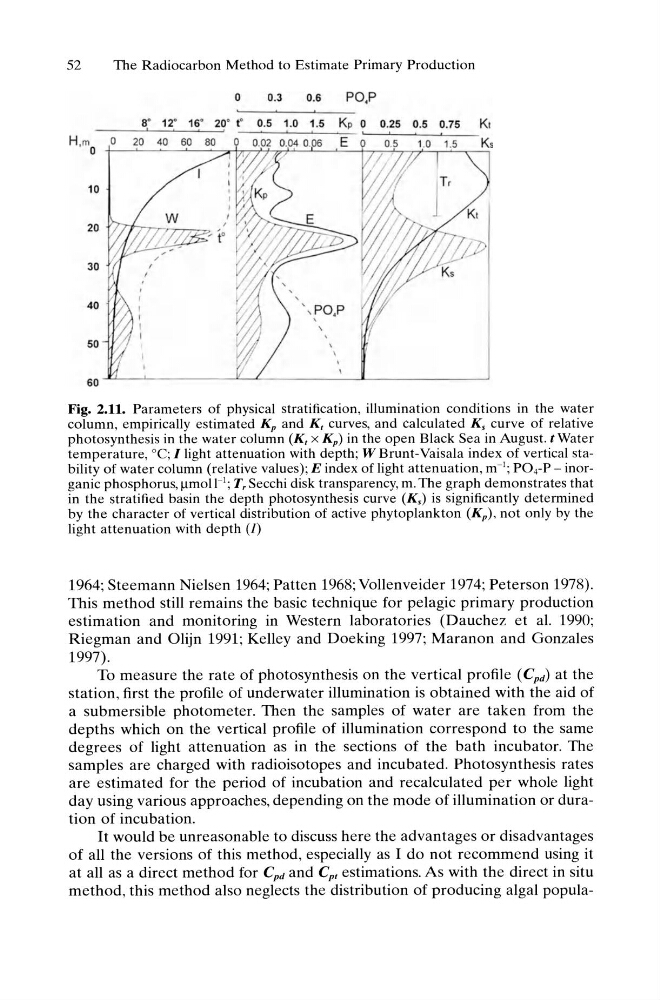
Fig. 2.11. Parameters of physical stratification, illumination conditions in the water
column, empirically estimated Kp and K, curves, and calculated Ks curve of relative
photosynthesis in the water column (K, x Kp) in the open Black Sea in August. t Water
temperature, °C; I light attenuation with depth; W Brunt-Vaisala index of vertical stability of water column (relative values) ; E index of light attenuation, m- I ; P04-P - inorganic phosphorus, f.1moll-l; T, Secchi disk transparency, m. The graph demonstrates that
in the stratified basin the depth photosynthesis curve (Ks) is significantly determined
by the character of vertical distribution of active phytoplankton (Kp), not only by the
light attenuation with depth (I)
1964; Steemann Nielsen 1964; Patten 1968; Vollenveider 1974; Peterson 1978).
This method still remains the basic technique for pelagic primary production
estimation and monitoring in Western laboratories (Dauchez et al. 1990;
Riegman and Olijn 1991; Kelley and Doeking 1997; Maranon and Gonzales
1997).
To measure the rate of photosynthesis on the vertical profile (Cpd) at the
station, first the profile of underwater illumination is obtained with the aid of
a submersible photometer. Then the samples of water are taken from the
depths which on the vertical profile of illumination correspond to the same
degrees of light attenuation as in the sections of the bath incubator. The
samples are charged with radioisotopes and incubated. Photosynthesis rates
are estimated for the period of incubation and recalculated per whole light
day using various approaches, depending on the mode of illumination or duration of incubation.
It would be unreasonable to discuss here the advantages or disadvantages
of all the versions of this method, especially as I do not recommend using it
at all as a direct method for C pd and Cpt estimations. As with the direct in situ
method, this method also neglects the distribution of producing algal popula-
The Radiocarbon Method to Estimate Primary Production
0
0.3
0.6
PO,P
8; 12· 16· 20· t· 0.5 1.0
.
1.5
0 0.25 0.5 0.75
KI
,
H,m O 0 20 40 60 80 0 0.02
10
20
30
40
', POp
\
f
\
50
\
\
60
Fig. 2.11. Parameters of physical stratification, illumination conditions in the water
column, empirically estimated Kp and K, curves, and calculated Ks curve of relative
photosynthesis in the water column (K, x Kp) in the open Black Sea in August. t Water
temperature, °C; I light attenuation with depth; W Brunt-Vaisala index of vertical stability of water column (relative values) ; E index of light attenuation, m- I ; P04-P - inorganic phosphorus, f.1moll-l; T, Secchi disk transparency, m. The graph demonstrates that
in the stratified basin the depth photosynthesis curve (Ks) is significantly determined
by the character of vertical distribution of active phytoplankton (Kp), not only by the
light attenuation with depth (I)
1964; Steemann Nielsen 1964; Patten 1968; Vollenveider 1974; Peterson 1978).
This method still remains the basic technique for pelagic primary production
estimation and monitoring in Western laboratories (Dauchez et al. 1990;
Riegman and Olijn 1991; Kelley and Doeking 1997; Maranon and Gonzales
1997).
To measure the rate of photosynthesis on the vertical profile (Cpd) at the
station, first the profile of underwater illumination is obtained with the aid of
a submersible photometer. Then the samples of water are taken from the
depths which on the vertical profile of illumination correspond to the same
degrees of light attenuation as in the sections of the bath incubator. The
samples are charged with radioisotopes and incubated. Photosynthesis rates
are estimated for the period of incubation and recalculated per whole light
day using various approaches, depending on the mode of illumination or duration of incubation.
It would be unreasonable to discuss here the advantages or disadvantages
of all the versions of this method, especially as I do not recommend using it
at all as a direct method for C pd and Cpt estimations. As with the direct in situ
method, this method also neglects the distribution of producing algal popula-