

Technique of Measuring Phytoplankton Primary Production
41
-pump
- - - -
- -
- - - -- =--==
-
----deliver
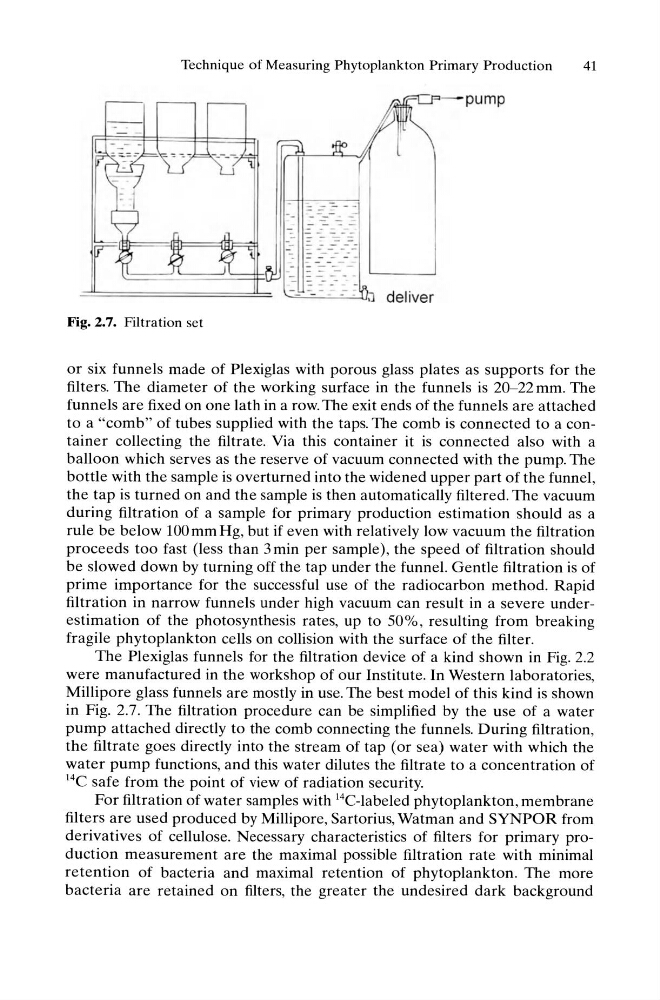
Fig. 2.7. Filtration set
or six funnels made of Plexiglas with porous glass plates as supports for the
filters. The diameter of the working surface in the funnels is 20-22 mm. The
funnels are fixed on one lath in a row. The exit ends of the funnels are attached
to a "comb" of tubes supplied with the taps. The comb is connected to a container collecting the filtrate. Via this container it is connected also with a
balloon which serves as the reserve of vacuum connected with the pump. The
bottle with the sample is overturned into the widened upper part of the funnel,
the tap is turned on and the sample is then automatically filtered. The vacuum
during filtration of a sample for primary production estimation should as a
rule be below 100 mm Hg, but if even with relatively low vacuum the filtration
proceeds too fast (less than 3 min per sample), the speed of filtration should
be slowed down by turning off the tap under the funnel. Gentle filtration is of
prime importance for the successful use of the radiocarbon method. Rapid
filtration in narrow funnels under high vacuum can result in a severe underestimation of the photosynthesis rates, up to 50% , resulting from breaking
fragile phytoplankton cells on collision with the surface of the filter.
The Plexiglas funnels for the filtration device of a kind shown in Fig. 2.2
were manufactured in the workshop of our Institute. In Western laboratories,
Millipore glass funnels are mostly in use. The best model of this kind is shown
in Fig. 2.7. The filtration procedure can be simplified by the use of a water
pump attached directly to the comb connecting the funnels. During filtration,
the filtrate goes directly into the stream of tap (or sea) water with which the
water pump functions, and this water dilutes the filtrate to a concentration of
14C safe from the point of view of radiation security.
For filtration of water samples with 14C-Iabeled phytoplankton, membrane
filters are used produced by Millipore, Sartorius, Watman and SYNPOR from
derivatives of cellulose. Necessary characteristics of filters for primary production measurement are the maximal possible filtration rate with minimal
retention of bacteria and maximal retention of phytoplankton. The more
bacteria are retained on filters, the greater the undesired dark background
41
-pump
- - - -
- -
- - - -- =--==
-
----deliver
Fig. 2.7. Filtration set
or six funnels made of Plexiglas with porous glass plates as supports for the
filters. The diameter of the working surface in the funnels is 20-22 mm. The
funnels are fixed on one lath in a row. The exit ends of the funnels are attached
to a "comb" of tubes supplied with the taps. The comb is connected to a container collecting the filtrate. Via this container it is connected also with a
balloon which serves as the reserve of vacuum connected with the pump. The
bottle with the sample is overturned into the widened upper part of the funnel,
the tap is turned on and the sample is then automatically filtered. The vacuum
during filtration of a sample for primary production estimation should as a
rule be below 100 mm Hg, but if even with relatively low vacuum the filtration
proceeds too fast (less than 3 min per sample), the speed of filtration should
be slowed down by turning off the tap under the funnel. Gentle filtration is of
prime importance for the successful use of the radiocarbon method. Rapid
filtration in narrow funnels under high vacuum can result in a severe underestimation of the photosynthesis rates, up to 50% , resulting from breaking
fragile phytoplankton cells on collision with the surface of the filter.
The Plexiglas funnels for the filtration device of a kind shown in Fig. 2.2
were manufactured in the workshop of our Institute. In Western laboratories,
Millipore glass funnels are mostly in use. The best model of this kind is shown
in Fig. 2.7. The filtration procedure can be simplified by the use of a water
pump attached directly to the comb connecting the funnels. During filtration,
the filtrate goes directly into the stream of tap (or sea) water with which the
water pump functions, and this water dilutes the filtrate to a concentration of
14C safe from the point of view of radiation security.
For filtration of water samples with 14C-Iabeled phytoplankton, membrane
filters are used produced by Millipore, Sartorius, Watman and SYNPOR from
derivatives of cellulose. Necessary characteristics of filters for primary production measurement are the maximal possible filtration rate with minimal
retention of bacteria and maximal retention of phytoplankton. The more
bacteria are retained on filters, the greater the undesired dark background