

40
The Radiocarbon Method to Estimate Primary Production
' 00
15
50
25
11
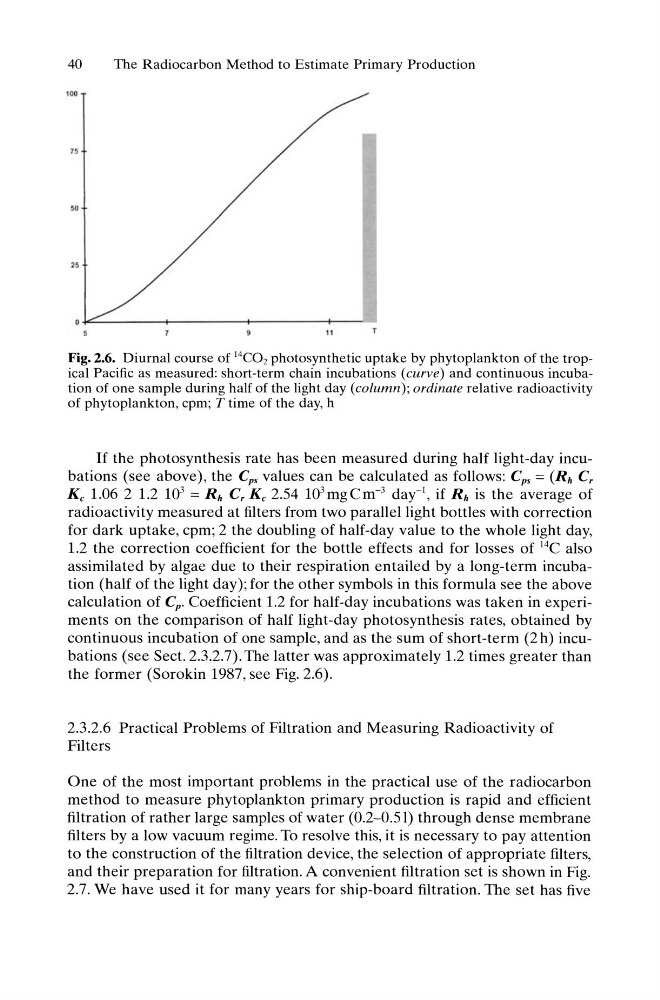
Fig.2.6. Diurnal course of 14C02 photosynthetic uptake by phytoplankton of the tropical Pacific as measured: short-term chain incubations (curve) and continuous incubation of one sample during half of the light day (column); ordinate relative radioactivity
of phytoplankton, cpm; T time of the day, h
If the photosynthesis rate has been measured during half light-day incubations (see above), the Cps values can be calculated as follows: Cps = (Rh Cr
Kc 1.06 2 1.2 10 3 = Rh Cr Kc 2.54 10 3 mg C m- 3 day-l, if Rh is the average of
radioactivity measured at filters from two parallel light bottles with correction
for dark uptake, cpm; 2 the doubling of half-day value to the whole light day,
1.2 the correction coefficient for the bottle effects and for losses of 14C also
assimilated by algae due to their respiration entailed by a long-term incubation (half of the light day); for the other symbols in this formula see the above
calculation of Cpo Coefficient 1.2 for half-day incubations was taken in experiments on the comparison of half light-day photosynthesis rates, obtained by
continuous incubation of one sample, and as the sum of short-term (2h) incubations (see Sect. 2.3.2.7). The latter was approximately 1.2 times greater than
the former (Sorokin 1987, see Fig. 2.6).
2.3.2.6 Practical Problems of Filtration and Measuring Radioactivity of
Filters
One of the most important problems in the practical use of the radiocarbon
method to measure phytoplankton primary production is rapid and efficient
filtration of rather large samples of water (0.2-0.51) through dense membrane
filters by a low vacuum regime. To resolve this, it is necessary to pay attention
to the construction of the filtration device, the selection of appropriate filters,
and their preparation for filtration. A convenient filtration set is shown in Fig.
2.7. We have used it for many years for ship-board filtration. The set has five
The Radiocarbon Method to Estimate Primary Production
' 00
15
50
25
11
Fig.2.6. Diurnal course of 14C02 photosynthetic uptake by phytoplankton of the tropical Pacific as measured: short-term chain incubations (curve) and continuous incubation of one sample during half of the light day (column); ordinate relative radioactivity
of phytoplankton, cpm; T time of the day, h
If the photosynthesis rate has been measured during half light-day incubations (see above), the Cps values can be calculated as follows: Cps = (Rh Cr
Kc 1.06 2 1.2 10 3 = Rh Cr Kc 2.54 10 3 mg C m- 3 day-l, if Rh is the average of
radioactivity measured at filters from two parallel light bottles with correction
for dark uptake, cpm; 2 the doubling of half-day value to the whole light day,
1.2 the correction coefficient for the bottle effects and for losses of 14C also
assimilated by algae due to their respiration entailed by a long-term incubation (half of the light day); for the other symbols in this formula see the above
calculation of Cpo Coefficient 1.2 for half-day incubations was taken in experiments on the comparison of half light-day photosynthesis rates, obtained by
continuous incubation of one sample, and as the sum of short-term (2h) incubations (see Sect. 2.3.2.7). The latter was approximately 1.2 times greater than
the former (Sorokin 1987, see Fig. 2.6).
2.3.2.6 Practical Problems of Filtration and Measuring Radioactivity of
Filters
One of the most important problems in the practical use of the radiocarbon
method to measure phytoplankton primary production is rapid and efficient
filtration of rather large samples of water (0.2-0.51) through dense membrane
filters by a low vacuum regime. To resolve this, it is necessary to pay attention
to the construction of the filtration device, the selection of appropriate filters,
and their preparation for filtration. A convenient filtration set is shown in Fig.
2.7. We have used it for many years for ship-board filtration. The set has five