

38
The Radiocarbon Method to Estimate Primary Production
toplankton in the moving bottles forms aggregations and clumps and may soon
lose its activity; for exposure on vertical profiles, see below (Sect. 2.3.3.2). The
duration of incubation can be either 2-3 h or half a light day, depending on
the mode of Cps calculations preferred by the researcher. The Cps values, e.g.,
the primary production in the surface layer per day, can be calculated using
either the Cp-values of the photosynthesis rate h- 1 or the values of photosynthesis measured during the half light-day incubations (Cph). I recommend the
first mode from the practical point of view and also for adequacy of results.
Using the first mode of Cps estimation, the samples are exposed for 2-3 h within
the time interval from 08.00 to 17.00 to have enough light, and the values of
photosynthesis thus obtained are expressed as mgCm- 3 h- l • To calculate Cps
using C p values, K/ coefficients are introduced, which are equal to the ratios
Cp/Cp estimated at various periods of the light day for a given water body in
a given season. These coefficients are calculated by empirically estimated
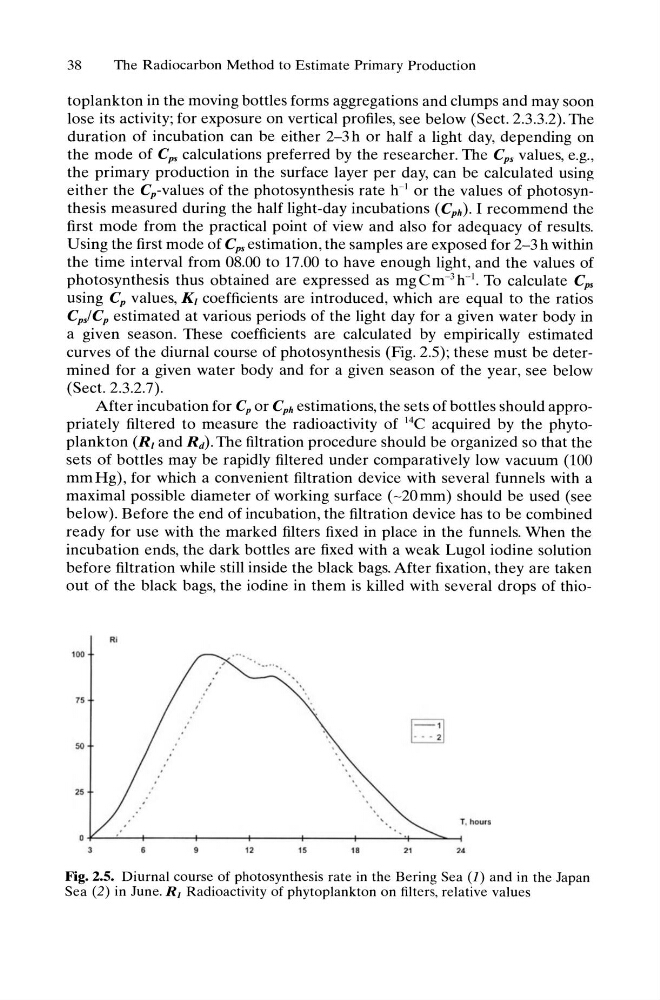
curves of the diurnal course of photosynthesis (Fig. 2.5); these must be determined for a given water body and for a given season of the year, see below
(Sect. 2.3.2.7).
After incubation for Cp or Cph estimations, the sets of bottles should appropriately filtered to measure the radioactivity of 14C acquired by the phytoplankton (R/ and Rd). The filtration procedure should be organized so that the
sets of bottles may be rapidly filtered under comparatively low vacuum (100
mmHg), for which a convenient filtration device with several funnels with a
maximal possible diameter of working surface (- 20mm) should be used (see
below). Before the end of incubation, the filtration device has to be combined
ready for use with the marked filters fixed in place in the funnels. When the
incubation ends, the dark bottles are fixed with a weak Lugol iodine solution
before filtration while still inside the black bags. After fixation, they are taken
out of the black bags, the iodine in them is killed with several drops of thioRI
100
,
i
7 5
50
25
12
15
18
r===1l
L.:..!l
21
T. hours
24
Fig. 2.5. Diurnal course of photosynthesis rate in the Bering Sea (1) and in the Japan
Sea (2) in June. RJ Radioactivity of phytoplankton on filters, relative values
The Radiocarbon Method to Estimate Primary Production
toplankton in the moving bottles forms aggregations and clumps and may soon
lose its activity; for exposure on vertical profiles, see below (Sect. 2.3.3.2). The
duration of incubation can be either 2-3 h or half a light day, depending on
the mode of Cps calculations preferred by the researcher. The Cps values, e.g.,
the primary production in the surface layer per day, can be calculated using
either the Cp-values of the photosynthesis rate h- 1 or the values of photosynthesis measured during the half light-day incubations (Cph). I recommend the
first mode from the practical point of view and also for adequacy of results.
Using the first mode of Cps estimation, the samples are exposed for 2-3 h within
the time interval from 08.00 to 17.00 to have enough light, and the values of
photosynthesis thus obtained are expressed as mgCm- 3 h- l • To calculate Cps
using C p values, K/ coefficients are introduced, which are equal to the ratios
Cp/Cp estimated at various periods of the light day for a given water body in
a given season. These coefficients are calculated by empirically estimated
curves of the diurnal course of photosynthesis (Fig. 2.5); these must be determined for a given water body and for a given season of the year, see below
(Sect. 2.3.2.7).
After incubation for Cp or Cph estimations, the sets of bottles should appropriately filtered to measure the radioactivity of 14C acquired by the phytoplankton (R/ and Rd). The filtration procedure should be organized so that the
sets of bottles may be rapidly filtered under comparatively low vacuum (100
mmHg), for which a convenient filtration device with several funnels with a
maximal possible diameter of working surface (- 20mm) should be used (see
below). Before the end of incubation, the filtration device has to be combined
ready for use with the marked filters fixed in place in the funnels. When the
incubation ends, the dark bottles are fixed with a weak Lugol iodine solution
before filtration while still inside the black bags. After fixation, they are taken
out of the black bags, the iodine in them is killed with several drops of thioRI
100
,
i
7 5
50
25
12
15
18
r===1l
L.:..!l
21
T. hours
24
Fig. 2.5. Diurnal course of photosynthesis rate in the Bering Sea (1) and in the Japan
Sea (2) in June. RJ Radioactivity of phytoplankton on filters, relative values