

Technique of Measuring Phytoplankton Primary Production
37
the next morning, when they should be charged for incubation in natural light.
The samples should be collected into 3-1 glass jars and kept in the deck aquarium in the shade at a temperature close to that in situ, and next morning distributed into the sets of bottles for Cps measurements. When working aboard
ship, incubation of bottles for Cps estimations during calm weather can be
carried out directly in the sea in situ. The bottles in this case are immersed
into the upper water layer some 0.5-1 m under the water surface, being
attached by special clamps at the end of the rope. However, if the sea is not
ideally calm and the ship is rolling, exposures should be performed aboard
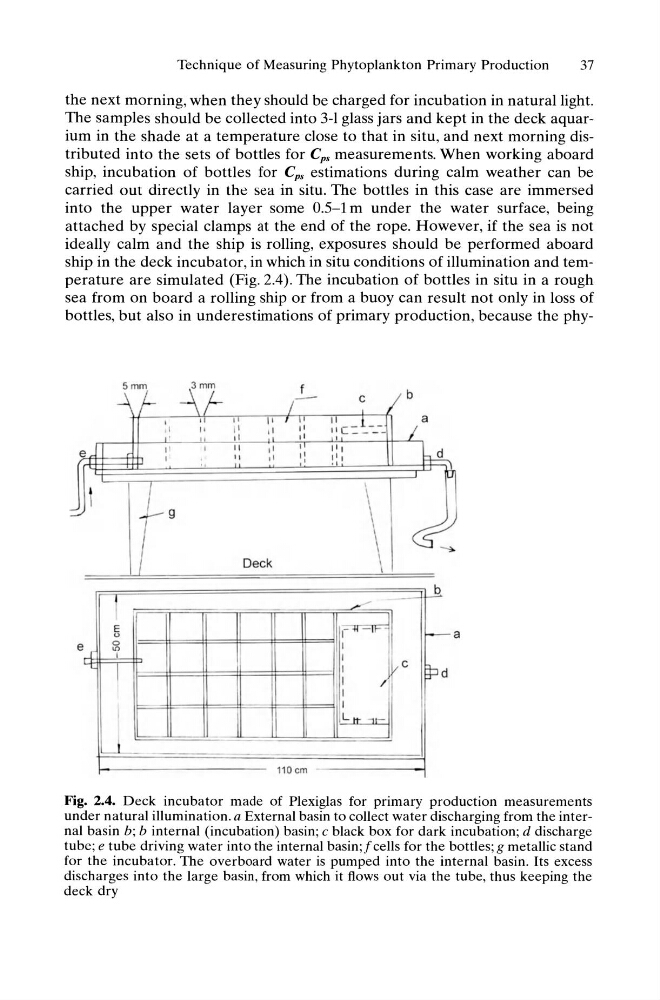
ship in the deck incubator, in which in situ conditions of illumination and temperature are simulated (Fig. 2.4). The incubation of bottles in situ in a rough
sea from on board a rolling ship or from a buoy can result not only in loss of
bottles, but also in underestimations of primary production, because the phy5mm
3mm
b
a
"
e
"
"
' "
,
" "
'"
"
\
9
\
Deck
I
--=..... --- ~
E
I~
r-<)
a
e
0
I
J"
'" I
I
I
I
lI c
~ d
I
/
I
I
IL tt - 11U
110cm
Fig. 2.4. Deck incubator made of Plexiglas for primary production measurements
under natural illumination. a External basin to collect water discharging from the internal basin b; b internal (incubation) basin; c black box for dark incubation; d discharge
tube; e tube driving water into the internal basin; f cells for the bottles; g metallic stand
for the incubator. The overboard water is pumped into the internal basin. Its excess
discharges into the large basin, from which it flows out via the tube, thus keeping the
deck dry
37
the next morning, when they should be charged for incubation in natural light.
The samples should be collected into 3-1 glass jars and kept in the deck aquarium in the shade at a temperature close to that in situ, and next morning distributed into the sets of bottles for Cps measurements. When working aboard
ship, incubation of bottles for Cps estimations during calm weather can be
carried out directly in the sea in situ. The bottles in this case are immersed
into the upper water layer some 0.5-1 m under the water surface, being
attached by special clamps at the end of the rope. However, if the sea is not
ideally calm and the ship is rolling, exposures should be performed aboard
ship in the deck incubator, in which in situ conditions of illumination and temperature are simulated (Fig. 2.4). The incubation of bottles in situ in a rough
sea from on board a rolling ship or from a buoy can result not only in loss of
bottles, but also in underestimations of primary production, because the phy5mm
3mm
b
a
"
e
"
"
' "
,
" "
'"
"
\
9
\
Deck
I
--=..... --- ~
E
I~
r-<)
a
e
0
I
J"
'" I
I
I
I
lI c
~ d
I
/
I
I
IL tt - 11U
110cm
Fig. 2.4. Deck incubator made of Plexiglas for primary production measurements
under natural illumination. a External basin to collect water discharging from the internal basin b; b internal (incubation) basin; c black box for dark incubation; d discharge
tube; e tube driving water into the internal basin; f cells for the bottles; g metallic stand
for the incubator. The overboard water is pumped into the internal basin. Its excess
discharges into the large basin, from which it flows out via the tube, thus keeping the
deck dry