

288
Assay of Some Common Hydrobiological Techniques
ring used for calculations, so that the column cut by it becomes elliptic and
not cylindrical. It is obvious that the degree of such undercatches is unique to
each zooplankton species having different shapes, sizes, and moving speed
(Tables 6.1, 6.2), just as it depends on each given plankton net, given its share,
mesh size, and age. The latter is especially important, because the nets become
clogged with age, and their filtration capacity decreases. Then what should
the researcher do if he really wants to obtain realistic data on the density
composition and distribution of zooplankton, but not to count "something for
nothing" merely to write a paper? (1) plankton net tows should be rejected
in favor of either passing a volume of water of 30-501 through the plankton
net of 40-70-/lm mesh when working in shallow (I-3m depths) basins, or of
filtration of a series of water bottle samples (5 to 501, depending on plankton
density), taken on vertical profile, taking the character of stratification into
account (see Sect. 2.3.2.4), or (2) plankton net tows can be used, but taking
possible undercatch of main zooplankton species into account by comparing
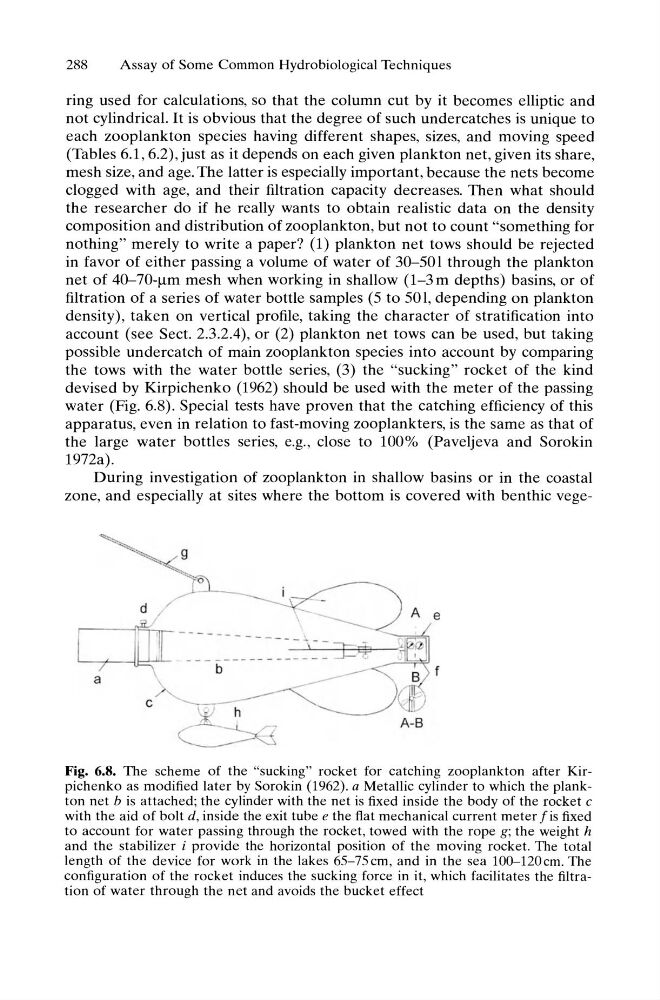
the tows with the water bottle series, (3) the "sucking" rocket of the kind
devised by Kirpichenko (1962) should be used with the meter of the passing
water (Fig. 6.8). Special tests have proven that the catching efficiency of this
apparatus, even in relation to fast-moving zooplankters, is the same as that of
the large water bottles series, e.g., close to 100% (Paveljeva and Sorokin
1972a).
During investigation of zooplankton in shallow basins or in the coastal
zone, and especially at sites where the bottom is covered with benthic vege~g
d /
/
~-- - - - --- - ---- ~ -
~ --- 1)--- ---- - ---c
h
~
f
A- 8
Fig. 6.8. The scheme of the "sucking" rocket for catching zooplankton after Kirpichenko as modified later by Sorokin (1962). a Metallic cylinder to which the plankton net b is attached; the cylinder with the net is fixed inside the body of the rocket c
with the aid of bolt d, inside the exit tube e the flat mechanical current meter fis fixed
to account for water passing through the rocket, towed with the rope g; the weight h
and the stabilizer i provide the horizontal position of the moving rocket. The total
length of the device for work in the lakes 65-75cm, and in the sea lOO-120cm. The
configuration of the rocket induces the sucking force in it, which facilitates the filtration of water through the net and avoids the bucket effect
Assay of Some Common Hydrobiological Techniques
ring used for calculations, so that the column cut by it becomes elliptic and
not cylindrical. It is obvious that the degree of such undercatches is unique to
each zooplankton species having different shapes, sizes, and moving speed
(Tables 6.1, 6.2), just as it depends on each given plankton net, given its share,
mesh size, and age. The latter is especially important, because the nets become
clogged with age, and their filtration capacity decreases. Then what should
the researcher do if he really wants to obtain realistic data on the density
composition and distribution of zooplankton, but not to count "something for
nothing" merely to write a paper? (1) plankton net tows should be rejected
in favor of either passing a volume of water of 30-501 through the plankton
net of 40-70-/lm mesh when working in shallow (I-3m depths) basins, or of
filtration of a series of water bottle samples (5 to 501, depending on plankton
density), taken on vertical profile, taking the character of stratification into
account (see Sect. 2.3.2.4), or (2) plankton net tows can be used, but taking
possible undercatch of main zooplankton species into account by comparing
the tows with the water bottle series, (3) the "sucking" rocket of the kind
devised by Kirpichenko (1962) should be used with the meter of the passing
water (Fig. 6.8). Special tests have proven that the catching efficiency of this
apparatus, even in relation to fast-moving zooplankters, is the same as that of
the large water bottles series, e.g., close to 100% (Paveljeva and Sorokin
1972a).
During investigation of zooplankton in shallow basins or in the coastal
zone, and especially at sites where the bottom is covered with benthic vege~g
d /
/
~-- - - - --- - ---- ~ -
~ --- 1)--- ---- - ---c
h
~
f
A- 8
Fig. 6.8. The scheme of the "sucking" rocket for catching zooplankton after Kirpichenko as modified later by Sorokin (1962). a Metallic cylinder to which the plankton net b is attached; the cylinder with the net is fixed inside the body of the rocket c
with the aid of bolt d, inside the exit tube e the flat mechanical current meter fis fixed
to account for water passing through the rocket, towed with the rope g; the weight h
and the stabilizer i provide the horizontal position of the moving rocket. The total
length of the device for work in the lakes 65-75cm, and in the sea lOO-120cm. The
configuration of the rocket induces the sucking force in it, which facilitates the filtration of water through the net and avoids the bucket effect