

Quantification of Mesozooplankton
287
even in this field, the use of insufficient techniques often occurs. This concerns
especially the use of plankton net tows, which do not account for grave undercatches of zooplankton. An undercatch of two to ten times is a common
phenomenon when using Juday or other kinds of plankton nets (Dyjachenko
1963; Sorokin and Paveljeva 1972; Grese et al. 1975; Kovalev et al. 1977;
Kovalev lYt)O; Shushkina et aI., 1980; Vinogradov and Shushkina, 1983; see
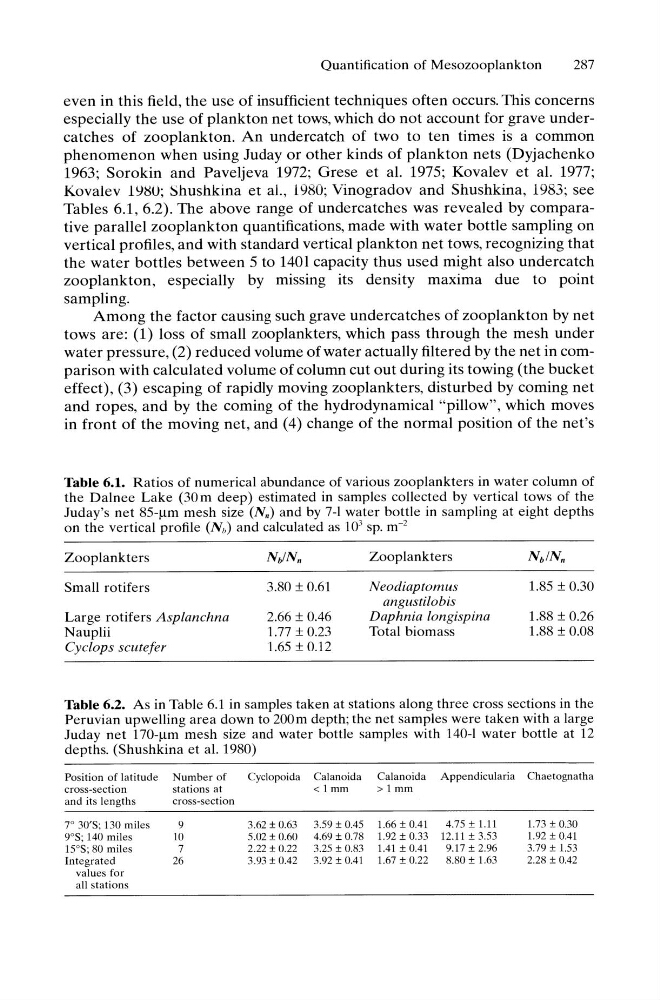
Tables 6.1,6.2). The above range of undercatches was revealed by comparative parallel zooplankton quantifications, made with water bottle sampling on
vertical profiles, and with standard vertical plankton net tows, recognizing that
the water bottles between 5 to 1401 capacity thus used might also undercatch
zooplankton, especially by missing its density maxima due to point
sampling.
Among the factor causing such grave undercatches of zooplankton by net
tows are: (1) loss of small zooplankters, which pass through the mesh under
water pressure, (2) reduced volume of water actually filtered by the net in comparison with calculated volume of column cut out during its towing (the bucket
effect), (3) escaping of rapidly moving zooplankters, disturbed by coming net
and ropes, and by the coming of the hydro dynamical "pillow", which moves
in front of the moving net, and (4) change of the normal position of the net's
Table 6.1. Ratios of numerical abundance of various zooplankters in water column of
the Dalnee Lake (30m deep) estimated in samples collected by vertical tows of the
Juday's net 85-~m mesh size (Nn) and by 7-1 water bottle in sampling at eight depths
on the vertical profile (Nb) and calculated as 10 3 sp. m- 2
Zooplankters
NblNn
Zooplankters
NblNn
Small rotifers
3.80 ± 0.61
Neodiaptomus
1.85 ± 0.30
angustilobis
Large rotifers Asplanchna
2.66 ± 0.46
Daphnia longispina
1.88 ± 0.26
Nauplii
1.77 ± 0.23
Total biomass
1.88 ± 0.08
Cyclops scutefer
1.65 ± 0.12
Table 6.2. As in Table 6.1 in samples taken at stations along three cross sections in the
Peruvian upwelling area down to 200m depth; the net samples were taken with a large
Juday net 170-~m mesh size and water bottle samples with 140-1 water bottle at 12
depths. (Shush kina et al. 1980)
Position of latitude Number of
Cyclopoida Calanoida
Calanoida Appendicularia Chaetognatha
cross-section
stations at
< Imm
> Imm
and its lengths
cross-section
7° 30'S; 130 miles
9
3.62 0.63
3.59 0.45 1.66 0.41
4.75 1.11
1.73 0.30
goS; 140 miles
10
5.02 D.60
4.69 0.78 1.92 0.33 12.11 3.53
1.92 0.41
15°S; 80 miles
7
2.22 0.22
3.25 0.83 1.41 0.41
9.17 2.96
3.79 1.53
Integrated
26
3.93 0.42
3.92 0.41 1.67 0.22
8.80 1.63
2.28 D.42
values for
all stations
287
even in this field, the use of insufficient techniques often occurs. This concerns
especially the use of plankton net tows, which do not account for grave undercatches of zooplankton. An undercatch of two to ten times is a common
phenomenon when using Juday or other kinds of plankton nets (Dyjachenko
1963; Sorokin and Paveljeva 1972; Grese et al. 1975; Kovalev et al. 1977;
Kovalev lYt)O; Shushkina et aI., 1980; Vinogradov and Shushkina, 1983; see
Tables 6.1,6.2). The above range of undercatches was revealed by comparative parallel zooplankton quantifications, made with water bottle sampling on
vertical profiles, and with standard vertical plankton net tows, recognizing that
the water bottles between 5 to 1401 capacity thus used might also undercatch
zooplankton, especially by missing its density maxima due to point
sampling.
Among the factor causing such grave undercatches of zooplankton by net
tows are: (1) loss of small zooplankters, which pass through the mesh under
water pressure, (2) reduced volume of water actually filtered by the net in comparison with calculated volume of column cut out during its towing (the bucket
effect), (3) escaping of rapidly moving zooplankters, disturbed by coming net
and ropes, and by the coming of the hydro dynamical "pillow", which moves
in front of the moving net, and (4) change of the normal position of the net's
Table 6.1. Ratios of numerical abundance of various zooplankters in water column of
the Dalnee Lake (30m deep) estimated in samples collected by vertical tows of the
Juday's net 85-~m mesh size (Nn) and by 7-1 water bottle in sampling at eight depths
on the vertical profile (Nb) and calculated as 10 3 sp. m- 2
Zooplankters
NblNn
Zooplankters
NblNn
Small rotifers
3.80 ± 0.61
Neodiaptomus
1.85 ± 0.30
angustilobis
Large rotifers Asplanchna
2.66 ± 0.46
Daphnia longispina
1.88 ± 0.26
Nauplii
1.77 ± 0.23
Total biomass
1.88 ± 0.08
Cyclops scutefer
1.65 ± 0.12
Table 6.2. As in Table 6.1 in samples taken at stations along three cross sections in the
Peruvian upwelling area down to 200m depth; the net samples were taken with a large
Juday net 170-~m mesh size and water bottle samples with 140-1 water bottle at 12
depths. (Shush kina et al. 1980)
Position of latitude Number of
Cyclopoida Calanoida
Calanoida Appendicularia Chaetognatha
cross-section
stations at
< Imm
> Imm
and its lengths
cross-section
7° 30'S; 130 miles
9
3.62 0.63
3.59 0.45 1.66 0.41
4.75 1.11
1.73 0.30
goS; 140 miles
10
5.02 D.60
4.69 0.78 1.92 0.33 12.11 3.53
1.92 0.41
15°S; 80 miles
7
2.22 0.22
3.25 0.83 1.41 0.41
9.17 2.96
3.79 1.53
Integrated
26
3.93 0.42
3.92 0.41 1.67 0.22
8.80 1.63
2.28 D.42
values for
all stations