

Techniques for the Quantification Density of Microplankton Populations
283
I
I
I
I
B
I
I
J
J
I
J
__ L e
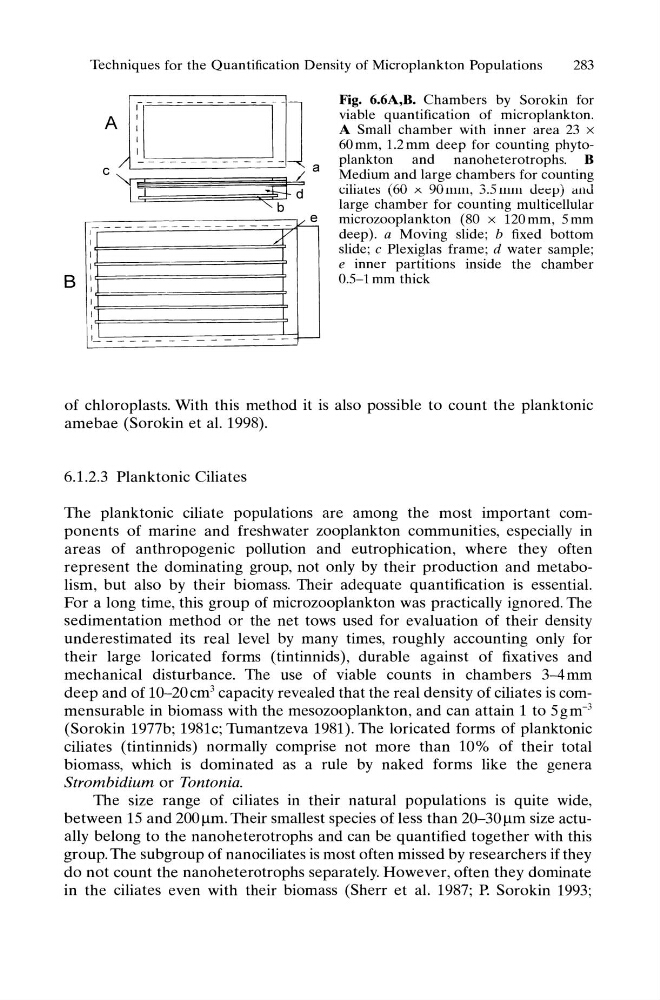
Fig. 6.6A,B. Chambers by Sorokin for
viable quantification of microplankton.
A Small chamber with inner area 23 x
60mm, 1.2mm deep for counting phytoplankton and nanoheterotrophs. B
Medium and large chambers for counting
ciliale~ (60 x 90 III III , 3.5ullll Jeep) allJ
large chamber for counting multicellular
microzooplankton (80 x 120 mm, 5 mm
deep). a Moving slide; b fixed bottom
slide; c Plexiglas frame; d water sample;
e inner partitions inside the chamber
0.5-1 mm thick
of chloroplasts. With this method it is also possible to count the planktonic
amebae (Sorokin et al. 1998).
6.1.2.3 Planktonic Ciliates
The planktonic ciliate populations are among the most important components of marine and freshwater zooplankton communities, especially in
areas of anthropogenic pollution and eutrophication, where they often
represent the dominating group, not only by their production and metabolism, but also by their biomass. Their adequate quantification is essential.
For a long time, this group of microzooplankton was practically ignored. The
sedimentation method or the net tows used for evaluation of their density
underestimated its real level by many times, roughly accounting only for
their large loricated forms (tintinnids), durable against of fixatives and
mechanical disturbance. The use of viable counts in chambers 3-4 mm
deep and of 10-20cm 3 capacity revealed that the real density of ciliates is commensurable in biomass with the mesozooplankton, and can attain 1 to 5 gm- 3
(Sorokin 1977b; 1981c; Tumantzeva 1981). The loricated forms of planktonic
ciliates (tintinnids) normally comprise not more than 10% of their total
biomass, which is dominated as a rule by naked forms like the genera
Strombidium or Tontonia.
The size range of ciliates in their natural populations is quite wide,
between 15 and 200 ~m. Their smallest species of less than 20-30 ~m size actually belong to the nanoheterotrophs and can be quantified together with this
group. The subgroup of nanociliates is most often missed by researchers if they
do not count the nanoheterotrophs separately. However, often they dominate
in the ciliates even with their biomass (Sherr et al. 1987; P. Sorokin 1993;
283
I
I
I
I
B
I
I
J
J
I
J
__ L e
Fig. 6.6A,B. Chambers by Sorokin for
viable quantification of microplankton.
A Small chamber with inner area 23 x
60mm, 1.2mm deep for counting phytoplankton and nanoheterotrophs. B
Medium and large chambers for counting
ciliale~ (60 x 90 III III , 3.5ullll Jeep) allJ
large chamber for counting multicellular
microzooplankton (80 x 120 mm, 5 mm
deep). a Moving slide; b fixed bottom
slide; c Plexiglas frame; d water sample;
e inner partitions inside the chamber
0.5-1 mm thick
of chloroplasts. With this method it is also possible to count the planktonic
amebae (Sorokin et al. 1998).
6.1.2.3 Planktonic Ciliates
The planktonic ciliate populations are among the most important components of marine and freshwater zooplankton communities, especially in
areas of anthropogenic pollution and eutrophication, where they often
represent the dominating group, not only by their production and metabolism, but also by their biomass. Their adequate quantification is essential.
For a long time, this group of microzooplankton was practically ignored. The
sedimentation method or the net tows used for evaluation of their density
underestimated its real level by many times, roughly accounting only for
their large loricated forms (tintinnids), durable against of fixatives and
mechanical disturbance. The use of viable counts in chambers 3-4 mm
deep and of 10-20cm 3 capacity revealed that the real density of ciliates is commensurable in biomass with the mesozooplankton, and can attain 1 to 5 gm- 3
(Sorokin 1977b; 1981c; Tumantzeva 1981). The loricated forms of planktonic
ciliates (tintinnids) normally comprise not more than 10% of their total
biomass, which is dominated as a rule by naked forms like the genera
Strombidium or Tontonia.
The size range of ciliates in their natural populations is quite wide,
between 15 and 200 ~m. Their smallest species of less than 20-30 ~m size actually belong to the nanoheterotrophs and can be quantified together with this
group. The subgroup of nanociliates is most often missed by researchers if they
do not count the nanoheterotrophs separately. However, often they dominate
in the ciliates even with their biomass (Sherr et al. 1987; P. Sorokin 1993;