

266
Use of Radioisotopes to Study Biogeochemical Cycling of Elements
estimate the value of Ap using Nucleopore filters for the separation of phytoplankton from bacterioplankton, and then to calculate the Ab values (Sorokin
1985). The procedure of their estimation is as follows: 3-4 pore size Nucleopore filters are used for the separation of phytoplankton from bacterioplankton. These filters retain the majority of phytoplankton populations plus the
minority of bacteria which are aggregated or attached to particles. The goal is
to estimate the degree of retention by these filters of only phytoplankton and
bacterioplankton, to correct the results of separation of these components
using Nucleopore filters in experiments with 33P04-P' This problem is solved
as follows.
Both microplankton components are labeled with 14C in parallel samples:
the phytoplankton with 14C02 via photosynthesis and the bacterioplankton via
assimilation of labeled glucose.
To determine A p , the sample taken with the water bottle is distributed into
three 300-cm 3 parallel bottles, one of which is then charged with 33P04, the
second with 14C-carbonate, and the third with 14C-glucose. All three bottles are
incubated for 4 h under in situ conditions. Then the content of each bottle is
split into two portions. One portion of each is filtered in duplicate subsamples
of 50ml (without previous fixation) through the 2-3-/-lm pore size Nucleopore
filters. Filtration is performed without an external vacuum as described above
(see Fig. 4.8). Filters with 33P04 are rinsed twice with 3 ml of filtered natural
water followed with 3 ml of 0.005% H3P04 in the same water. The filters
with 14C-phytoplankton are rinsed in the same way, and the filters with 14C_
bacterioplankton with 3 ml of 0.1 % glucose solution followed by the same
volume of natural water. All three duplicate filters are radioassayed and
their corresponding radioactivity is recorded as r1, r], and r3. The remained
halves of samples are also filtered in duplicates through the Sartorius membrane filters with pore size 0.3-0.4/-lm, and are then treated as described above.
Their radioactivity is designated as R 1 , R z, and R 3 • The radioactivity of labeled
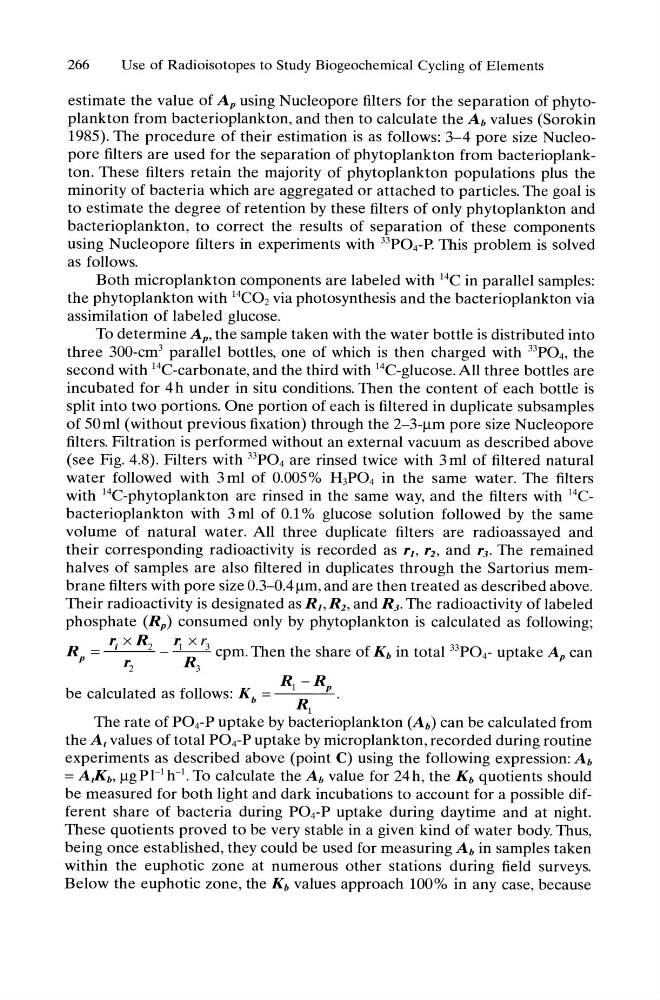
phosphate (Rp) consumed only by phytoplankton is calculated as following;
r. x R
1: X r
R = '
2 - _1 __ 3 cpm. Then the share of Kb in total 33p0 4 _ uptake Ap can
p
r 2
R3
R -R
be calculated as follows: Kb =
1
P
RI
The rate of P04-P uptake by bacterioplankton (Ab) can be calculated from
the At values of total P04-P uptake by microplankton, recorded during routine
experiments as described above (point C) using the following expression: Ab
= AtKb, /-lg P 1-1 h- 1 . To calculate the Ab value for 24 h, the Kb quotients should
be measured for both light and dark incubations to account for a possible different share of bacteria during P04-P uptake during daytime and at night.
These quotients proved to be very stable in a given kind of water body. Thus,
being once established, they could be used for measuring Ab in samples taken
within the euphotic zone at numerous other stations during field surveys.
Below the euphotic zone, the Kb values approach 100% in any case, because
Use of Radioisotopes to Study Biogeochemical Cycling of Elements
estimate the value of Ap using Nucleopore filters for the separation of phytoplankton from bacterioplankton, and then to calculate the Ab values (Sorokin
1985). The procedure of their estimation is as follows: 3-4 pore size Nucleopore filters are used for the separation of phytoplankton from bacterioplankton. These filters retain the majority of phytoplankton populations plus the
minority of bacteria which are aggregated or attached to particles. The goal is
to estimate the degree of retention by these filters of only phytoplankton and
bacterioplankton, to correct the results of separation of these components
using Nucleopore filters in experiments with 33P04-P' This problem is solved
as follows.
Both microplankton components are labeled with 14C in parallel samples:
the phytoplankton with 14C02 via photosynthesis and the bacterioplankton via
assimilation of labeled glucose.
To determine A p , the sample taken with the water bottle is distributed into
three 300-cm 3 parallel bottles, one of which is then charged with 33P04, the
second with 14C-carbonate, and the third with 14C-glucose. All three bottles are
incubated for 4 h under in situ conditions. Then the content of each bottle is
split into two portions. One portion of each is filtered in duplicate subsamples
of 50ml (without previous fixation) through the 2-3-/-lm pore size Nucleopore
filters. Filtration is performed without an external vacuum as described above
(see Fig. 4.8). Filters with 33P04 are rinsed twice with 3 ml of filtered natural
water followed with 3 ml of 0.005% H3P04 in the same water. The filters
with 14C-phytoplankton are rinsed in the same way, and the filters with 14C_
bacterioplankton with 3 ml of 0.1 % glucose solution followed by the same
volume of natural water. All three duplicate filters are radioassayed and
their corresponding radioactivity is recorded as r1, r], and r3. The remained
halves of samples are also filtered in duplicates through the Sartorius membrane filters with pore size 0.3-0.4/-lm, and are then treated as described above.
Their radioactivity is designated as R 1 , R z, and R 3 • The radioactivity of labeled
phosphate (Rp) consumed only by phytoplankton is calculated as following;
r. x R
1: X r
R = '
2 - _1 __ 3 cpm. Then the share of Kb in total 33p0 4 _ uptake Ap can
p
r 2
R3
R -R
be calculated as follows: Kb =
1
P
RI
The rate of P04-P uptake by bacterioplankton (Ab) can be calculated from
the At values of total P04-P uptake by microplankton, recorded during routine
experiments as described above (point C) using the following expression: Ab
= AtKb, /-lg P 1-1 h- 1 . To calculate the Ab value for 24 h, the Kb quotients should
be measured for both light and dark incubations to account for a possible different share of bacteria during P04-P uptake during daytime and at night.
These quotients proved to be very stable in a given kind of water body. Thus,
being once established, they could be used for measuring Ab in samples taken
within the euphotic zone at numerous other stations during field surveys.
Below the euphotic zone, the Kb values approach 100% in any case, because