

228
Use of Radioisotopes to Study Biogeochemical Cycling of Elements
between the experimental bottle and the control one (Rm - Ro). The latter
is equal to the sum of radioactivity of the end products of labeled methane
oxidized in the bottled subsamples during their incubation: CO2 + dissolved
metabolites + biomass carbon. This technique can be intercalibrated after
the direct one.
Finally, an even more simple approach may be the 14COTlabel. In
accordance with this approach, the excess uptake of the labeled CO2,
induced by the bacterial oxidation of unlabeled methane, added as a small
volume (0.3 cm3/100 ml) into the natural samples serves as an estimator of
in situ methane oxidation. The samples are incubated under native ambiental
conditions. The experiments are performed as described above (point B),
the only difference being that the samples are collected and treated so as
not to disturb natural conditions, as described above in this paragraph. The in
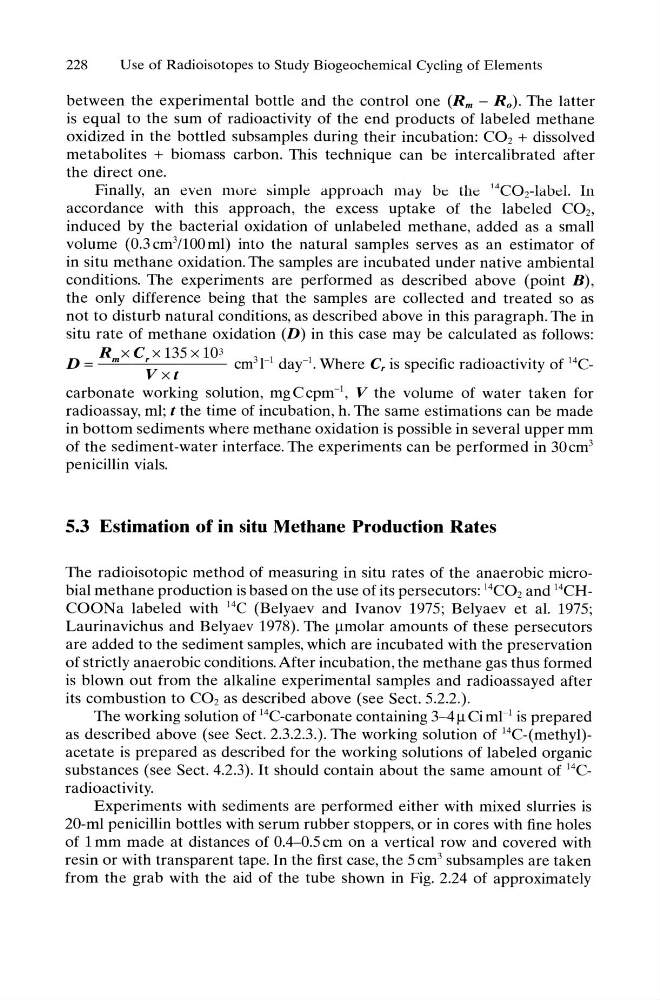
situ rate of methane oxidation (D) in this case may be calculated as follows:
R x C x 135 X 10 3
.
.
.
. .
D = m r
cm 3 1- 1 day-I. Where C r IS specIfic radIOactIvIty of I4C_
Vxt
carbonate working solution, mgCcpm-l, V the volume of water taken for
radioassay, ml; t the time of incubation, h. The same estimations can be made
in bottom sediments where methane oxidation is possible in several upper mm
of the sediment-water interface. The experiments can be performed in 30cm 3
penicillin vials.
5.3 Estimation of in situ Methane Production Rates
The radioisotopic method of measuring in situ rates of the anaerobic microbial methane production is based on the use of its persecutors: 14C02 and l4 CHCOONa labeled with 14C (Belyaev and Ivanov 1975; Belyaev et al. 1975;
Laurinavichus and Belyaev 1978). The Ilmolar amounts of these persecutors
are added to the sediment samples, which are incubated with the preservation
of strictly anaerobic conditions. After incubation, the methane gas thus formed
is blown out from the alkaline experimental samples and radioassayed after
its combustion to CO2 as described above (see Sect. 5.2.2.).
The working solution of 14C-carbonate containing 3-4 Il Ci ml- 1 is prepared
as described above (see Sect. 2.3.2.3.). The working solution of 14C-(methyl)acetate is prepared as described for the working solutions of labeled organic
substances (see Sect. 4.2.3). It should contain about the same amount of 14C_
radioactivity.
Experiments with sediments are performed either with mixed slurries is
20-ml penicillin bottles with serum rubber stoppers, or in cores with fine holes
of 1 mm made at distances of 0.4-0.5 cm on a vertical row and covered with
resin or with transparent tape. In the first case, the 5 cm 3 subsamples are taken
from the grab with the aid of the tube shown in Fig. 2.24 of approximately
Use of Radioisotopes to Study Biogeochemical Cycling of Elements
between the experimental bottle and the control one (Rm - Ro). The latter
is equal to the sum of radioactivity of the end products of labeled methane
oxidized in the bottled subsamples during their incubation: CO2 + dissolved
metabolites + biomass carbon. This technique can be intercalibrated after
the direct one.
Finally, an even more simple approach may be the 14COTlabel. In
accordance with this approach, the excess uptake of the labeled CO2,
induced by the bacterial oxidation of unlabeled methane, added as a small
volume (0.3 cm3/100 ml) into the natural samples serves as an estimator of
in situ methane oxidation. The samples are incubated under native ambiental
conditions. The experiments are performed as described above (point B),
the only difference being that the samples are collected and treated so as
not to disturb natural conditions, as described above in this paragraph. The in
situ rate of methane oxidation (D) in this case may be calculated as follows:
R x C x 135 X 10 3
.
.
.
. .
D = m r
cm 3 1- 1 day-I. Where C r IS specIfic radIOactIvIty of I4C_
Vxt
carbonate working solution, mgCcpm-l, V the volume of water taken for
radioassay, ml; t the time of incubation, h. The same estimations can be made
in bottom sediments where methane oxidation is possible in several upper mm
of the sediment-water interface. The experiments can be performed in 30cm 3
penicillin vials.
5.3 Estimation of in situ Methane Production Rates
The radioisotopic method of measuring in situ rates of the anaerobic microbial methane production is based on the use of its persecutors: 14C02 and l4 CHCOONa labeled with 14C (Belyaev and Ivanov 1975; Belyaev et al. 1975;
Laurinavichus and Belyaev 1978). The Ilmolar amounts of these persecutors
are added to the sediment samples, which are incubated with the preservation
of strictly anaerobic conditions. After incubation, the methane gas thus formed
is blown out from the alkaline experimental samples and radioassayed after
its combustion to CO2 as described above (see Sect. 5.2.2.).
The working solution of 14C-carbonate containing 3-4 Il Ci ml- 1 is prepared
as described above (see Sect. 2.3.2.3.). The working solution of 14C-(methyl)acetate is prepared as described for the working solutions of labeled organic
substances (see Sect. 4.2.3). It should contain about the same amount of 14C_
radioactivity.
Experiments with sediments are performed either with mixed slurries is
20-ml penicillin bottles with serum rubber stoppers, or in cores with fine holes
of 1 mm made at distances of 0.4-0.5 cm on a vertical row and covered with
resin or with transparent tape. In the first case, the 5 cm 3 subsamples are taken
from the grab with the aid of the tube shown in Fig. 2.24 of approximately